 NFL2026-08-28
Kirk Cousins Is Atop the Raiders Depth Chart and Fernando Mendoza Is Second
By Verdexed NFL Desk
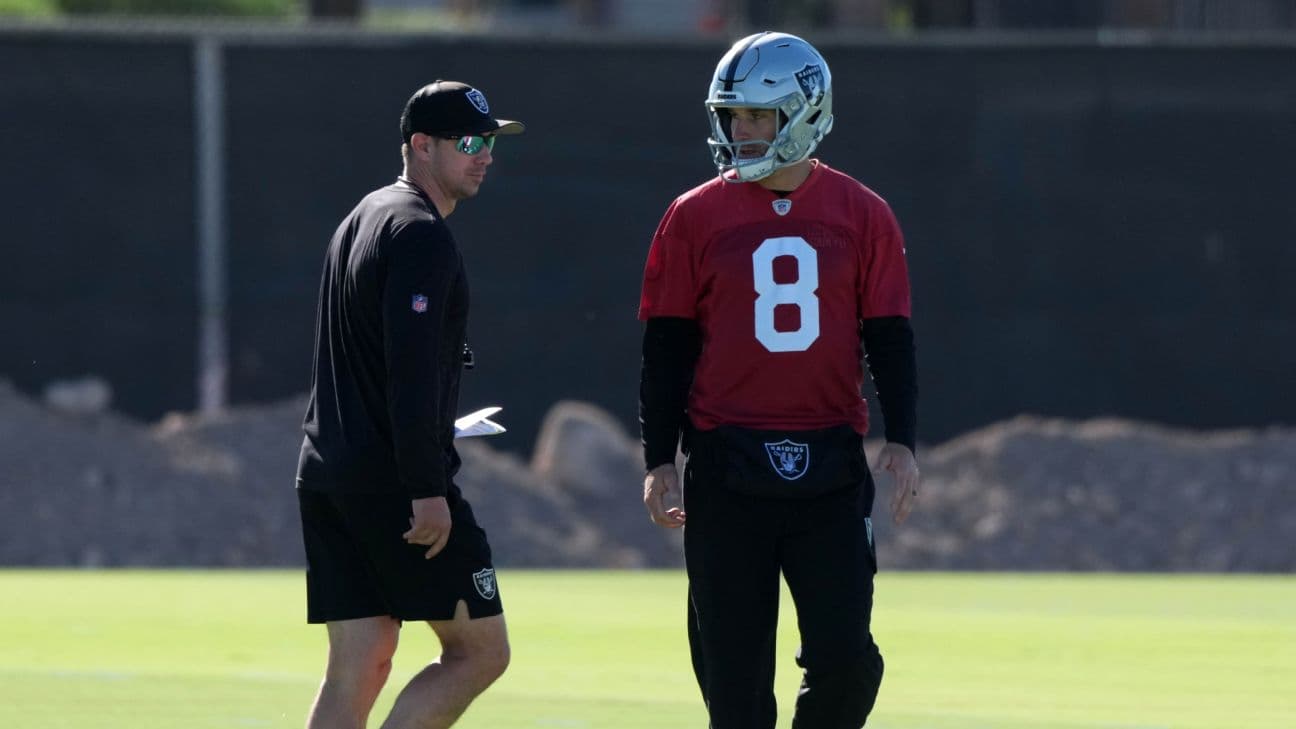
The Raiders' published depth chart lists Kirk Cousins as the starting quarterback and Fernando Mendoza, the No. 1 overall pick in the 2026 draft, as the backup, with Aidan O'Connell third. Head coach Klint Kubiak has declined to formally name a Week 1 starter, but the depth chart, the first-team reps, and the preseason usage all point the same direction: Cousins takes the first snap of the season and Mendoza waits.
For fantasy purposes that is a settled question until it is not, and the timeline of when it stops being settled is the actual asset here. Nobody drafts a rookie quarterback in a single-quarterback league on the expectation that he plays in September. Everybody should be thinking about what happens in October and November.
What the depth chart is and is not saying
Teams routinely list veterans ahead of high draft picks on the first published depth chart, and just as routinely reverse it by the time the games matter. That is not a Raiders quirk, it is standard operating procedure, and it is why the listing itself should not be read as a franchise commitment. What it does signal is that Las Vegas is not planning to hand the job over in August.
Kubiak has said the staff wanted all three quarterbacks to take first-team reps during camp and that he would be comfortable with any of them starting. That is coach-speak, but it is a specific flavor of coach-speak: it is the version teams use when they genuinely have not decided how long the bridge lasts, as opposed to the version they use when a rookie is going to sit for a full year.
Mendoza got extended preseason work by design. The stated plan was to give him meaningful game exposure rather than a series and a seat, which is what a staff does when it expects the rookie to play in the calendar year. Cousins, meanwhile, is on a roster that went 3-14 in the season before he arrived and traded away the quarterback who started those games. That is not a situation with a long leash.
The fantasy fallout
Cousins is a streamer, not a starter, in redraft leagues. He carries no rushing floor, and the Raiders' pass catching group is not the kind that props up an immobile quarterback's weekly ceiling. His fantasy value is almost entirely matchup-dependent, and it comes with the extra risk that a bad three-game stretch triggers the transition rather than a benching for one week.
Mendoza is the more valuable asset and he is nearly free. In superflex and two-quarterback leagues he is worth a real pick right now, because the difference between a rookie who plays six games and a rookie who plays none is enormous in those formats and the price does not reflect it. In dynasty he is obviously a cornerstone. In single-quarterback redraft he is a late-season stash for a contender with a bench spot to spare, not a draft-day target.
The more actionable read is on the Raiders' skill players. Ashton Jeanty is the offense's centerpiece and the one asset whose value is largely independent of who takes the snap, which is exactly why his ankle sprain earlier this week mattered more than the quarterback question does. Jeanty is a fantasy RB1 under Cousins and a fantasy RB1 under Mendoza. The receivers are the ones whose outlooks bend with the change: a Cousins offense is more structured, more timing-based, and more friendly to a possession receiver, while a rookie's offense tends to shorten the field, raise the checkdown rate, and inflate the value of whoever the back is.
That argues for treating the Raiders' pass catchers as sell-high candidates if Cousins starts hot, and buy-low candidates if the transition happens and the passing game goes through a rough month.
The scheme question nobody is pricing
Klint Kubiak's offenses have been built on wide zone, play-action, and heavy usage of motion, and that system is unusually quarterback-agnostic. It asks the quarterback to make full-field reads less often than most modern schemes, and it generates explosive plays through structure rather than through improvisation. That is a real argument for Cousins holding the job longer than the roster's record would suggest, because the scheme minimizes the exact things Cousins can no longer do well.
It is also an argument that Mendoza's transition, whenever it comes, will be smoother than a typical rookie's. A quarterback stepping into a wide-zone play-action system with a legitimate feature back does not have to carry the offense. He has to protect the ball and hit the throws the scheme creates. That is a low bar for a No. 1 overall pick and it is why the Raiders drafted where they drafted with a veteran already signed.
The Verdexed model take
Verdexed's model treats the Raiders quarterback situation as a two-stage season rather than a single projection. The first stage is Cousins in a run-heavy structure with an elite young back, which produces a low-variance, low-ceiling offense that grades out closer to league average than the win-loss record implies. The second stage is Mendoza, and the model's spread of outcomes there is enormous, because a No. 1 pick playing behind a rebuilt offensive line with a good scheme can be anything.
The model's most confident output is not about either quarterback. It is that the Raiders' team total is more stable than their win total, because the run game and the scheme hold up regardless of who plays. That is the practical betting read: this is a team to attack in game totals and player props rather than in sides, at least until the quarterback situation resolves.
What to do in your league
In single-quarterback redraft, ignore both Raiders quarterbacks on draft day and monitor. In superflex, take Mendoza in the final rounds and be content to hold him for six weeks. In dynasty, he is untouchable at anything close to current market prices.
On the skill side, draft Jeanty on his merits and do not discount him for the quarterback uncertainty, because the offense is built to run through him under either passer. Treat the receiver room as a source of weekly streamers rather than season-long starters, and be ready to move quickly when the transition happens, because the market reprices a rookie quarterback's pass catchers slowly and that lag is where the value lives.