 NHL2026-08-28
Elvis Merzlikins Had Shoulder Surgery and Jet Greaves Has No Insurance
By Verdexed NHL Desk
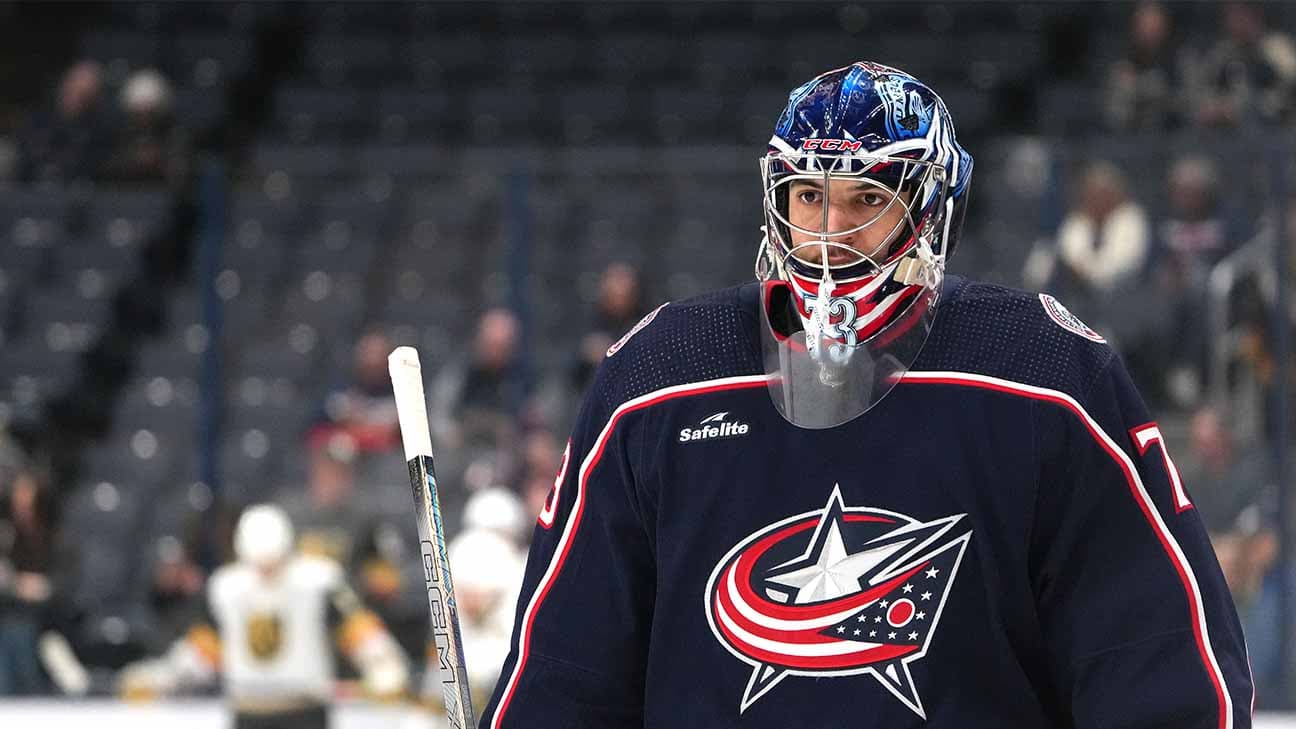
The Blue Jackets announced that goaltender Elvis Merzlikins underwent shoulder surgery and has no timetable for a return. Merzlikins reported discomfort during offseason workouts, an MRI followed, and surgery was determined to be the best course of action. The procedure was described as successful. Columbus has not attached a return date to it.
With training camps opening September 16, that turns a tandem into a single goaltender and a question mark. Jet Greaves, who signed a three-year contract worth a reported $15 million in July, is now unambiguously the Blue Jackets' starter, and Columbus has one veteran signed at the minimum behind him.
What Columbus actually has now
Merzlikins split the crease with Greaves last season and posted a 14-11-3 record with an .883 save percentage and a 3.40 goals-against average. Those are not numbers a team builds around, and the Greaves contract had already signaled that Columbus considered the tandem question resolved. What the surgery changes is not the hierarchy. It is the depth.
The Blue Jackets signed Pheonix Copley to a one-year, $850,000 contract on July 1, and he projects as the backup if Merzlikins is not available for the start of the season. That is a reasonable insurance policy for a team expecting its starter to play 55 games. It is a thin one for a team whose only alternative is now a minimum-salary veteran.
The absence of a timetable is the detail that matters most. Shoulder surgeries for goaltenders carry a wide recovery range depending on what was repaired, and the position places demands on the shoulder that are unlike any other in hockey: the butterfly recovery, the post-to-post push, and the glove hand all load the joint in different ways. Teams that expect a goaltender back inside three months usually say so. Columbus did not.
The fantasy fallout
Greaves was already a fantasy target after the contract. He is now a substantially better one, and the reason is games played rather than talent.
Goaltender scoring in fantasy hockey is driven more by volume than by any other input. A goaltender who starts 60 games will outproduce a better goaltender who starts 45, in almost every format, in almost every season. Greaves entered the summer projected for a heavy but shared workload. He now projects for as many starts as his body can absorb, on a team that has no credible alternative.
That is the specific circumstance that produces fantasy value at the position, and it is worth moving up the board for. Greaves is not an elite goaltender, and the Blue Jackets are not an elite defensive team, which caps his save percentage upside. But volume is the category most drafters underweight, and a starter with no competition is a rarer asset every year as more teams commit to true tandems.
The risk is the mirror image of the opportunity. A team with one healthy goaltender is a team one injury away from a crisis, and a fantasy manager who drafts Greaves and does not handcuff him is exposed. Copley is worth a late-round look in deep leagues purely as insurance, and the Blue Jackets are a strong candidate to add another veteran once NHL rosters shake out in the first week of October.
The betting angle
Columbus is not a team whose season win total moves dramatically on this news, because Merzlikins was not projected to be the difference-maker. What does move is the distribution of outcomes.
A team with a settled starter and no backup has a narrower path to its projection than a team with two viable goaltenders. If Greaves stays healthy and plays to his contract, Columbus performs roughly as expected. If he misses a month, there is nothing behind him, and the downside is severe. That is an argument for the under on the Blue Jackets' win total rather than for any change in the central projection, because the tail risk is now one-sided.
The more actionable in-season angle is game-level. Teams that rely on a single goaltender play more back-to-back sets with a fatigued starter or a minimum-salary backup, and the second night of a back-to-back is where the value shows up. Tracking which nights Copley draws in will be worth more than any preseason futures position.
The Verdexed model take
Verdexed's model treats goaltending workload concentration as a risk factor rather than a neutral input, and Columbus now grades among the most concentrated situations in the league. The model's projection for Greaves has moved up on volume and held steady on rate statistics, which is the correct shape: more starts, same quality of play, worse defensive support in the games where a tired starter is the only option.
On Merzlikins specifically, the model applies its default recovery distribution for a surgery announced without a timetable, which is wide and skews long. Teams that have a return date share it. The absence of one is information.
The model's broader read on the Blue Jackets is unchanged. This is a team whose ceiling depends on scoring rather than on goaltending, and a slightly worse goaltending depth chart does not alter that. What it alters is how much of the season goes according to plan.
What to do in your league
Move Greaves up the goalie board and draft him ahead of goaltenders in genuine timeshares, because volume wins the position. If you take him, spend a late pick on the Columbus backup, and be ready to pivot the moment the Blue Jackets add a veteran in early October.
Watch for a Merzlikins update at the opening of camp on September 16. Teams routinely provide clarity on unresolved injuries when players report, and a Columbus statement that puts a number on the recovery would be the first real information available since the surgery was announced. Until then, the safest assumption is that Greaves carries this crease alone for at least the first two months.