 NHL2026-07-26
Dylan Larkin's Trade Request Stalls as Detroit's Front Office Turns Over: The Fantasy Read
By Verdexed NHL Desk
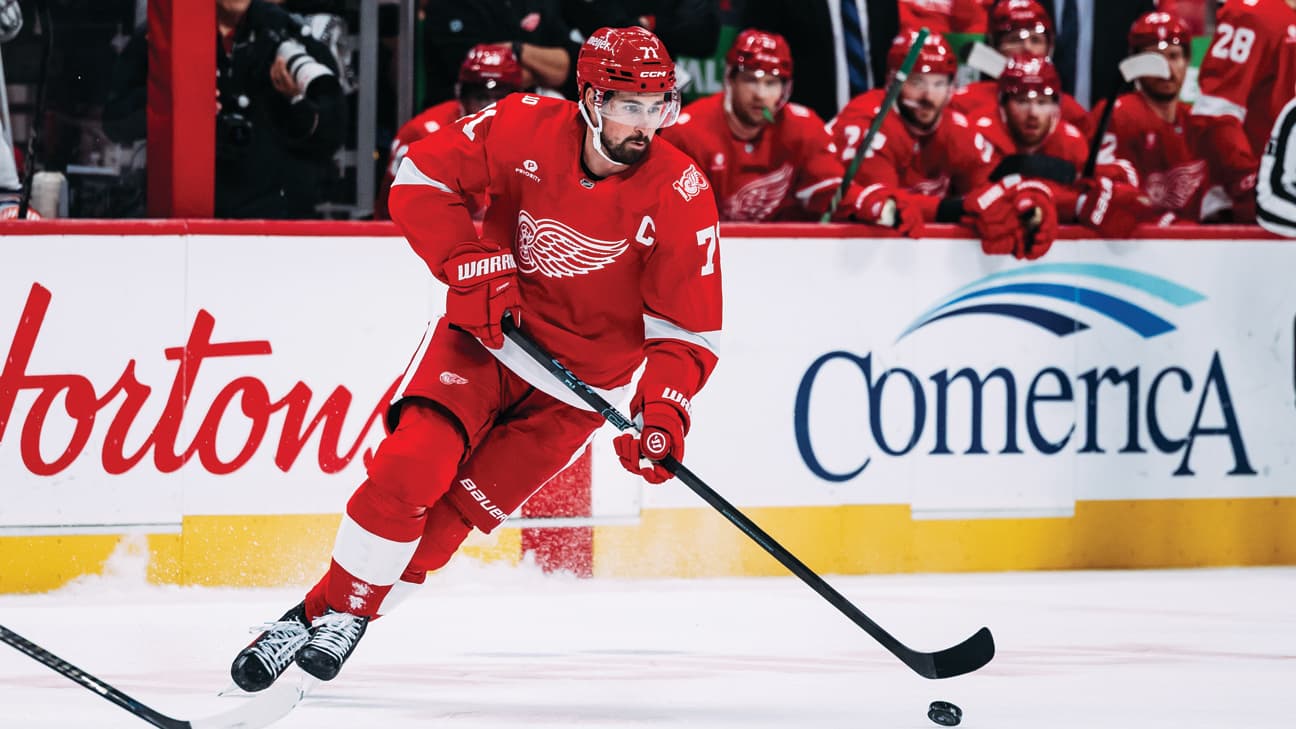
Dylan Larkin's agent informed the Detroit Red Wings shortly after the 2025-26 season that the captain wanted to be traded, following it about a week later with a short list of teams he would consider waiving his no-movement clause to join. Two months on, nothing has happened, and the front office that received the request no longer looks the same.
Steve Yzerman stepped down as executive vice president and general manager on July 15, moving into a senior advisor role reporting to governor and chief executive Chris Ilitch. The organization has begun a search for its next head of hockey operations, considering both internal and external candidates, with Yzerman remaining in place on an interim basis to handle day-to-day operations. Reporting on the change cited a decade without a playoff appearance as the backdrop.
Before the transition, Yzerman had addressed the request publicly and said he could not guarantee it would be met, framing his obligation as doing what was best for the Red Wings. He also asked Larkin to expand his list of acceptable destinations. Larkin has not done so.
The list is the leverage
Reporting places Larkin's approved destinations at the Minnesota Wild, Vegas Golden Knights, and Florida Panthers, with at least one report adding the Dallas Stars more recently. Combined with a full no-movement clause, that is close to total control on the player's side, and it is exactly why nothing has moved.
A three or four-team market is not a market. It is a negotiation with three or four counterparties who all know they are the only counterparties, and who therefore have no reason to bid against one another. Detroit's problem is not a lack of interest in Larkin. It is that the absence of a genuine auction means no offer will ever look like fair value for a franchise captain, and the front office is not obligated to accept less.
Some reporting has described Minnesota as the frontrunner without a clear timeline. Signs have also pointed toward Larkin simply opening training camp in Detroit, which is the outcome that follows naturally from a standoff neither side is under pressure to break.
The front-office change cuts both ways
A general manager transition in the middle of a captain's trade request introduces genuine uncertainty into the projection. A new head of hockey operations arriving at a club that has missed the playoffs for a decade has every incentive to restructure, and a captain who has already asked to leave is the least awkward major asset to move. That argues for a higher trade probability once someone is hired.
The counterargument is timing. New executives rarely make franchise-altering trades in their first weeks, and a search that is still ongoing in late July will not produce a hire with the mandate and the relationships to execute a deal like this before camp. The most likely near-term outcome is inertia.
For fantasy purposes, inertia has a specific meaning: plan on Larkin in Detroit for the start of the season and treat any trade as upside.
Fantasy fallout
Larkin's fantasy value is built on top-line minutes, power-play unit one deployment, and the shooting and faceoff volume that comes with being his team's number one center. All of that is guaranteed in Detroit and none of it is guaranteed anywhere else.
That is the counterintuitive part of this story, and it is where the market tends to get it wrong. Managers instinctively treat a move from a non-playoff team to a contender as an upgrade. For a first-line center, it frequently is not. Landing in Vegas or Florida, both of which have established centers occupying premium roles, could mean second-line minutes and second power-play unit deployment. That combination costs more fantasy points than the improvement in team quality gains back.
Minnesota is the more interesting destination on that basis, since a top-six role with meaningful power-play time is a more realistic fit there. Dallas, if the reported addition to the list is accurate, sits somewhere in between.
The plus-minus and team-context categories would improve in every scenario. The volume categories, which are the ones that actually decide fantasy hockey leagues, would most likely get worse.
The Verdexed model take
The model's central case is that Larkin opens the season in Detroit, and the confidence on that is higher than the volume of trade chatter would suggest. Three structural facts drive it: a no-movement clause with a short list, a front office in transition without a permanent decision-maker, and a seller under no financial or competitive pressure to act.
On the projection itself, the model has Larkin's fantasy value as slightly higher in Detroit than in the weighted average of his listed destinations. That is not a statement about the Red Wings being good. It is a statement about role security, and role security is the dominant term in any skater projection.
The model does flag one downside branch that fantasy managers should hold in mind. A player who has requested a trade and been told no does not always start the season at his usual level, and an unresolved situation carrying into camp is a soft negative on both the player and the team's early-season results. That is a small adjustment, but it is not zero.
What to do in your league
Draft Larkin at his usual price and do not pay a premium on the theory that a trade to a contender unlocks him. If anything, the trade scenarios are more likely to hurt his counting stats than help them.
In keeper and dynasty formats, the situation is a modest buy-low. The uncertainty depresses his price in offseason trade markets, and the most likely resolution, which is that he plays a full season as Detroit's top-line center, is the one that preserves his value entirely.
What's next
The hire is the gate. Nothing meaningful happens on this file until Detroit names a permanent head of hockey operations, and the identity of that person, an internal promotion versus an outside rebuild-minded executive, will tell you more about Larkin's future than any rumor between now and then. The second marker is whether Larkin expands his list. He has been asked once and declined. If that changes, a real market forms and a trade becomes likely quickly.