 NHL2026-08-30
Dylan Larkin Asked Out of Detroit and Is Reporting to Camp Anyway
By Verdexed NHL Desk
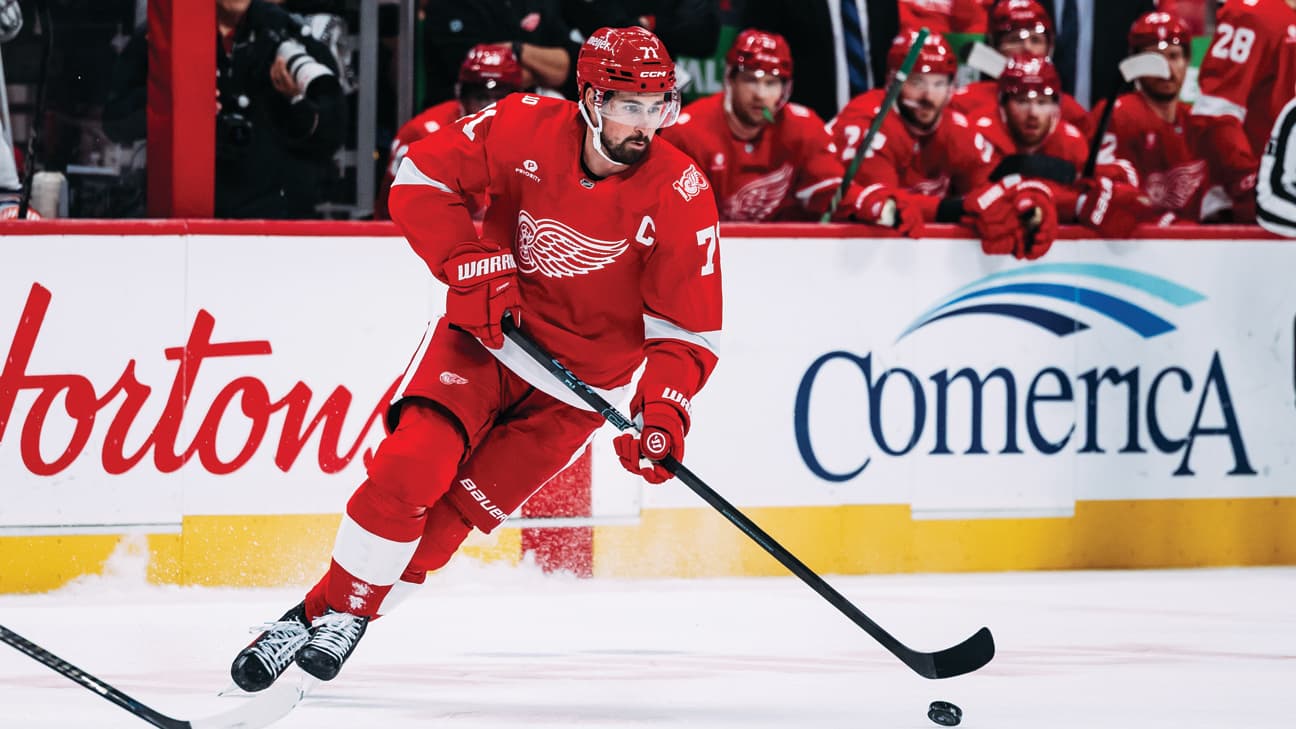
Dylan Larkin requested a trade out of Detroit through his agent shortly after last season ended, and with training camp opening September 17, he is expected to report to the Red Wings anyway. Reporting through August has consistently indicated that no deal is imminent and that Larkin will not be moved before the season starts.
The trade market for him has shrunk rather than grown. Both Vegas and Florida are reported to have no interest, leaving Minnesota as the one team still meaningfully engaged. That is a thin market for a player of Larkin's caliber, and it is the practical reason this has not been resolved.
Why the standoff has held
Two structural obstacles are doing most of the work. The first is Larkin's full no-movement clause, which means he controls where he can be sent. A no-movement clause turns a trade market into a negotiation among a handful of acceptable destinations, and when two of the obvious contenders drop out, the list gets very short.
The second is the front office transition. Detroit has moved on from Steve Yzerman as general manager, and a club in the middle of a leadership change is not well positioned to execute a franchise-altering trade. That same vacancy has been cited as a factor in other unresolved Detroit business this summer, including on the restricted free agent side.
Detroit has also reportedly been unwilling to accept a package built primarily on future assets, which is the kind of return a rebuilding-adjacent team usually has to take. A club that wants players back for its captain, from a market of one, is a club that is going to keep its captain.
What Larkin has said and done
The important detail for fantasy managers is that Larkin and his representation have not considered a holdout. He is expected at camp and expected to play. That removes the single worst outcome for anyone rostering him, which is a player sitting out into October while two sides negotiate.
Players who request trades and then report generally play. The professional incentive to perform is enormous, since a strong start is the fastest way to expand the market and force a midseason deal.
Fantasy fallout
Larkin's fantasy profile in Detroit is well established. He is a top-line center on a team that needs him to drive offense, he plays on the power play, and he absorbs the toughest matchups. That combination produces reliable scoring and a heavy shot volume, which is exactly what fantasy managers want from a second or third center.
The trade request does not lower that outlook for the start of the season. If anything, a player in a contract-adjacent standoff who wants to raise his market value is motivated to produce early.
The question is what a midseason move would do. A trade to Minnesota, the one team reported to still be engaged, would put Larkin on a roster with more offensive support than Detroit provides, which typically improves a center's assist totals while potentially reducing his ice time and power play role. That is close to a wash in fantasy terms, with the balance depending on the deployment.
The scenario that would genuinely hurt fantasy value is a trade to a team that uses him as a second-line center behind an established No. 1. That is not currently on the table given the market, but it is the risk to keep in mind.
The Verdexed model take
Verdexed's model projects Larkin's production off deployment rather than team quality, and his deployment in Detroit is about as favorable as a center's can be on a middling roster: first line, first power play unit, heavy minutes. The model's projection for him is essentially unchanged by the trade request.
Where the model does adjust is on variance. A player who could change teams midseason carries a wider outcome distribution than one who will not, and the model widens Larkin's range in both directions rather than shifting his median. That argues for drafting him at his normal price rather than at a discount, and for not paying a premium on the theory that a trade would help him.
The model's Detroit team projection is the more pessimistic output. A roster with an unsigned key defenseman, a captain who has asked out, and no permanent general manager is a roster with real downside relative to its talent, and the model's Red Wings scoring projection reflects that uncertainty.
Betting angle
Detroit's season point total is the market most exposed to this situation. A team total set with the assumption that Larkin plays the full season in Detroit is a different bet than one that accounts for a midseason trade, and the market has generally settled toward the former.
The other market to watch is Larkin's own point total, if it is offered. Season-long player totals are typically set assuming a full year with the current team, and a no-movement clause plus a thin market makes that assumption more likely to hold here than the trade chatter suggests.
What's next
Camp opens September 17 and the season begins September 29 under the new 84-game schedule. The most likely path is that Larkin plays the opener in a Red Wings sweater and the trade conversation restarts closer to the deadline, when more teams have identified a need and are willing to pay in players rather than picks.
For fantasy purposes, draft him as a Red Wing, and treat any trade as an upside scenario rather than a reason to discount him.