 NHL2026-09-11
Dylan Larkin Skipped Detroit's Captain's Practice and Camp Opens Next Week
By Verdexed NHL Desk
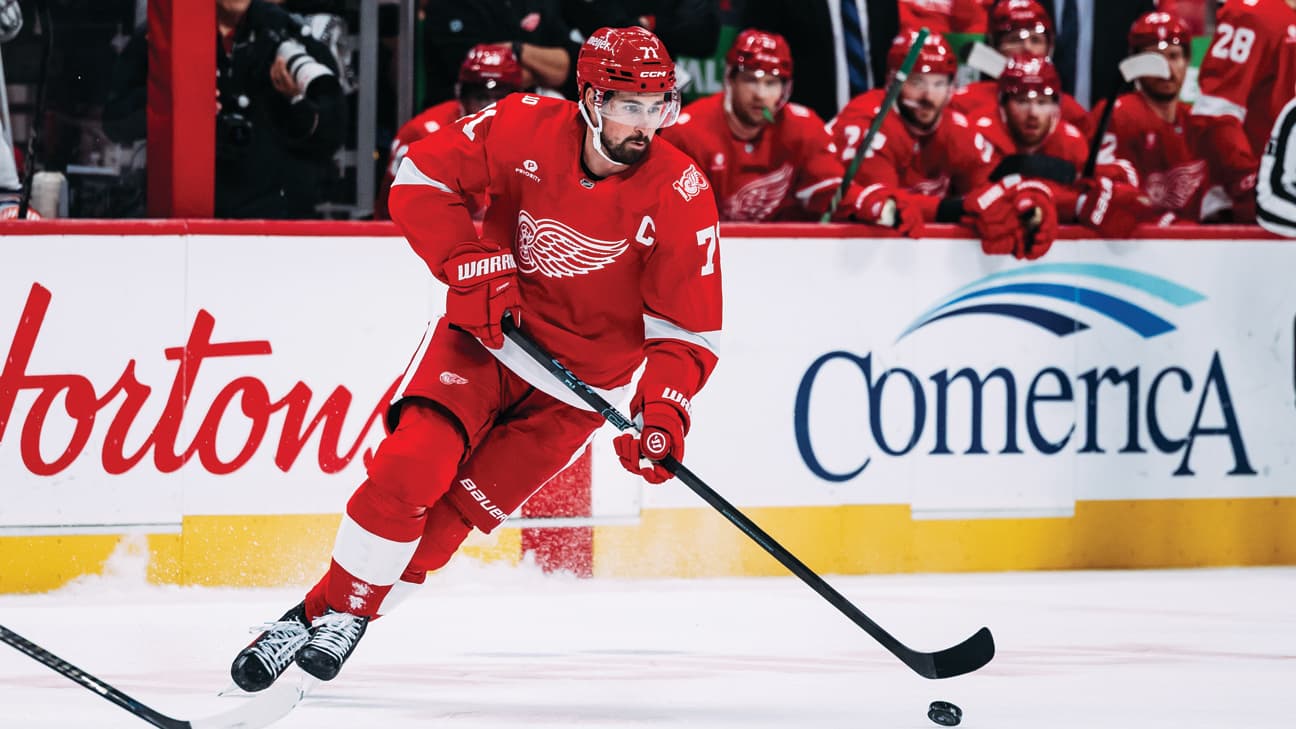
Dylan Larkin did not take part in Detroit's captain's practice this week, according to reporting from Michael Russo of The Athletic, and his trade request remains unresolved with NHL training camps opening on September 16 and 17.
The important qualifier is that captain's practices are informal offseason skates organized by players, not official team activities. Larkin's absence is not a holdout, it carries no contractual consequence, and Russo has previously indicated he had no reason to believe Larkin intends to stay away once official camp begins. Reading it as an escalation requires reading more into it than the reporting supports.
Reading it as nothing would also be a mistake. A captain who does not show up to the skate he would normally organize is sending a message, and the message is that nothing has changed.
The stalemate
Larkin asked out months ago and has limited his approved destinations to a short list. Minnesota, Vegas and Florida have been consistently reported as his preferred landing spots, and Minnesota is the one most often described as his actual target. Philadelphia checked in on him and was turned away after being told the Flyers were not on his list.
None of the approved teams has met Detroit's asking price. That is the entire problem, and it is a structural one rather than a temporary one. A player who narrows his market to three teams hands those three teams enormous leverage, because each of them knows the others are the only competition and that the selling team cannot threaten to go elsewhere.
Detroit's position is complicated further by a front office in transition. The Red Wings have moved on from Steve Yzerman as general manager and have not installed a permanent replacement, which means there is no executive with the standing to accept a franchise-altering offer for the captain. A trade of this size requires someone whose job will still exist when it is evaluated.
What happens if he reports
The most likely outcome by a wide margin is that Larkin shows up to camp, plays for Detroit, and the situation gets revisited closer to the trade deadline. Players in his position almost always report. The contract requires it, the alternative costs money, and an unhappy player who is still producing is easier to trade in January than in September.
That creates an awkward season for everyone. A captain who has publicly asked to leave, playing for a team that cannot move him, on a roster that knows all of it, is a difficult room to manage.
Fantasy fallout
Larkin's fantasy value in Detroit is well established and should be drafted accordingly: a first-line center with power play time on a team that will give him every opportunity, producing points at a rate that makes him a reliable mid-round asset in standard leagues.
A trade to any of his approved destinations would change the profile. Minnesota and Florida would likely mean better linemates and a better team shooting percentage, but also potentially a smaller share of the power play and fewer minutes overall. Vegas is similar. In all three cases the ceiling probably rises modestly and the floor rises more, because a center on a good team gets easier matchups.
What draft strategy should not do is discount him for the uncertainty. Larkin is going to play roughly 80 games somewhere and get first-line minutes wherever that is. The range of outcomes is narrow compared with a player whose role is genuinely in question.
The more interesting fantasy angle is on the Detroit side. If Larkin moves midseason, the next center up inherits a large role on a team that will be selling, and that player becomes one of the better waiver adds of the year. Keep a list.
Betting angle
Detroit's win total and playoff odds already price in a full season of Larkin, which is the correct assumption. A midseason trade would move those numbers, but futures markets on a fringe playoff team in a deep conference offer poor value in either direction.
The more efficient market is on the acquiring side. Minnesota, Vegas and Florida all carry Stanley Cup prices that would tighten on a Larkin acquisition, and the movement tends to be sharp and immediate. Anyone with a strong view on which team eventually gets him has a clear pre-news position available.
The caution is that this has been rumored since spring without resolution, and futures positions held for months carry a real cost in tied-up capital. This is a story to act on when it breaks, not one to front-run indefinitely.
The Verdexed model take
Player projection models treat linemate quality and power play unit as the two largest swing factors for a center's scoring rate, and both would improve in a move to any of Larkin's approved teams. The offsetting factor is ice time, which almost always falls when a player moves from being his team's clear number one to being part of a deeper group.
Netting those out, the model projects a modest increase in Larkin's points per 60 minutes and a modest decrease in his total minutes, which lands his season-long point total in roughly the same place regardless of where he plays. That is an unusual and useful conclusion: for fantasy purposes, the trade barely matters.
For team-level projections, the model reads the acquisition as worth a meaningful improvement to any of the three approved teams, because a legitimate first-line center is the scarcest commodity in the sport and all three have needs down the middle.
What's next
Camp opens next week. If Larkin is on the ice in Detroit, the story goes quiet until December and the fantasy answer is to draft him as a Red Wing. If he is not, the situation escalates into something genuinely unusual, and the Red Wings will be negotiating from the weakest position they have held yet.