 NFL2026-09-06
Dave Canales Says Carolina Opens With a Committee and Jonathon Brooks Is Not the Lead Back
By Verdexed Fantasy Desk
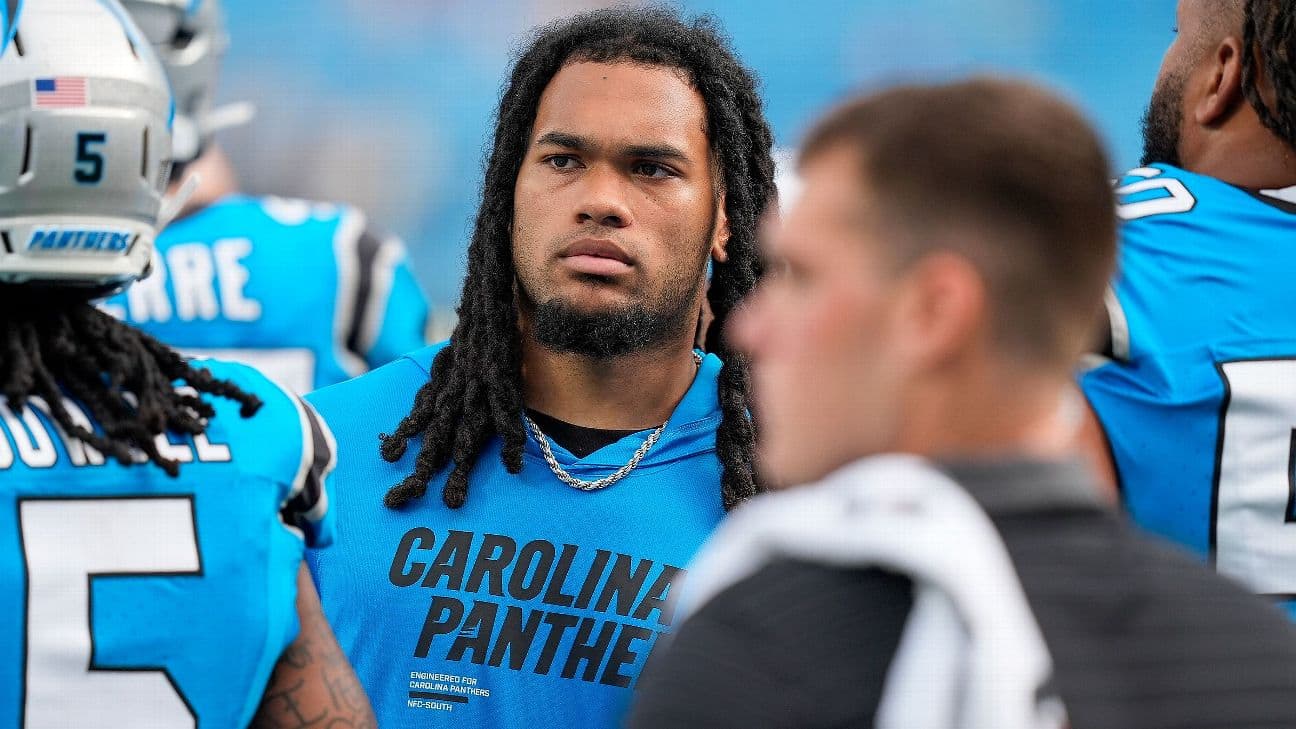
Carolina head coach Dave Canales has told reporters the Panthers plan to open the season with a running back committee, with Chuba Hubbard as the primary option and Jonathon Brooks working alongside him, provided Hubbard is healthy enough to play. Carolina opens at home against the Bears on September 13, and Canales has said he expects Hubbard to be available for it.
Hubbard was labeled week-to-week during camp with a hamstring injury and was held out of Carolina's second preseason game. The hamstring is the reason Brooks got a heavier share of camp reps, and it is the reason a portion of the fantasy market spent August convincing itself that Brooks was going to walk into a featured role. The coach's own words point somewhere else.
The knee history is the whole story
Brooks has not played an NFL regular-season game since December 2024, when he tore his right ACL. He missed the entire 2025 season recovering. That is the second significant knee injury of his young career, following the one that ended his final college season, and it is the single most important input into how Carolina will use him.
Teams do not hand a full workload to a back returning from a second ACL reconstruction in Week 1. They ration him, they protect him from the highest-contact touches, and they build his snap count across a month rather than across a game. Everything Canales has said publicly is consistent with that approach. The extra camp reps Brooks absorbed while Hubbard was out were about getting him ready, not about promoting him.
Hubbard, meanwhile, is the incumbent. He has produced when given volume in this offense, he knows the protections, and his hamstring is reportedly recovered enough that his coach is publicly comfortable naming him for the opener. A veteran back who is healthy on Sunday is going to get the early-down work over a back who has played zero football in twenty-one months.
Fantasy fallout
The actionable takeaway is that Hubbard is being underdrafted and Brooks is being overdrafted, and the gap is wide enough to matter in leagues still drafting this weekend.
Brooks carries a name-recognition premium built on his college profile and on the summer narrative that Hubbard's hamstring had opened the door. That door is closing, at least for September. A rookie-contract back in a genuine timeshare with a healthy veteran, coming off a second ACL tear, is a bench stash with upside rather than a weekly starter. He is worth rostering. He is not worth a pick two rounds ahead of where the veteran is going.
Hubbard is the opposite trade. He is being priced as an injury risk in a committee, and the committee framing is accurate while the injury framing is now stale. If his coach expects him to play against Chicago, he is a flex play in twelve-team formats and an RB2 in deeper leagues, at a cost that reflects neither.
The scenario that changes everything is a Hubbard setback. Hamstrings recur, and a hamstring that cost a back most of August is not a solved problem in September. Managers who draft Hubbard should understand they are also buying the risk that Brooks inherits the job in Week 2 or 3, which is precisely why owning both is the cleanest way to play this backfield.
The betting angle
Carolina opening at home against Chicago is not a game that will attract heavy handle, and that is usually where running back prop lines are least efficient. A committee announced in advance depresses both backs' attempt lines, which is the correct market response, but it tends to overcorrect on the veteran when the injury story is the recent one.
The team-level read is unchanged by any of this. Carolina's offense is not built to be carried by its backfield, and a split does not meaningfully change the Panthers' team total. Bettors should treat this as a props story, not a sides story.
The Verdexed read
Verdexed's model weights stated coaching intent heavily in Week 1 and then discounts it quickly, because Week 1 is the only week of the season where public statements are the best available information and no snap data exists to contradict them. Canales has stated the intent clearly. The model takes him at his word for the opener and reserves judgment beyond it.
Where the model diverges from the consensus is on the durability adjustment. A back returning from a second ACL reconstruction carries both an availability discount and a per-touch discount in the first month, and neither is reflected in Brooks's summer draft price. The same model applies a smaller discount to a veteran coming off a hamstring, because the recovery curve for soft-tissue injuries is far better understood and the player has an established production baseline to fall back on.
What to do in your league
Draft Hubbard where he is falling and take Brooks a round or two later than the market wants you to. If you can own both, do it, because this is a backfield where the two outcomes are near-perfectly correlated and holding one without the other means holding the risk without the hedge.
Start Hubbard in Week 1 in twelve-team leagues if he is active on Sunday. Bench Brooks in Week 1 in every format shallower than a fourteen-team league, and watch his snap count rather than his box score. The number that will tell you when Brooks is ready to start for you is the percentage of Carolina's offensive plays he is on the field for, and that number will move before the production does.