 NFL2026-07-28
Daniel Jones Is Full Go for Colts Camp: The Fantasy Read on an Achilles Return
By Verdexed Fantasy Desk
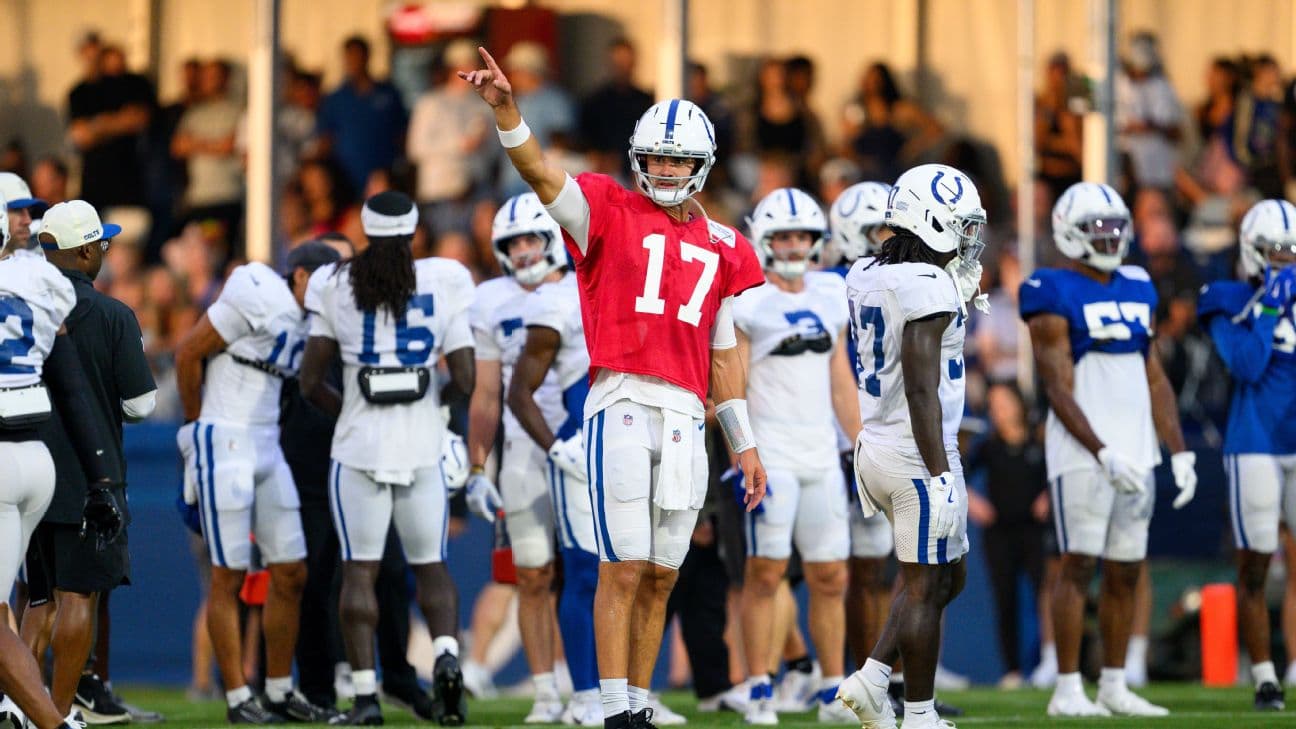
Daniel Jones said Monday that he feels good and plans to be a full participant when the Colts open training camp practice Wednesday, roughly nine months after the torn Achilles that ended his 2025 season. Jones told reporters that a few minor items remain in his rehab process but that he can do everything he could before the injury. Indianapolis has offered no indication that he will be limited.
For a quarterback who earned a significant contract on the strength of a strong 2025 before the injury, that is the best available news at this point on the calendar. It is also not the same thing as a clean bill of fantasy health, and the distinction is where the useful analysis lives.
What an Achilles return actually costs a quarterback
The relevant comparisons are recent and specific. Aaron Rodgers and Kirk Cousins are the two most prominent quarterbacks to return from Achilles tears in the modern era, and both saw notable dips in passing efficiency in their first year back. The mechanism is not mysterious: the Achilles governs push-off, and push-off governs the base of the throwing motion, the ability to reset in a collapsing pocket, and the willingness to climb rather than drift. Arm strength survives. Platform consistency does not, at least not immediately.
Jones has an additional variable that cuts both ways. His fantasy value has always carried a rushing component, and rushing production is the single most Achilles-sensitive part of a quarterback's profile. If the designed runs and scrambles come back at full volume, he is a materially better fantasy asset than his passing floor suggests. If they do not, he is a low-end QB2 in a two-quarterback format and a non-factor in one-quarterback leagues.
Why the timeline is genuinely encouraging
Nine months from tear to full camp participation is a good number, not a marginal one. Players who arrive at camp on a pitch count, or who open on the physically unable to perform list, are the ones whose Week 1 status is in doubt. Jones is not in that group. He completed the offseason on schedule, he has been cleared, and he is expected to take a normal first-practice workload.
The caution is that camp clearance measures whether a player can practice, not whether he can push off through a full seventeen-game season with a defensive end on his back. The honest read is that the Achilles risk shifts from an availability question in August to an efficiency and durability question in November.
The fantasy fallout for Indianapolis
Jones himself is priced roughly where he should be, near the back end of the QB2 range in most drafts, which means the risk is already reflected. There is no meaningful edge in either drafting or fading him at that cost. In superflex formats he is a reasonable third quarterback and a poor second one.
The pass catchers are where the decision matters. Every Indianapolis receiver and tight end projection is downstream of whether Jones is the 2025 version or a diminished one, and those players are being drafted at prices that assume something closer to the good version. That is a bet worth being deliberate about. A quarterback whose efficiency drops even modestly takes the entire receiving corps down with him, and the Colts do not have an obvious alternative structure to fall back on.
The running back room is the other side of the trade. A quarterback who is less willing to run and less efficient throwing is a quarterback whose offense leans harder on early-down handoffs and on checkdowns. Both of those are positives for Indianapolis backfield volume, and they are not priced in.
The betting angle
Indianapolis's season win total and its early-season game totals are built on an assumption that Jones is functionally the same player he was before the injury. The market has had all offseason to process the injury and has largely settled on that assumption, which is reasonable given the clean rehab timeline.
The exploitable side is the shape of the offense rather than its overall quality. Quarterback rushing props and team rushing totals are the two markets that respond most directly to an Achilles return, and both have historically been slow to adjust in the first month of the season. If Jones's camp reports show a quarterback who is throwing well but not scrambling, quarterback rushing unders and running back volume overs are the cleanest expressions.
The Verdexed model take
Verdexed's model separates availability risk from performance risk, and Jones's profile is now clearly weighted toward the second. His expected games played has climbed steadily through the offseason and now sits near the level of a healthy starter. His projected efficiency, by contrast, carries a wider distribution than almost any other established starter, because the historical sample of quarterbacks returning from this injury is small and the outcomes within it are inconsistent.
The practical output is a projection that treats Jones as a volume-driven quarterback with a suppressed ceiling and a wide band around the middle. That is exactly the profile that makes a good third quarterback in superflex and a bad target in one-quarterback leagues, and it is the profile that argues for buying Indianapolis running back touches rather than Indianapolis passing efficiency.
What to do in your league
Do not chase Jones on the news. Full camp participation was the expected outcome and is already in his price. If you want Colts exposure, the better route is the backfield, where an offense leaning on the run is a live possibility and the market has not adjusted for it.
If you already roster Indianapolis receivers, the plan is to monitor rather than sell. Camp reports through mid-August will tell you whether Jones is moving normally, and preseason snaps, however few, will tell you whether he is willing to leave the pocket. Those two data points are worth more than every offseason projection published to date.
What's next
Wednesday's first practice is the first real checkpoint. The specific things to watch for are not completion percentage in a shell drill but movement: whether he is climbing the pocket, whether he is running the boot and naked concepts that the Colts built into the offense last season, and whether the coaching staff schedules him a veteran rest day in the first week. Any one of those tells you more than a full month of quotes.