Chuba Hubbard Is Week to Week With a Hamstring and Jonathon Brooks Is the Draft's Best Late Bet
By Verdexed Fantasy Desk
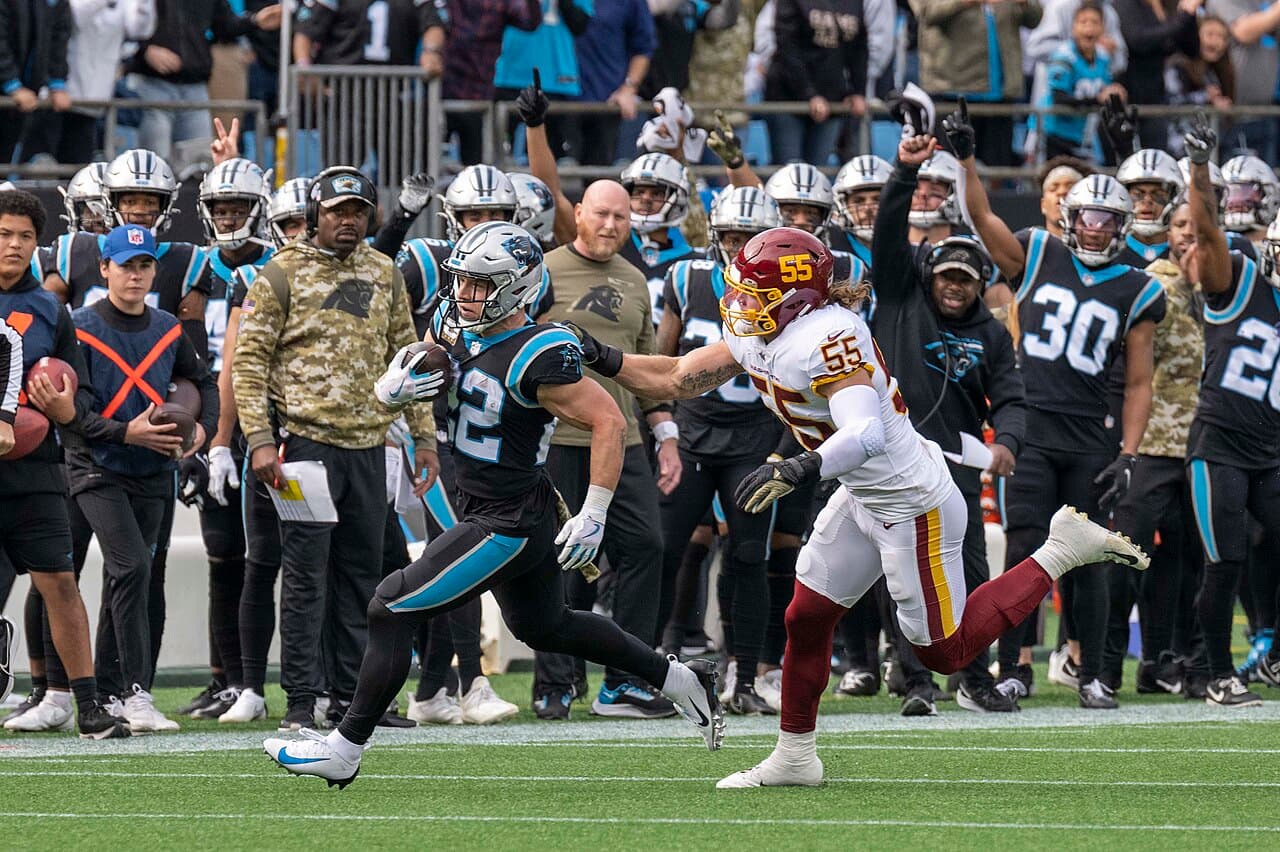
Chuba Hubbard is week to week with a hamstring strain suffered in Carolina Panthers training camp, an MRI having confirmed the injury. Head coach Dave Canales has said publicly that he is very confident Hubbard will be ready for the September 13 season opener against the Chicago Bears.
Both of those things can be true, and fantasy managers need to hold them together rather than pick the one they prefer. Week to week is a real designation with real August consequences: missed practices, missed preseason reps, and a compressed ramp into Week 1. A coach's confidence about a game four weeks out is also genuine information, and Canales has no obvious reason to overstate it.
What it adds up to is a lead back who will probably play in Week 1 and will almost certainly do so without a normal August of conditioning work. That is the specific scenario that produces limited snap counts in the first two weeks of the season, and it is not what Hubbard's draft price currently reflects.
The depth chart behind him is the story
Hubbard opened camp atop Carolina's first unofficial depth chart, with Jonathon Brooks listed second, Trevor Etienne third, and AJ Dillon behind them. That ordering matters because Carolina's backfield structure has changed materially from a year ago.
Rico Dowdle, who took the lead role from Hubbard during the 2025 season, left in free agency for Pittsburgh. That departure removed the one player who had already proven he could take the job. It also left the Panthers without an established veteran alternative if Hubbard's hamstring lingers, which pushes the opportunity down to a player the market has spent two years writing off.
Jonathon Brooks is that player. He has already been taking first-team reps in Carolina this August, and his presence there is the outcome of one of the longer rehab stories in the league: two ACL tears, a lost rookie season, and a full offseason of buildup before finally arriving at camp healthy. The Panthers have handled him carefully, but they have not hidden him.
Fantasy fallout
The market has started to move. In CBS Sports' mid-August rankings update, Brooks climbed roughly eleven spots to sit just outside the top 100, explicitly on the strength of the Hubbard news. That is a meaningful jump, and it is still not enough.
Here is why. A running back's fantasy value is close to a step function around the workload threshold. A back splitting carries in a two-man committee is a flex play. A back taking 65 percent of the snaps in an offense that wants to run is a weekly starter. Brooks is currently priced as the first thing, and the path to the second thing is one hamstring that does not fully cooperate.
Carolina's offense under Canales has been built to establish the run and control possession, and the receiving corps got a real addition this offseason with Darren Waller signing on to give the passing game a genuine tight end. That combination, a run-committed scheme with just enough passing threat to keep defenses honest, is the environment where a lead back accumulates carries at a high rate.
The counter-argument to Brooks is legitimate and should be stated plainly: two ACL reconstructions on the same career is a genuine durability concern, and there is no guarantee the Panthers give him a full workload even if Hubbard misses time. Trevor Etienne exists, and Canales has shown a willingness to rotate. A three-way split in Week 1 is a real possibility.
The Verdexed model take
Verdexed's running back projections weight three inputs above all others: expected team rushing attempts, projected snap share, and goal line role. Hubbard's expected snap share has come down since the MRI, not because the Panthers have said anything negative, but because a back who misses August practices historically enters the season on a snap count.
That reallocated share does not disappear. It goes to Brooks and Etienne, and the model splits it toward Brooks based on the first-team reps he has already been taking. The result is a Brooks projection that has moved up more sharply than his ADP, which is precisely the gap that makes a player worth drafting.
Hubbard's own projection has not collapsed. The model still treats him as the likely Week 1 starter and still projects him for the majority of Carolina's early down work over a full season. What has changed is the shape of the distribution: his floor in the first month of the season has dropped meaningfully, and his week-to-week reliability in September is now genuinely uncertain.
For best ball and season-long formats, that produces the same recommendation from different directions. Hubbard is fine at a discounted price. Brooks is a buy at any price near his current one. Rostering both is the highest-expected-value outcome available in the late rounds of a 2026 draft.
The betting angle
Carolina's Week 1 game against Chicago is the specific market to watch. If Hubbard is limited or inactive, the Panthers' team total does not move much, because the offense's structure does not change. What moves is the rushing yards prop market, where a backup back's number is typically set well below what his actual projected volume would justify in a lead role.
The pattern is consistent across the league in Week 1: books price backup running back rushing props off the previous season's usage rather than off the current week's depth chart, and the correction happens after the opening line rather than before it. If Hubbard is ruled out in the days before the game and Brooks' rushing yardage number opens near a backup's price, that is the cleanest edge available.
What to do in your league
Draft Brooks. He should be coming off boards two to three rounds earlier than he is, and the cost of being wrong is a late-round pick.
If Hubbard is already on a roster, treat Brooks as a mandatory handcuff rather than an optional one, because the alternative back on the roster in a Hubbard absence is not a proven commodity.
The next real data point is whether Hubbard practices this week and whether he appears at all in Carolina's remaining preseason work. A back who does not practice by the end of August is a back whose Week 1 workload is capped regardless of what the injury report says.