 MLB2026-07-26
Byron Buxton's No-Trade Clause Is the Deadline's Biggest Lever: Phillies Interest and Conflicting Signals
By Verdexed MLB Desk
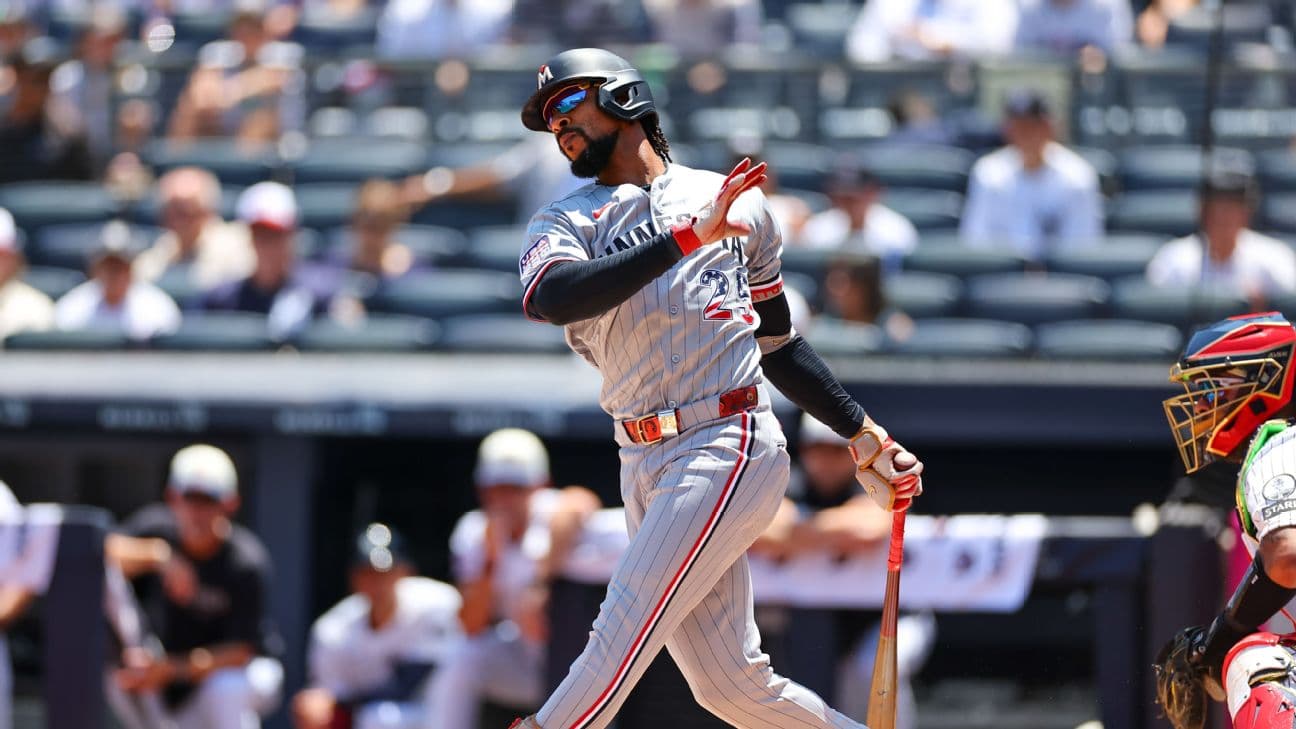
Byron Buxton is the most interesting name on the board heading into the August 3 deadline, and the reason has nothing to do with whether a team wants him. ESPN's Jeff Passan identified the Twins center fielder as a dream match for the Phillies on the trade market, and Philadelphia has been linked to him repeatedly this month. The obstacle is a full no-trade clause and a player who has said, on the record, that he is staying.
Asked directly whether there was any wiggle room on waiving that clause for Philadelphia, Buxton was unambiguous that he was not going anywhere. That was the clear public position. More recent reporting complicates it: one line of reporting indicates Philadelphia is the single club he would waive for, and a major-league source suggested that Buxton, who turns 32 next month, wants to play for a winner and may reconsider his stance for certain clubs if the Twins continue to break up their roster.
Those two versions cannot both be the last word, and this piece is not going to pretend to know which is right. What is confirmable is the shape of the situation: a productive center fielder with total veto power, a suitor with a clear need, and a front office whose own actions may change the player's calculus.
What he is producing
Reporting places Buxton at a .271 average with a .904 OPS, 25 home runs, and 45 runs batted in through 75 games this season. The games-played number is the one to sit with. Buxton's career has always been a question of availability rather than quality, and 75 games at this point in the calendar is roughly a full-time pace by his own standards, which is a meaningful part of why the market is engaged at all.
A center fielder producing at that rate is close to the most valuable commodity a contender can add in July, because the position is scarce and because the bat plays anywhere in a lineup. That scarcity is what turns a no-trade clause from a formality into the deciding factor in the entire deadline.
Fantasy fallout
Buxton is rostered everywhere, so the question for fantasy managers is what changes if he moves and what changes if he does not.
If he stays in Minnesota on a club that keeps subtracting, his counting stats suffer. Runs and runs batted in are the categories most sensitive to lineup quality, and a hitter surrounded by replacement-level bats loses production he has no control over. His home runs and his rate stats would hold; the counting categories would sag.
If he lands in Philadelphia, the upgrade is on both sides of the ledger. He would join a deeper lineup, which lifts the counting stats, and he would play meaningful September games, which sustains the intensity of his usage. The one caution is workload management: a contender acquiring a player with Buxton's injury history has every incentive to rest him strategically down the stretch to have him available in October. Fantasy leagues end before October does.
The deeper-league play is on the Minnesota side. If the Twins move Buxton, outfield at-bats open up on a club with nothing to lose, and non-contenders in August are the single best source of unexpected playing time in fantasy baseball. Watch the corresponding roster move more closely than the trade itself.
The Verdexed model take
The model's read is that Buxton stays, and the confidence on that is higher than the deadline chatter suggests. The reasoning is simple: a full no-trade clause converts a probabilistic market into a binary one controlled entirely by the player, and the player has publicly stated his position. Anonymous sourcing about what someone might reconsider is weaker evidence than an on-the-record statement, and treating the two as equivalent is how bad projections get made.
That said, the model does not treat the possibility as negligible, because the conditional in the reporting is meaningful. If Minnesota trades other core pieces before August 3, the player's stated position was formed under different assumptions. The sequencing matters: watch what the Twins do with everyone else first, because that is the input that would change Buxton's answer.
On the projection itself, the model has Buxton's rest-of-season value rising modestly in a Philadelphia scenario and holding roughly flat in a Minnesota scenario, with the games-played estimate discounted in both. His career availability record is the dominant term in any Buxton projection and no trade changes it.
The betting angle
The derivative market worth watching is the Phillies playoff and division odds rather than anything Buxton-specific. A contender adding a center fielder of this caliber is a genuine roster upgrade, but deadline additions are consistently overpriced by markets in the 48 hours after a deal, because the narrative of a team going all in is more exciting than the marginal win expectancy actually involved. The disciplined play is to take a position before the deadline if you believe a deal happens, not after.
On the Minnesota side, a selling club's remaining-season win total and its game-level pricing both deteriorate, and books are typically slower to adjust a non-contender's numbers than a contender's.
What to do in your league
Hold Buxton and do not sell into the uncertainty. In trade-active leagues, the exploitable angle is buying him from a manager who is spooked by the possibility of a workload-managed September on a contender, because that is a real but modest risk being priced as a large one.
If you need outfield at-bats in a deep league, set an alert for the Twins roster moves in the first week of August rather than for the trade itself.
What's next
The deadline is 6 p.m. Eastern on August 3. Two things to track: whether Minnesota trades other core players first, which is the condition the reporting attached to any change in Buxton's stance, and whether any direct quote emerges from Buxton softening his position. Until one of those happens, the on-the-record no is the operative fact.