 NFL2026-07-22
Ashton Jeanty's Year 2 Leap: Why the Raiders RB Is a Fantasy RB1 Bet Despite the QB Question
By Verdexed Fantasy Desk
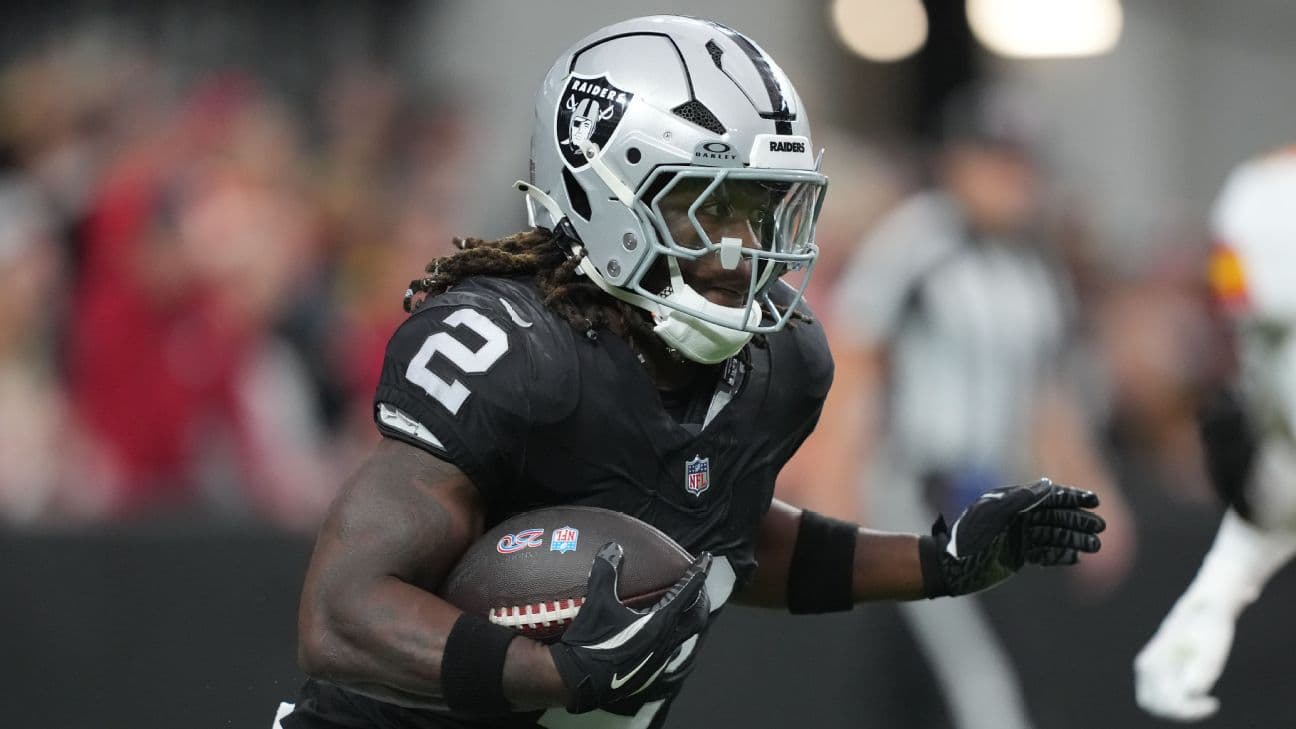
Ashton Jeanty did not deliver the league-winning rookie season fantasy managers dreamed of, but the underlying usage tells a more encouraging story than his finish. Jeanty ended his first year as the RB15 in points per game on 321 touches and 1,321 total yards, and the workload metrics point to a player set up for a genuine second-year leap. For 2026 drafts, the Raiders back is one of the better bets to climb into the every-week RB1 conversation.
The volume was never the problem. Jeanty ranked near the top of the league in opportunity share, finished second in rush share at roughly 78 percent, and posted a target share around 14 percent, which is exactly the three-down profile that produces elite fantasy backs. A running back who already commands that kind of workload does not need a usage change to break out; he needs the offense around him to improve. And that is precisely what Las Vegas has set up.
The scheme and supporting cast
The Raiders brought in Klint Kubiak to run the offense, and a zone-based, play-action-heavy scheme is historically a friendly environment for a workhorse back with vision and receiving ability. Jeanty fits that mold. A healthy Brock Bowers gives the offense a genuine middle-of-the-field threat that forces defenses to respect the pass, which in turn keeps extra defenders out of the box against the run. Improved blocking up front, if it materializes, would address the biggest drag on Jeanty's rookie efficiency.
The quarterback situation is the swing factor. Veteran Kirk Cousins is the likely Week 1 starter given his familiarity with the system, but the expectation is that rookie Fernando Mendoza, the top overall pick, takes over the majority of the season at some point. Either way, the passing game should be functional enough to keep defenses honest, which is all Jeanty's rushing production really needs.
The fantasy case
The projections have caught up to the opportunity. Industry rankings have Jeanty in the top-six range at running back in point-per-reception formats, and one prominent projection has him around 1,137 rushing yards, seven rushing touchdowns, and 65 receptions for roughly 494 receiving yards, which lands him near the top of the position in total PPR value. Some analysts are even more aggressive, floating a top-three overall finish if the offensive improvements land.
The receiving role is the key to that ceiling. A back with 65-plus projected receptions has a PPR floor that survives negative game scripts, and Jeanty's target share means he stays on the field in obvious passing situations rather than ceding third downs to a change-of-pace back. That workload security is what makes him a legitimate first-round consideration rather than a bounce-back gamble.
The Verdexed model take
Verdexed's model treats Jeanty as a high-floor, rising-ceiling asset, and the reason is the opportunity share. Our framework weights projected touches and receiving usage heavily, and Jeanty scores in the top tier on both, which sets a strong baseline regardless of the quarterback outcome. The upside case is tied to two variables: the offensive line's improvement and the efficiency gains that typically come in a back's second year as he adjusts to NFL speed and pass protection.
The primary risk our model flags is game script. If the Raiders' passing game struggles and the team trails often, Jeanty's rushing volume could dip in favor of pass-catching work, though his target share actually protects his PPR value in that scenario. The touchdown projection is the noisiest input, as it depends on how frequently this offense reaches the red zone, and that is the number most likely to swing his finish up or down. On balance, the model sees a back whose floor justifies a top-15 pick and whose ceiling justifies a first-round one.
The ADP value
The market has Jeanty priced as a mid-to-late first-round pick in most formats, and the question managers face is whether that cost is justified for a back who finished as the RB15 as a rookie. The answer, on the underlying usage, is yes. Draft price should track projected opportunity more than prior-year finish, and Jeanty's opportunity share and receiving role put him firmly in the first-round tier even before accounting for the scheme upgrade and a healthy Brock Bowers.
The value case sharpens if he slips at all on draft day. Managers who remember the underwhelming rookie finish more than the elite workload may let Jeanty fall a few spots, and any discount off his top-eight projection is a buying opportunity. This is the classic post-hype profile: a talented player whose disappointing debut depresses his cost below his true expected value. Target him at the back of the first round, be willing to take him if he falls to the early second, and treat the year-two leap as the base case rather than the ceiling. The workload is the safety net, and the offensive improvements are the upside.
What to do in your league
Draft Jeanty as a top-eight running back and be comfortable taking him in the back half of the first round in PPR formats. The workload is the reason: a three-down back with a locked-in role and 60-plus projected receptions is a foundational fantasy piece, and the scheme change plus a healthy Bowers only raise the ceiling. Do not let the quarterback question scare you off; Jeanty's value is built on volume that survives whoever is under center. This is the year the usage and the finish line up.