 NFL2026-07-28
Vita Vea Requests a Trade From the Buccaneers: The Fantasy and Betting Fallout in Tampa
By Verdexed NFL Desk
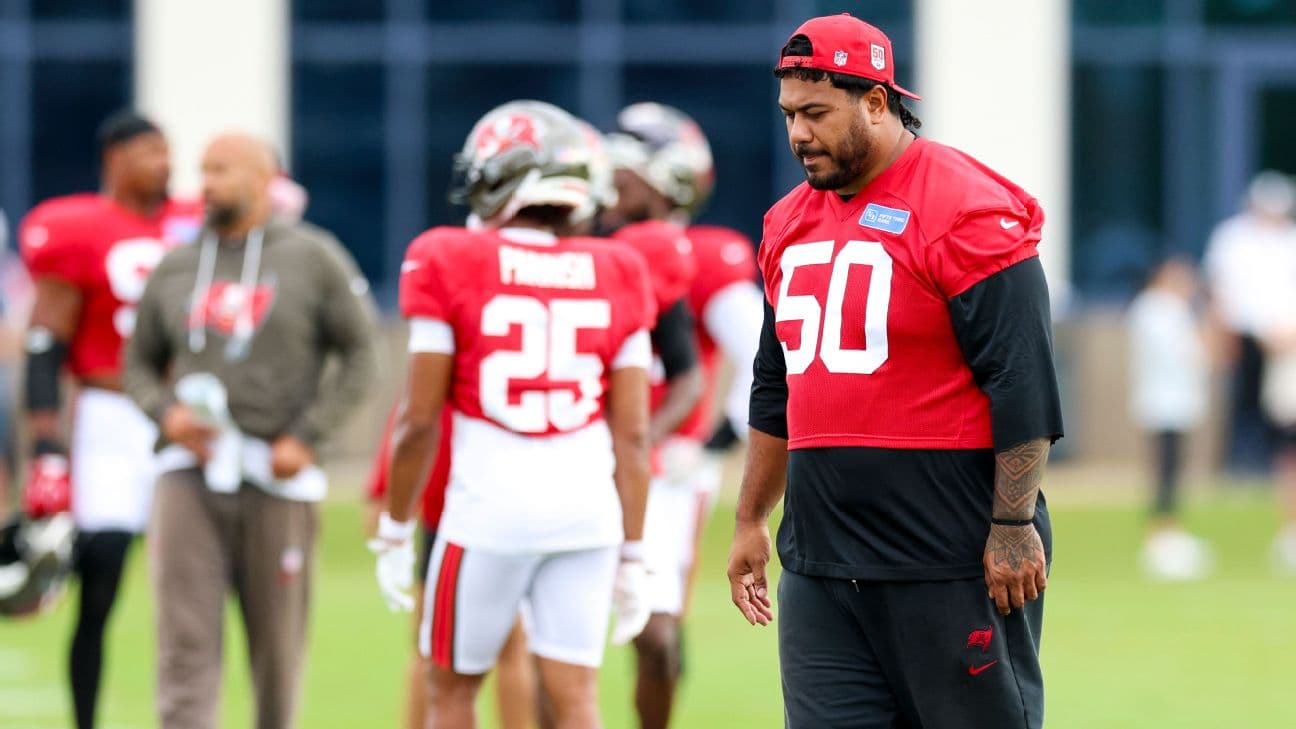
Vita Vea has requested a trade from the Buccaneers, his agent confirmed Monday as training camps opened around the league, after extension talks between the two sides stalled. The two-time Pro Bowl defensive tackle is entering the final year of the four-year, $71 million contract he signed in Tampa Bay, and the roughly $17 million he is scheduled to earn in 2026 carries no guarantees. That combination, a 31-year-old interior anchor with no security and no new deal, is exactly the profile that produces a summer standoff.
Vea was a hold-in at Tampa Bay's mandatory minicamp in June, attending to avoid fines without practicing. He is expected to report for camp, but his participation level is undetermined. The request itself does not force anything: the Buccaneers hold his rights, they have no cap incentive to move him quickly, and general managers rarely reward a public ask by shipping out a starting nose tackle a month before Week 1. What the request does is put a number on Tampa Bay's leverage clock.
What Vea is actually asking for
The framing matters. This is not a player who has refused to report or a player who has been suspended. It is a contract dispute in which the player has run out of patience and chosen the loudest legal tool available to him. Reports indicate Vea would prefer a move to the West Coast, with California, his home state, and the Raiders mentioned as destinations he would welcome. Preference is not the same as control, and Vea has no no-trade protection to enforce it.
Production is the argument on his side. Vea appeared in all 17 games last season and posted 4.5 sacks, 13 quarterback hits and 34 tackles, numbers that undersell what a two-gapping 340-pound nose does for the players around him. Interior defenders of that build are graded less on sack totals than on how often their double teams free a linebacker or a stunting three-technique, and Vea has been the structural reason Tampa Bay's front has held up against the run for most of his tenure.
Where Tampa Bay's defense stands without him
The Buccaneers went into camp with a defensive line that projected as one of the league's better units: Vea and Calijah Kancey inside, with A'Shawn Robinson and Rakeem Nunez-Roches as the veteran support and a young group including DeMonte Capehart, Jayson Jones, Elijah Simmons and Elijah Roberts competing behind them. Kancey missed most of the 2025 season after a torn pectoral muscle, and the entire projection for this front assumed a healthy Kancey working next to a fully engaged Vea.
Remove Vea and the math changes in two places. First, the run defense loses its most reliable double-team magnet, which is the single hardest thing to replace on a defensive line because it is not a skill that shows up in box scores. Second, Kancey's pass-rush win rate is at least partly a function of the attention Vea draws. A three-technique who was going to be schemed into one-on-ones now sees more coordinated protection.
The IDP and defense fantasy read
For IDP leagues, Vea was never a high-volume tackle producer and never a source of splash numbers, so his individual value is contained. The fallout runs downhill. Tampa Bay's linebackers benefit the most from Vea's presence, because clean run fits and unblocked flow are the entire basis of interior linebacker tackle production. If Vea sits, holds in, or is dealt, downgrade Tampa Bay's off-ball linebackers modestly in tackle-heavy formats and raise the volatility on Kancey, who becomes a boom-or-bust weekly IDP rather than a stable one.
Team defense is where the practical fantasy decision lives. Tampa Bay's DST was drafting as a mid-range starter on the strength of an interior front expected to hold up on early downs and force third-and-long. Take away the nose tackle and the unit's floor drops more than its ceiling, because the sack rate can survive but the third-down leverage does not. In one-defense leagues, Tampa Bay moves from a set-and-forget DST to a streaming option whose value depends on the Week 1 opponent.
The betting angle
Interior defensive line attrition is one of the more mispriced inputs in early-season totals. Books adjust aggressively for quarterbacks, meaningfully for edge rushers and left tackles, and slowly for nose tackles, because the public does not bet on run defense. That gap is the opportunity. If Vea is traded or holds out into September, Tampa Bay's early-season game totals and opponent team totals are likely to be slower to move than the underlying change warrants, particularly against opponents with a committed downhill run game.
The Buccaneers' season win total is a different matter. One defensive tackle, even a very good one, is not worth a full win on its own in most models. The more useful expression is opponent rushing props and first-half team totals in the specific matchups where Tampa Bay's interior would have been the deciding factor.
The Verdexed model take
Verdexed's model treats interior defensive line as a stability input rather than a splash input, which is why it responds to a Vea absence through Tampa Bay's expected points allowed on early downs rather than through its sack projection. The directional read is straightforward: the Buccaneers' defensive floor is meaningfully lower without him, their ceiling is close to unchanged, and the widest gap between the model and the market shows up in opponent rushing volume rather than in game sides.
The model also does not price a trade request as a trade. Historically, most summer trade requests from veterans under contract end in a reworked deal or a quiet reporting date, not a move. The base case remains that Vea plays for Tampa Bay in 2026, with the probability of a deal rising if the Buccaneers stumble early or if a contending team suffers a defensive line injury in August.
What to do now
Do not overreact in redraft leagues. Vea's absence is not yet a fact, and the players whose value swings on it, Tampa Bay's linebackers and DST, are late-round assets whose price barely moves. In dynasty and IDP formats where Kancey is rostered, this is worth monitoring rather than selling into: a Vea trade would hurt Kancey's efficiency but could raise his snap-share and target rate as the front's primary threat.
The real action is on the betting side, where the market has not yet processed what a Tampa Bay front without its nose tackle looks like. Track Vea's camp participation, not his agent's statements. If he practices in pads within the first two weeks, this ends the way most of these end. If he does not, the Buccaneers' September numbers are worth a second look before the books catch up.