 NFL2026-07-16
Travis Hunter's Second-Year Reset: The Jaguars Star Is 2026's Highest-Variance Fantasy Bet
By Verdexed NFL Desk
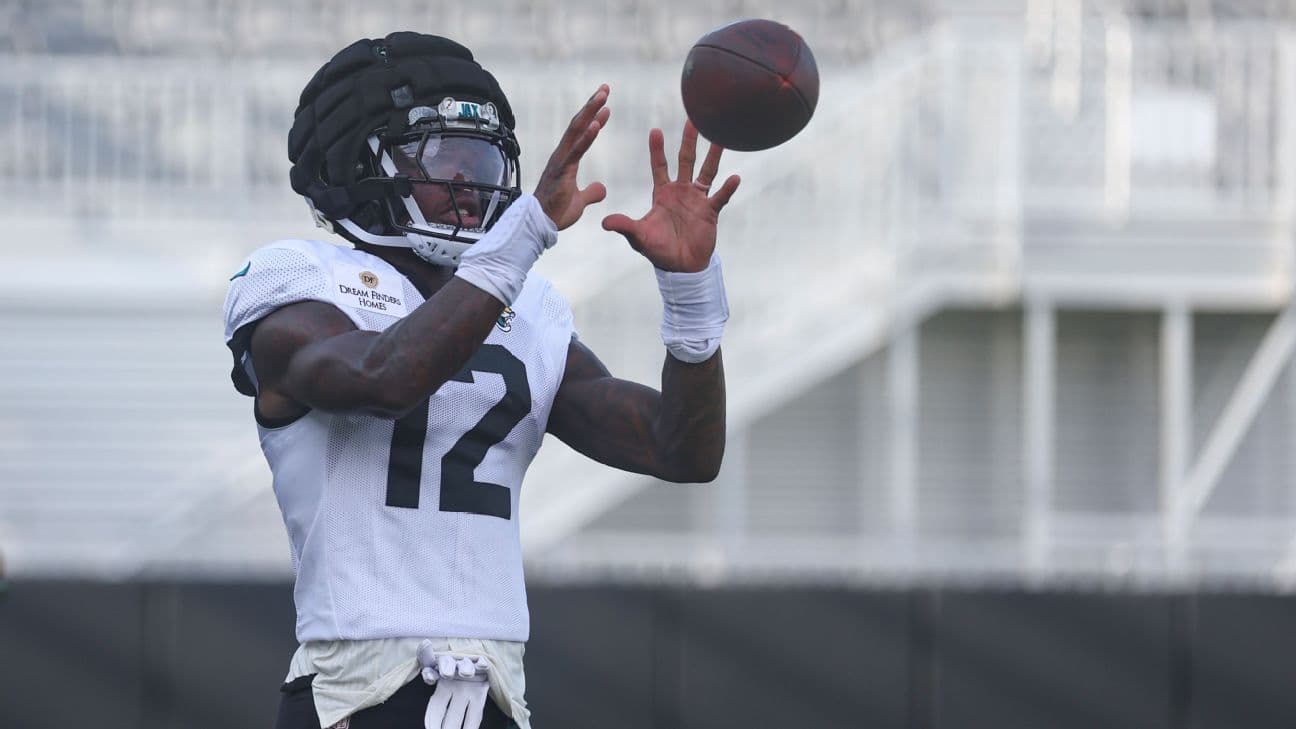
Travis Hunter is the most fascinating fantasy football projection on the board, and after a lost rookie season, nobody is quite sure what to do with him. The Jacksonville Jaguars' two-way star saw his debut campaign derailed by a knee injury, and he heads into 2026 reportedly a full go for training camp with everything to prove. His range of outcomes is wider than almost any other skill player in the league, which makes him equal parts opportunity and trap.
A rookie year cut short
Hunter's first NFL season never got off the ground the way it was supposed to. He caught just 28 passes on 45 targets for 298 yards and one touchdown across seven games before a knee injury suffered in practice ended his year. There was a flash of the ceiling in a London game against the Rams, where he posted more than 100 receiving yards and a score, but that peak was followed almost immediately by the injury. The sample is small, the production modest, and the interruption total.
That leaves fantasy managers projecting into a fog. There is not enough NFL tape to anchor a confident forecast, and the injury adds a health question on top of the usage question.
The two-way puzzle
The variable that makes Hunter unlike anyone else is his snap distribution. He is a genuine two-way player, and the share of his workload that goes to offense versus defense is the entire ballgame for his fantasy value. A receiver who plays a full complement of offensive snaps and commands targets is a startable fantasy asset. A player who splits his time and rotates in as a part-time weapon is a boom-or-bust flex at best.
The reporting entering camp suggests his exact role and usage remain uncertain, which is the honest state of things. Jacksonville has every incentive to maximize a special talent, but coaching staffs also protect two-way players from overload, especially one coming off a knee injury. Where the team lands on that balance determines whether Hunter is a weekly starter or a matchup-dependent dart.
The Verdexed model take
Verdexed's model treats Hunter as a high-variance flier rather than a core pick, and the reasoning is about information, not talent. The talent is obvious. The problem is that his projection depends on two unknowns stacked on top of each other: how many offensive snaps he plays, and how healthy he is coming off the knee. When a forecast rests on multiplying two uncertain inputs, the range of outcomes balloons, and that is exactly what the model shows for Hunter.
The model's read is that his ceiling, a healthy, target-earning receiver who also makes splash plays, is a genuine league-winner in the back half of drafts. His floor, a rotational role capped by snap management, is a player you cannot start most weeks. There is not much in between, which is what makes him a lottery ticket rather than a foundation.
The Jacksonville context
The offense around Hunter adds another layer of uncertainty. Jacksonville's passing-game hierarchy, the pace it plays at, and how the coaching staff chooses to script Hunter's touches all bear on whether the targets are there when he is on the field. A team that leans run-heavy or spreads the ball around suppresses even a talented receiver's fantasy output, while a pass-forward attack that funnels him manufactured touches raises his floor. Until the preseason clarifies both his snap count and how the offense intends to use him, projecting his target volume is closer to educated guesswork than forecasting.
That is not a knock on Hunter the player. It is a statement about the information available. The gap between his talent and his projectability is the widest of any notable skill player in fantasy this year, and drafters should price the uncertainty rather than the highlight reel.
How to draft him
Hunter belongs in the late-round upside portion of your draft, not the middle rounds where you need reliable production. Draft him as your final receiver or a bench stash in redraft, the kind of pick where a zero costs you nothing and a hit changes your season. Do not reach for him at a price that assumes the ceiling, because the path to that ceiling runs through too many unknowns.
Dynasty is where his value holds up best. A supremely talented young player with a unique skill set is worth holding through a murky season, and his long-term outlook does not hinge on a single uncertain year the way his 2026 redraft value does. If a Hunter manager in your dynasty league is discouraged by the lost rookie season, that is a window to buy a premium talent at a discount.
What to watch
Everything about Hunter's fantasy value will be settled in camp and the preseason. Track the beat reporting on his offensive snap share, because that number is the single most important input in his projection. Watch for any sign the knee is limiting him early. And temper the highlight-reel hype with the reality that a two-way role, by design, caps volume. Hunter is one of the most talented players in football and one of the hardest to project. Treat him accordingly: a swing for the fences, taken late, held loosely, and celebrated if it connects. The managers who win their leagues with a player like this are the ones who paid a late-round price for the upside, not a mid-round price for the hype.