 NFL2026-09-02
The Week 1 Handcuffs Worth a Roster Spot After a Rough NFL Camp for Backfields
By Verdexed Fantasy Desk
Four NFL backfields look materially different than they did on August 1, and in every case the change was created by an injury rather than by a coaching decision. That is the profile of value that fantasy managers systematically underprice, because draft boards get built in July and injury news arrives after the board is set.
With Week 1 starting September 9, here are the backfield situations that have actually changed and what to do about each of them.
Arizona: Tyler Allgeier is a starter, not a handcuff
James Conner opened the season on injured reserve with a return designation, which rules him out for at least four games. That was the expected outcome after Arizona signed Allgeier in March and spent a top-five draft pick on Jeremiyah Love, but the confirmation matters because it removes the ambiguity.
Love's own status is the complication. The rookie suffered a high ankle sprain in an August 13 preseason game against Las Vegas, avoided surgery, and has been progressing without the coaching staff committing to Week 1. That leaves Allgeier as the clear early-down back for the opener with Bam Knight in a complementary role.
Allgeier is the highest-priority add of this group. He is not a handcuff, he is a projected starter for a month, and in leagues that drafted in August his name is very likely still on the waiver wire. Spend real free-agent budget on him.
Chicago: D'Andre Swift's workload just widened
Kyle Monangai suffered a hyperextended knee in a training camp practice in mid-August and was ruled out for multiple weeks. Imaging came back positive in the sense that mattered most: the knee is structurally sound. The rookie was still expected to miss the balance of the preseason while working toward the Week 1 opener against Carolina.
Swift is the beneficiary either way. Chicago's offense projects as one of the more efficient units in the NFC under its current staff, and Swift enters the season as the unambiguous lead back with Roschon Johnson, Salvon Ahmed and Brittain Brown behind him rather than a rookie pushing for a timeshare.
The actionable move here is not adding Swift, who is rostered everywhere. It is treating him as a weekly RB2 with a higher floor than his draft price implied, and it is holding Roschon Johnson in deeper leagues as the direct handcuff if Monangai's return is slower than advertised.
Las Vegas: Ashton Jeanty's ankle is the one to monitor
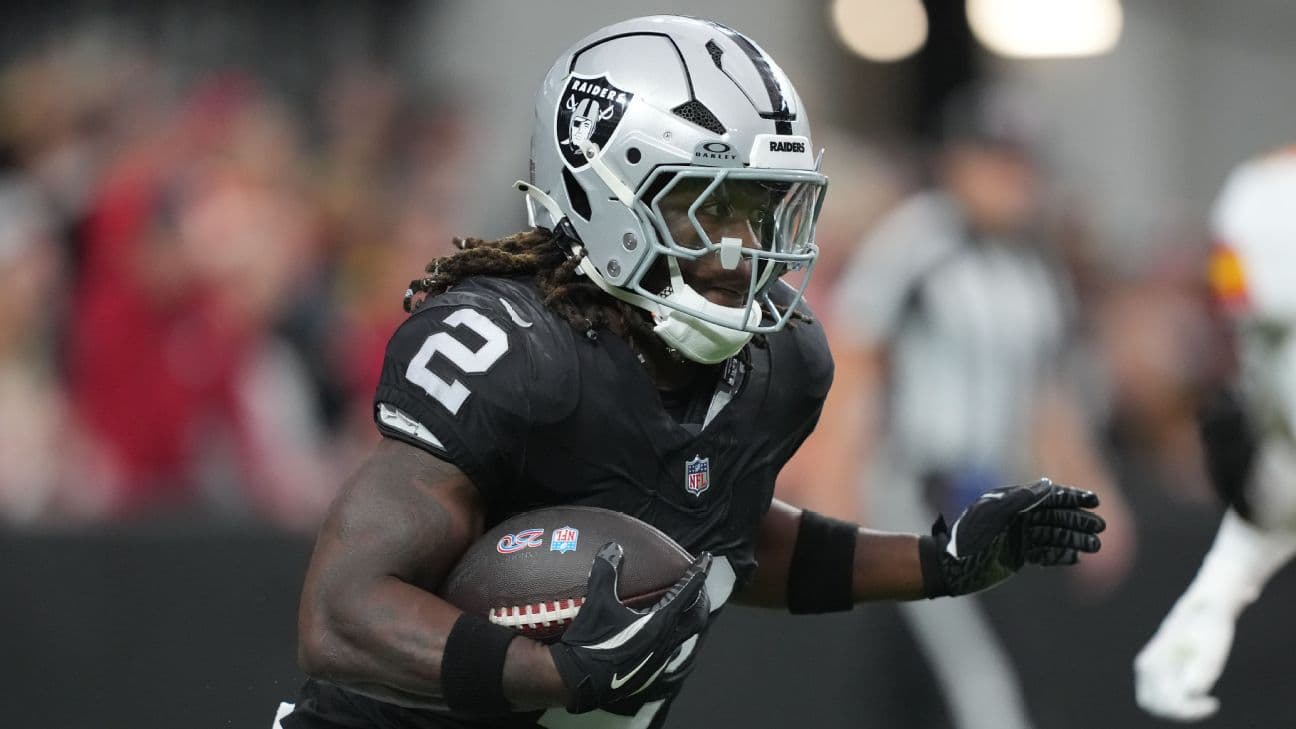
Ashton Jeanty is believed to have sprained an ankle in practice, and while the injury was not characterized as long-term, the Raiders have been careful with him. Head coach Klint Kubiak told reporters the team is counting on Jeanty for Week 1 while allowing that another week of assessment is coming before the September 13 opener against Miami.
Jeanty's fantasy price makes this the most consequential of the four situations. He was drafted as a bell-cow back, and a first-round fantasy pick with an ankle question 11 days before kickoff is a genuine roster problem. The Raiders' first official injury report, due the Wednesday before the opener, is the document that resolves it.
Managers who drafted Jeanty should be securing the backup behind him now, before the injury report creates a bidding war. That is the definition of a handcuff worth a bench spot: cheap now, unbuyable later.
Seattle: the Charbonnet vacancy is already priced
Zach Charbonnet tore an ACL in the playoffs and is highly unlikely to be available to start the season, which leaves Seattle's backfield with a defined lead back and a genuine opening behind him. This one is different from the other three: the injury is old, the market has had months to absorb it, and the resulting depth chart is not a secret.
That means there is no waiver-wire arbitrage here. What there is instead is a betting angle. Seattle opens the season at home against New England on September 9 as a modest favorite, and a run game operating without one of its two established backs in a game the Seahawks are expected to control is a live under candidate combined with a rushing-attempt prop worth examining on the remaining back.
The Verdexed model take
Our projections treat backfield injury news differently than most consensus rankings do, because the model weights opportunity share more heavily than efficiency in the first four weeks of a season. Early-season efficiency estimates are noisy. Touch counts are not.
That produces a clear ordering for this group. Allgeier is the model's biggest riser of the past two weeks and projects inside the top 30 running backs for the first month. Swift moves up modestly. The backup behind Jeanty is the highest-variance holding on the board, worth almost nothing if Jeanty plays and worth a top-20 weekly projection if he does not.
What to do this week
Prioritize in this order: Allgeier first, Jeanty's backup second, Roschon Johnson third. Drop the fourth receiver on your bench to make room, because September receiver depth is the most replaceable commodity in fantasy football and September running back opportunity is the least.
Then set a calendar reminder for the Wednesday injury reports. Every one of these situations resolves in the same 48-hour window, and the managers who move before that window are the ones who get the players at cost.
Why this window closes fast
The reason to act now rather than after Week 1 is structural. Free-agent budgets are at their fullest in the first week of the season, and so are the rosters of the managers competing with you for these players. That sounds like a reason to wait. It is the opposite.
The players in this article are cheap right now precisely because the injuries that created their opportunity have not yet produced a box score. The moment Allgeier gets 18 carries in Week 1 or Jeanty is downgraded on a Friday injury report, the acquisition cost multiplies. Waiver-wire value is created in the gap between when information becomes public and when it becomes visible in the results, and that gap is currently open on all four of these situations.
The counterargument is roster spots, and it is a fair one. Nobody wants to carry three handcuffs into Week 1 at the expense of a startable receiver. The resolution is to be honest about which bench players you would actually start. In a 12-team league, the fifth receiver on your roster is not going into your lineup in September under any circumstance short of a bye-week catastrophe. A running back who could inherit 18 touches is a different asset entirely.
The one to avoid
Not every camp injury creates value, and the trap this year is chasing the third back in a committee that has not actually changed. Backfields where the starter is healthy and the injury happened to the No. 3 do not produce fantasy points, no matter how loud the training camp reporting was. Filter for one thing before you spend budget: would this player be the primary early-down back if the man ahead of him missed a game? If the answer is no, the add is not worth a roster spot.