 MLB2026-09-01
The MLB Playoff Picture Entering September: Both Final Wild Card Spots Are Inside Half a Game
By Verdexed Analytics
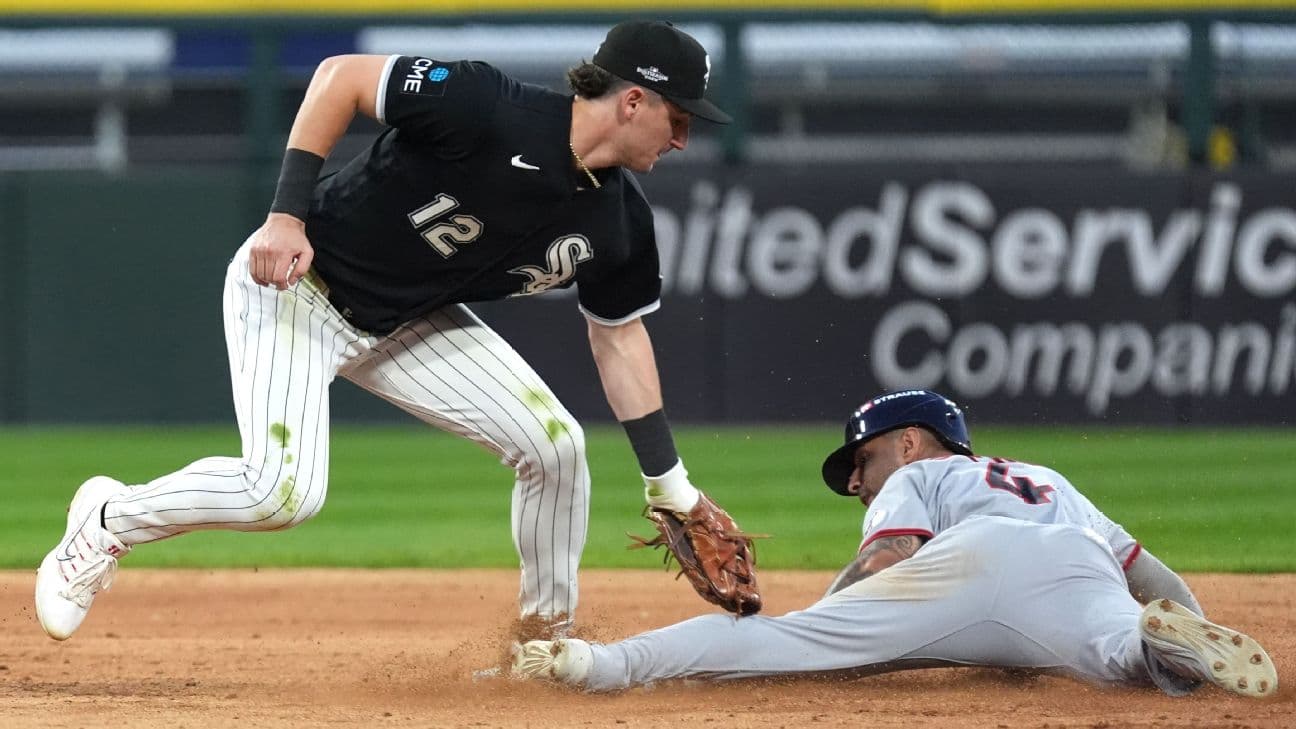
Baseball turned the calendar to September with both final wild card spots decided by half a game. In the American League, Cleveland holds the third berth over Baltimore by that margin. In the National League, San Diego holds it over Arizona by the same. Everything above those lines is comparatively settled; everything at them is a coin flip that will run for four more weeks.
The current bracket has Tampa Bay, Chicago's White Sox, and Houston leading their American League divisions, with the Yankees, Red Sox, and Guardians in the wild card slots. In the National League it is Milwaukee, Los Angeles, and Atlanta atop the divisions, with the Cubs, Phillies, and Padres holding the wild cards.
Where the races actually are
The top of both leagues is close to locked. Projection systems have Milwaukee tracking toward roughly 101 wins with playoff odds in the high nineties, and the Dodgers and Yankees carrying similar near-certainty on lower win totals. Tampa Bay and Atlanta sit just behind in projected wins with playoff probabilities in the high eighties and mid nineties respectively.
That leaves the drama concentrated in two places. The final wild card berth in each league is genuinely undecided, and the American League West remains the one division race with real uncertainty attached to it, which means Houston's positioning is not as safe as a first-place listing suggests.
The Yankees hold the top American League wild card by three games over Boston, which matters less for who makes it than for who hosts. In a three-game wild card series, home field is worth a meaningful chunk of series win probability, and that is what the last month is actually deciding for teams already safely in.
The Verdexed model take
Our model's disagreement with the consensus bracket is not about the teams at the top. It is about how much the half-game races should move on a single day's results.
When two teams are separated by half a game with roughly a month remaining, the derivative of playoff probability with respect to a single win is at its maximum. A team in that position gains or loses several percentage points of postseason odds on an ordinary Tuesday night, which is far more leverage than a comparable game carries in June. That is the mathematical reason September baseball feels different, and it is also why in-game markets in these matchups are frequently mispriced: the market updates the score correctly and the standings context lazily.
The second model note concerns Cleveland and San Diego specifically. Both are holding a spot rather than chasing one, and holding is harder than the standings imply, because the pursuing team gets the benefit of every tiebreaker scenario going against the leader. A half-game lead with a month left converts to a postseason berth less often than a naive reading of the standings suggests.
Betting angle
The two most interesting numbers on the board right now are Baltimore and Arizona to reach the postseason. Both are chasing by half a game, and chasing teams are systematically underpriced in playoff-berth markets because the public reads the standings as the answer rather than as the starting point.
The second angle is the American League West. A division race that is still live in September creates a specific betting inefficiency: the teams involved cannot rest anybody, which means their lineups stay at full strength longer than teams that have clinched. Full-strength lineups late in September are worth a fraction of a run per game that game totals do not adjust for, because the market prices the team, not the roster construction.
The third is the Yankees' seeding rather than their qualification. A three-game lead for the top wild card slot with a month left is roughly a coin flip weighted toward the leader, and the price on the trailing team to end up hosting is frequently better than the actual probability.
Fantasy fallout
The playoff picture is the single most important input into September fantasy roster construction, and most managers ignore it.
Hitters on contending teams play. Hitters on eliminated teams sit, get pulled early, and lose at-bats to September call-ups. The gap in plate appearances between a regular on a team fighting for a wild card spot and a regular on a team playing out the string is large enough to swing a head-to-head matchup by itself.
The same logic runs in reverse for pitching. Contenders manage innings, skip starts, and pull starters early in blowouts to protect arms for October. Non-contenders let young starters go deep because they are evaluating them. If you need innings or strikeouts, the eliminated teams are often the better source. If you need at-bats, the contenders are.
The practical rule: prioritize hitters on Cleveland, Baltimore, San Diego, Arizona, and the American League West clubs, because those rosters have zero incentive to rest anyone. Be careful with starting pitchers on Milwaukee and Los Angeles, where playoff rotation planning starts to override regular-season usage.
What to do this week
Audit your roster for eliminated-team exposure. Any hitter on a club that is out of it is a candidate to be replaced by a comparable hitter on a club that is not, and the upgrade is free.
In betting terms, get your positions on Baltimore and Arizona now rather than after a three-game winning streak reprices them. Half-game races resolve fast, and the number you want disappears in a weekend.
What's next
Head-to-head fantasy playoffs begin for most leagues in the next two weeks, which is the same window in which these races will start to separate. Watch the head-to-head schedules: the number of remaining games between the teams tied for the final spots is the biggest single driver of how quickly the half-game gaps resolve.