The Bears Paid Darnell Wright a Record Guarantee to Protect Caleb Williams
By Verdexed NFL Desk
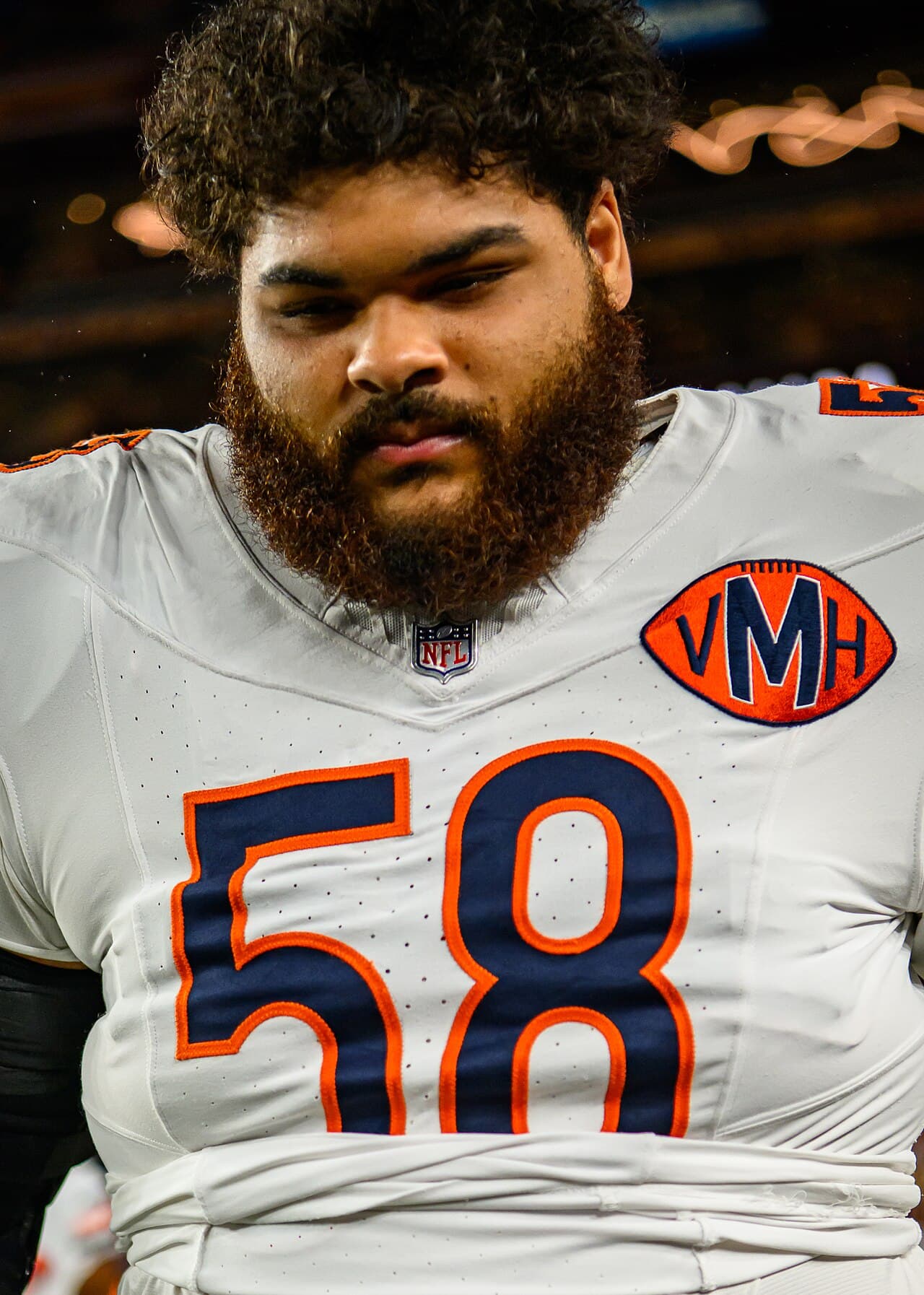
The Chicago Bears agreed Tuesday to a four-year extension with right tackle Darnell Wright reported at $116 million, including roughly $93 million guaranteed. Multiple outlets and the team itself confirmed the deal, and the guarantee figure has been described as the largest ever given to an NFL offensive lineman.
Offensive line contracts do not usually register in fantasy circles, and most of the time that instinct is correct. This one is different, because of who it protects and what it says about how Chicago intends to build.
The player and the price
Wright was the 10th overall pick in the 2023 draft out of Tennessee, selected after Chicago traded down one spot. He was inconsistent early last season and dealt with an elbow issue before finishing the year as a second-team All-Pro. That trajectory is exactly the sort a front office pays for: a young tackle whose worst stretch is behind him and whose best football is plausibly ahead.
The structure is the story. A $93 million guarantee at a non-premium position, and right tackle is still priced below left tackle across the league, is an aggressive bet. Teams typically guarantee that kind of money only to quarterbacks, edge rushers and left tackles. Chicago has decided the protection around its quarterback is worth premium pricing.
Why this matters for Caleb Williams
Quarterback fantasy production correlates with pressure rate more tightly than with almost any other offensive-line metric. Quarterbacks under pressure throw the ball away more, take more sacks, complete a smaller share of their attempts and generate fewer downfield yards. The relationship is well established and it is large.
Chicago has now committed long-term money to the right side of its line and has an offensive coaching staff building around Williams' skill set. A quarterback entering his third season behind a line the organization has paid to keep intact is the profile that produces breakout fantasy seasons. It is not a guarantee, but it is the setup.
The practical read is that Williams is a better bet at his current draft cost than he was a week ago, and specifically a better bet in the categories that reward clean pockets: completion rate, yards per attempt and touchdown volume. Quarterbacks who take fewer sacks also run less under duress, so the rushing floor may compress slightly, which is a real consideration for a quarterback whose fantasy value has partly come from scrambles.
Fantasy fallout for the skill group
Better protection raises the ceiling for every Chicago pass catcher, but not evenly. Downfield receivers benefit most, because deep routes take time to develop and a quarterback needs a clean pocket to throw them. Slot and short-area targets benefit least, because those throws come out fast regardless of protection quality.
Chicago's tight end room has drawn strong camp reviews, and the Bears' perimeter receivers have a defined pecking order. Both groups get a modest projection bump from this, with the perimeter group getting the larger share.
The running game is the less obvious beneficiary. Right tackle play matters more for the run game than pass-protection metrics capture, and a team that pays a tackle this much is signaling it intends to run behind him. Chicago's backfield should be treated as a slightly better environment than it looked a week ago, and the back who wins the early-down job in that offense has real value.
The Verdexed model take
Our offensive-line adjustment feeds into quarterback and skill-position projections through a pressure-rate input rather than a subjective line grade. Continuity is the single most predictive line variable we track: units that return the same starters year over year outperform units with equal individual talent but more turnover.
Locking Wright in long term improves Chicago's projected continuity through the length of the deal, which is a compounding benefit rather than a one-year one. The immediate 2026 projection moves modestly. The multi-year projection moves more.
That asymmetry is why this signing matters more in dynasty than in redraft. If you are evaluating Williams as a long-term dynasty asset, the organization just made a substantial, expensive commitment to the infrastructure around him. That is worth more than any single camp report.
Betting angle
Chicago's season win total is the market most directly affected, and lines rarely move on offensive-line news, which is precisely why there is sometimes value there. If the Bears' number has not adjusted, the over carries a small edge on the theory that improved and stable protection lifts a young quarterback's floor.
Williams' passing-yardage and passing-touchdown season props are the more targeted play. Books price quarterback props heavily off the previous season's output, and a quarterback whose protection improves materially is exactly the profile where that anchoring creates value on the over.
Be more cautious with Williams rushing props. Improved protection historically reduces scramble volume, and scramble yardage is a meaningful share of a mobile quarterback's rushing total. If a number was set assuming last year's rushing profile, the under has an argument.
What it means
Chicago has spent the offseason making the kind of commitments that suggest a front office confident in its direction. Paying record guaranteed money to a 25-year-old right tackle is not a move a team makes when it is hedging.
For fantasy purposes, the takeaway is straightforward. Move Williams up a tier in dynasty and a half-tier in redraft. Treat Chicago's downfield receivers as slightly better bets than their ADP implies. And pay attention to which running back emerges from the Bears backfield in the preseason, because the blocking in front of him just got a long-term guarantee attached to it.