Shedeur Sanders Starts Saturday Against the Bills and the Browns Job Is Still Open
By Verdexed NFL Desk
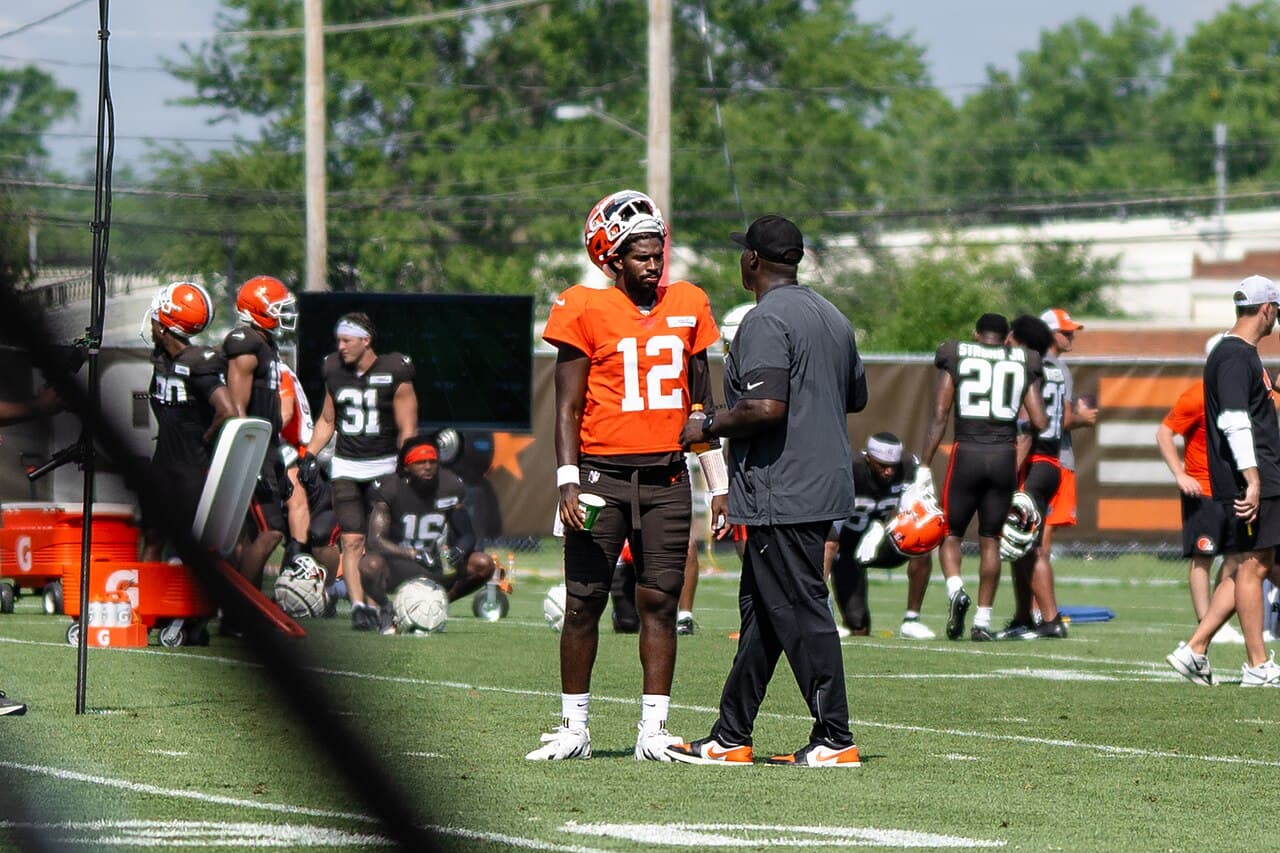
Shedeur Sanders is scheduled to start Cleveland's second preseason game against Buffalo on Saturday, the follow-up to Deshaun Watson's start in the preseason opener against Chicago. Head coach Todd Monken has said the starting quarterback in these games plays roughly a half and that the other quarterback also gets work, which means Saturday is the closest thing to an even-handed audition either passer will get before the roster deadline.
Monken has not named a Week 1 starter. That is the entire story.
Where the competition actually stands
Cleveland opened camp with four quarterbacks: Watson, Sanders, Dillon Gabriel, and rookie Taylen Green. The top two have been competing for the job since the spring, with the bottom two effectively fighting for developmental and emergency roles. Nothing was settled at minicamp, and the staff has repeatedly framed the decision as one that would be made once the pads came on and preseason snaps were available.
Watson opened the preseason with a modest line against Chicago, throwing for 126 yards in his first game action of any kind since tearing his Achilles during the 2024 season. That context matters more than the box score. A quarterback two years removed from live football is not going to look sharp in his first exhibition series, and the Browns knew that when they gave him the start.
Sanders now gets his turn with a full half against a Buffalo defense that will be playing its own roster-bubble evaluation game. The comparison will be imperfect, and it will be the one everybody makes anyway.
What the Browns are actually deciding
There are two separate questions here and they get conflated constantly. The first is who gives Cleveland the best chance to win football games in September. The second is what the organization wants its quarterback situation to look like in 2027.
Those questions have different answers, and that tension is why the competition has stayed open this long. A staff that was certain about the short-term answer would have settled this at minicamp. A staff that was certain about the long-term answer would have settled it in March.
Monken's history as a play caller is worth noting here. His offenses have generally been built on timing, play-action, and layered route concepts that ask the quarterback to work through progressions rather than create. That system fits an experienced pocket passer more naturally than a young quarterback still learning NFL defensive structures, which is a mild argument in Watson's favor that has nothing to do with either player's ceiling.
Fantasy fallout
The Cleveland skill players are the reason to care. Cleveland's receiver room has been reshaped around young talent, and the pass catchers' fantasy projections swing meaningfully depending on which quarterback is throwing.
If Watson starts: the offense likely leans conservative early, with heavier play-action usage and a lower attempt volume while the staff protects a quarterback returning from a serious injury. That profile suppresses receiver ceilings and mildly helps the running game.
If Sanders starts: expect more volatility in both directions. Rookie-contract quarterbacks in their first extended action produce more sacks, more turnovers, and more explosive plays than the veteran alternative. Fantasy managers holding Cleveland receivers would rather have the variance.
Either way, the Cleveland backfield is the more stable investment. Quinshon Judkins missed Thursday's practice with what the team called a minor issue and is day to day, which is a note rather than a concern, but the running back room is the part of this offense whose projection does not depend on the quarterback decision.
The Verdexed model take
Verdexed's model treats unresolved quarterback competitions as a blended projection rather than picking a winner, weighting each candidate by the probability he takes the Week 1 snaps. For Cleveland, that blend currently produces one of the widest projection ranges of any offense in the league.
The practical consequence is that the model's confidence interval on Cleveland's team totals is unusually fat, which is exactly the condition under which markets tend to misprice. A book that sets a Cleveland game total has to pick a number; the model gets to hold a distribution. That gap is where the edge lives, and it closes the moment Monken names a starter.
Betting angle
Cleveland's win total has sat near the bottom of the AFC North board all summer, and the quarterback uncertainty is a large part of why. The market is not going to move much on a preseason half from either passer, and it should not.
The number that will move is the Week 1 game line once the starter is announced. Historically, naming a returning veteran over a young quarterback moves a spread modestly toward the team; naming the young quarterback moves the total more than the spread, because books expect variance. Bettors with a strong read on which way Cleveland goes have a short window before the announcement to act.
Preseason sides themselves are a poor place to express any of this. Saturday's game is a roster-evaluation exercise for both teams, and playing time decisions made on Friday afternoon determine the result more than talent does.
What to do in your league
Do not draft a Cleveland quarterback in a one-quarterback league. That is not a knock on either player, it is a statement about a job that has no announced owner three weeks before the season.
The Cleveland receivers are draftable at their current cost precisely because the uncertainty is depressing their price. If you believe the young receiver room is legitimate, buying it in the last rounds while nobody knows who is throwing is a defensible strategy. Just do not pay up for it.
What's next
Saturday's first half is the evidence. Watch the situational usage more than the completion percentage: which quarterback gets the two-minute drill, who takes the red-zone reps, and whether Cleveland's first-team offensive line stays on the field for Sanders the way it did for Watson. Rosters must be cut to 53 by August 30, and quarterback decisions tend to arrive shortly before or shortly after that deadline rather than long before it.