Shedeur Sanders Is Closing the Gap on Deshaun Watson in Todd Monken's First Browns Camp
By Verdexed NFL Desk
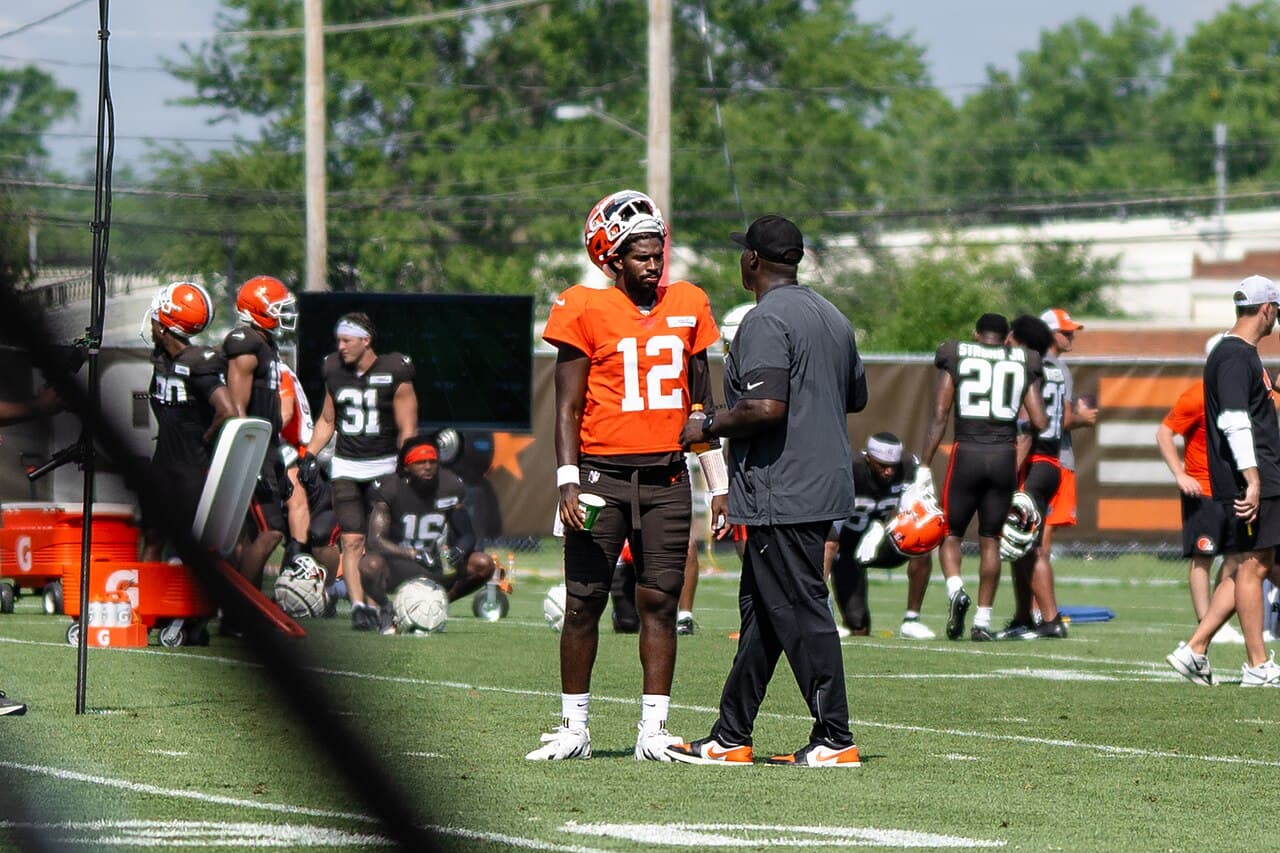
The Cleveland Browns' quarterback competition remains unresolved a week and a half into training camp, and the practice reports coming out of the CrossCountry Mortgage Campus suggest the gap between Deshaun Watson and Shedeur Sanders is narrowing rather than widening. First-year head coach Todd Monken has continued to split first-team reps between the two, and he has not put a timeline on naming a starter.
That is a meaningful data point on its own. Monken said during the offseason program that he would have preferred to walk into camp with a settled depth chart, and he came out of OTAs impressed enough with both quarterbacks that he could not do it. Camps that stay open into August generally stay open through the preseason.
What the early practices have shown
Watson took the first-team reps in the first padded practice, working through 7-on-7 and 11-on-11 with the starters. Beat reporting from that session had him completing 12 of 22 attempts with two interceptions and no touchdowns. Sanders, working primarily with the second unit, was reported at 16 of 19.
Those numbers come with the usual training camp caveats. Reps against backup defensive backs are easier than reps against starters, and a quarterback throwing into a first-team secondary will always show worse raw efficiency than one throwing into a second-team one. But Watson has reportedly thrown multiple interceptions in two of the first four practice days, and interception volume in camp is one of the few practice statistics that tends to carry signal, because it reflects decision-making rather than the quality of the opposing personnel.
Monken's response has been to keep splitting the reps. That is the tell. Coaches who have decided on a starter stop rotating.
The Monken variable
Monken's offensive history matters here more than most coaching changes do. His systems have historically been built on timing, layered concepts, and a quarterback who plays on rhythm from structure. That is a fit question for both candidates rather than an obvious advantage for either.
Watson's best football came in a scheme that let him extend plays and work off-platform. Monken's offense will ask for more decisiveness inside the pocket and faster processing on the first read. Sanders' collegiate profile was the opposite of Watson's: accuracy and anticipation from the pocket with a lower ceiling on second-reaction plays.
If the competition comes down to who runs the offense as designed, that favors Sanders. If it comes down to arm talent and the ability to create when the first three reads are covered, it favors Watson. Monken has not tipped which of those he weighs more heavily, though he has indicated he plans to play his starters in the preseason, which makes the exhibition games real evaluation windows rather than throwaways.
Fantasy fallout
The immediate fantasy consequence is that no Cleveland pass catcher can be drafted with confidence until this resolves. Quarterback uncertainty at this stage of August is a genuine drag on receiver and tight end projections, because the two quarterbacks throw the ball differently enough to change the shape of the target distribution.
A Sanders offense would likely produce more high-percentage throws to the intermediate middle and more volume for the tight ends and slot receivers. A Watson offense would produce more variance: deeper average depth of target, more scramble drill, and higher weekly ceilings paired with lower floors.
For redraft purposes, that means Cleveland's skill players belong in the double-digit rounds regardless of which name you prefer. The uncertainty discount is real and it should be applied.
Betting angle
Cleveland's win total has been priced in the range that reflects a roster in transition with a new head coach and an unsettled quarterback room. The relevant question for bettors is not who wins the job but how quickly the loser's contract situation forces a decision.
Quarterback competitions that run into the regular season tend to produce worse team results than competitions resolved by mid-August, because the reps get split all the way through the install period and neither quarterback gets a full starter's preparation. If Monken carries this into Week 1 without an announcement, that is a mild negative for the Browns' early-season scoring output and a reason to lean toward unders in September.
The Verdexed model take
Our model treats the Browns as one of the widest-variance teams in the league heading into the season, and the quarterback situation is the primary driver. The spread between the Sanders-led and Watson-led projections for team scoring is among the largest gaps we carry for any single roster decision, which is exactly why the model has not collapsed toward either outcome.
The directional read from the practice reporting is that Sanders' probability of opening as the starter has risen since camp began. Interception rate in camp correlates weakly with regular season performance in isolation, but it correlates strongly with whether a coaching staff hands over the job. That is the outcome being priced here.
What's next
The first preseason week begins August 13, and Monken's stated intention to play starters makes that the first real checkpoint. Watch two things: which quarterback takes the opening series, and whether the split of first-team reps in practice shifts before the game.
If Sanders gets the first series in the preseason opener, treat the job as effectively decided and move Cleveland's pass catchers up modestly on the theory that a settled offense is worth more than an unsettled one. If Monken opens with Watson and keeps splitting reps, the discount on every Cleveland skill player stays where it is.