 NFL2026-07-20
Rachaad White Is Washington's PPR Sleeper: The Pass-Catching Role Waiting in the Commanders' Backfield
By Verdexed Fantasy Desk
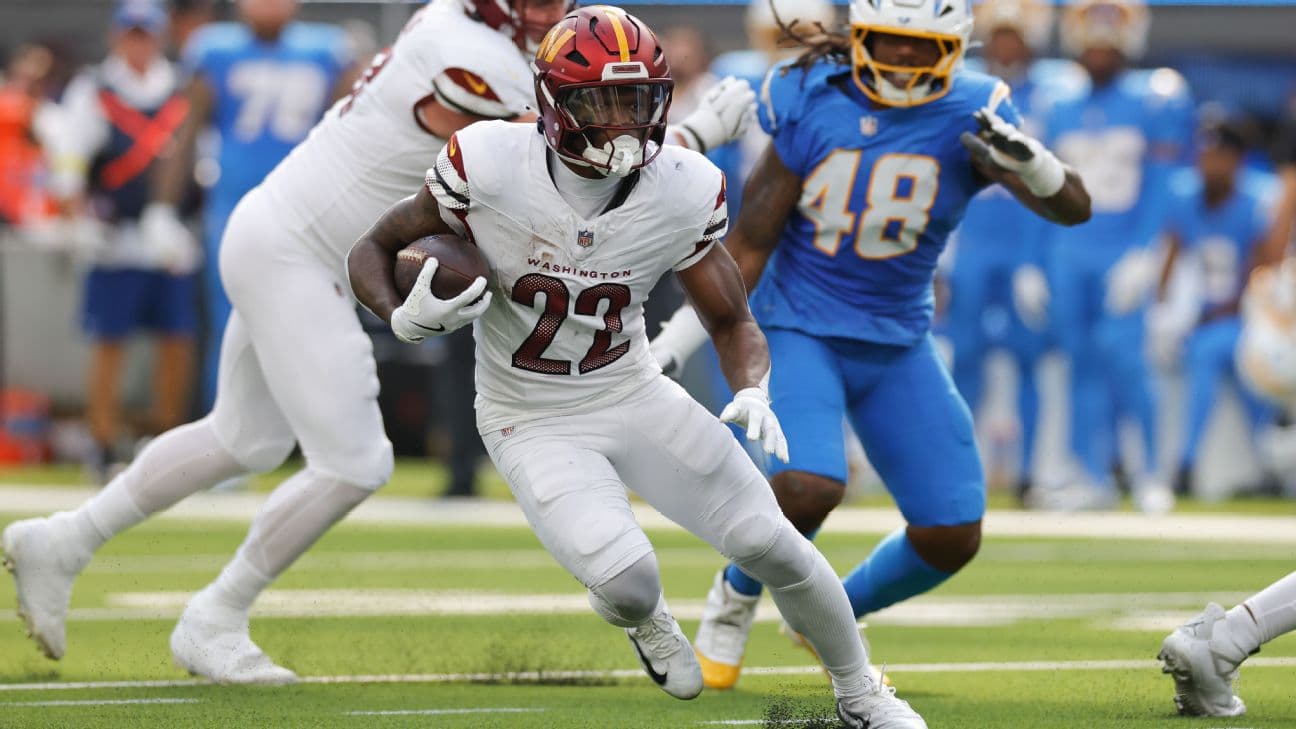
Rachaad White has been the talk of Commanders camp for the right reasons, and fantasy managers are starting to notice. Washington signed White to a modest one-year deal in March, and through OTAs and minicamp he emerged as one of the team's biggest offseason surprises. The reason he matters for drafts is specific: Washington targeted running backs just 55 times in 2025, the fewest in the NFL, and White arrives as a proven pass-catcher into an offense that suddenly wants to feed the position. That gap between opportunity and price is where PPR value lives.
The news
White inked a one-year contract worth around two million dollars, a bargain price that says nothing about the role he could carve out. New offensive coordinator David Blough has emphasized involving running backs in the passing game, a philosophy Washington conspicuously lacked a year ago. That schematic shift, paired with a back whose entire fantasy identity is receiving work, is the setup that turns a cheap veteran signing into a legitimate late-round target.
The receiving résumé backs it up. White has 205 receptions across four seasons and has never caught fewer than 40 passes in a year, averaging 51 catches per season. In a PPR format, a floor of 40-plus receptions from a back is meaningful production even before factoring in touches on the ground.
The committee caveat
The honest read is that this is not White's backfield alone. Washington's ground game is likely to run through a committee, with Jacory Croskey-Merritt in position to lead the team in early-down rushing while White handles the passing-down and change-of-pace work. Committees frustrate fantasy managers because they cap ceilings, and this one carries that risk. White is unlikely to be a bell-cow, and drafting him as one would be a mistake.
But the specific role he projects for is the one that travels best in PPR. A pass-catching back who is on the field in obvious passing situations and in the two-minute drill can post usable weekly lines even in a timeshare, because receptions are worth a point apiece and passing-down work correlates with garbage-time volume when a team trails. The comparison being floated, a version of the role Austin Ekeler filled, is instructive: that archetype produces RB2-and-flex value on catches and goal-line looks without ever dominating carries.
Fantasy fallout
For draft strategy, White is a target in the middle-to-late rounds where his cost still reflects skepticism about the committee rather than optimism about his receiving role. He is best deployed as a PPR flex with weekly upside in game scripts where Washington throws, and as a handcuff-plus who would see a real bump if Croskey-Merritt missed time. In standard, non-PPR scoring, temper the enthusiasm, because his value is disproportionately tied to receptions.
The corresponding fantasy note is on the Washington passing game. A back who absorbs 50-plus targets pulls a slice of the target pie away from the receivers and tight ends, a small negative for the pass-catchers' ceilings but a reflection of a more balanced, back-friendly scheme under Blough.
The betting angle
White's individual props are the cleanest market angle. If the OTA buzz translates to a defined passing-down role, his receptions and receiving-yardage numbers are set with committee assumptions baked in, which can leave room on the over if his snap share in passing situations is larger than the market expects. His rushing props are the riskier side, given the timeshare with Croskey-Merritt.
At the team level, a more balanced Washington offense that actually uses its backs is a modest positive for the Commanders' scoring consistency, though not a needle-mover on the win total by itself.
The Verdexed model take
The model prices White as a receiving-first back whose value is concentrated in PPR and in passing-down usage, and it treats the committee as a ceiling limiter rather than a value killer. The projection leans on his stable reception floor and the schematic shift toward feeding running backs, landing him as a back-end RB3 with flex appeal whose cost undersells his target profile.
The actionable takeaways: draft White in PPR as a late-round flex with upside, fade him a full tier in standard scoring, and treat him as a priority handcuff given how quickly his role would expand if the early-down back missed time. The buy window is now, before a strong August of the same reports that made him the offseason surprise pushes his ADP up.
The Croskey-Merritt question
The other half of this backfield is the swing factor. If Jacory Croskey-Merritt seizes the early-down and goal-line work outright, White's ceiling is capped at the passing-down role, valuable in PPR but touchdown-light. If the early-down job stays muddy into September, White's snap share climbs and his flex weeks become startable weeks. The reporting that White has been the offense's biggest surprise this offseason suggests he could push for more than a pure third-down role, and that ambiguity is exactly why his cost has not risen to match his opportunity. Drafters are effectively buying the passing-down floor and getting the early-down upside for free.
Goal-line usage is the specific stat to watch. White's fantasy weeks go from solid to spike when he vultures short touchdowns, and a committee that leaves the goal-line role undecided is one where White can steal scores. In a Blough offense that wants backs involved, even a handful of red-zone targets and short-yardage carries would meaningfully lift his weekly ceiling above what a pure receiving back typically posts.
What is next
Training camp will define the split. Watch White's usage in seven-on-seven and passing-down team periods, and watch how Washington deploys him in the two-minute drill and near the goal line, because that is where his fantasy value is made. A back who is on the field when the Commanders throw is a weekly PPR play regardless of how the carries divide, and White is trending toward exactly that role at a price that has not caught up.