 NFL2026-08-29
Quinshon Judkins Is Todd Monken's Workhorse and Dylan Sampson Is the Only Thing Capping Him
By Verdexed Fantasy Desk
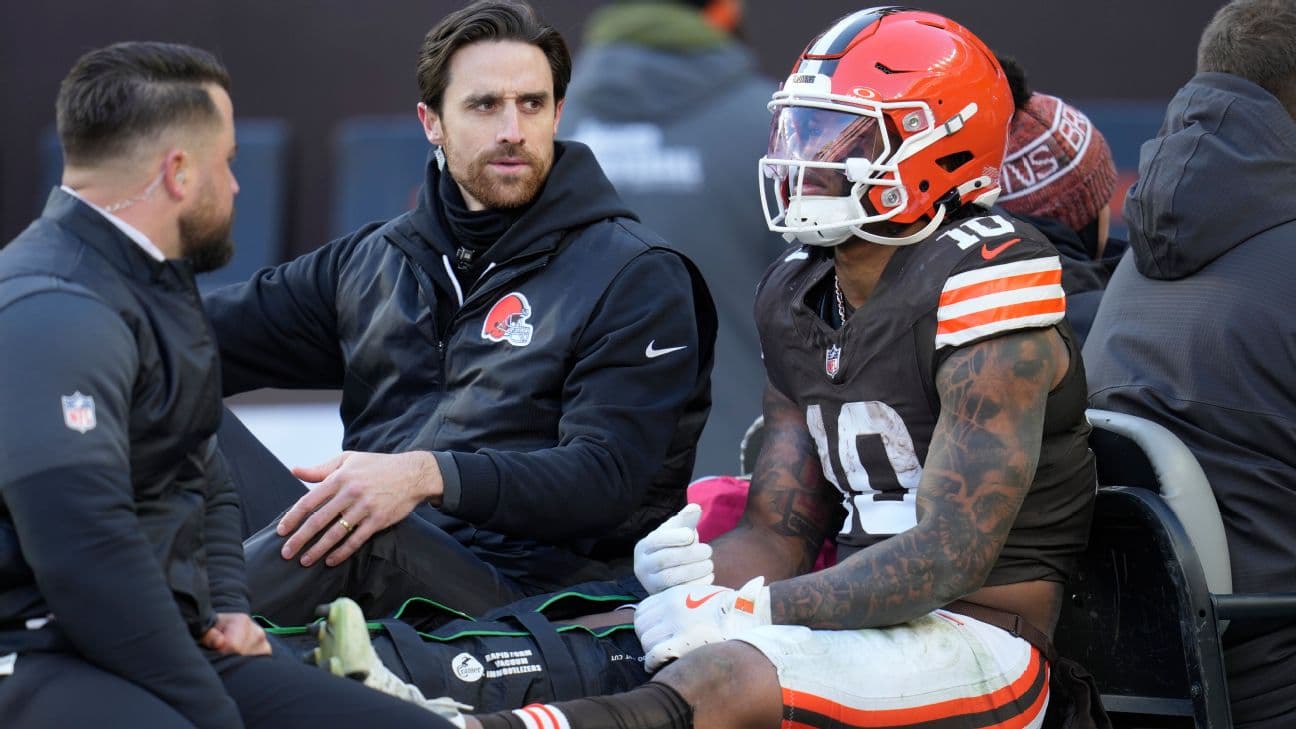
Quinshon Judkins enters his second NFL season as the clear lead back in Cleveland, in an offense run by a head coach who calls his own plays and who spent three seasons building one of the league's most productive rushing attacks in Baltimore. Todd Monken was hired as Browns head coach in late January and has confirmed he will handle offensive play-calling himself. Judkins is the back he intends to lean on.
That is a genuinely strong setup, and it is being drafted like one. The question worth answering before your draft this weekend is not whether Judkins gets volume. It is whether he gets the kind of volume that wins fantasy weeks.
The workload case
Judkins was the primary back for Cleveland as a rookie and enters camp atop the depth chart without a real challenger for early-down work. He is built to handle a heavy carry share and Cleveland has given no indication it wants to split those carries.
His preseason usage supports that read rather than undercutting it. He started the exhibition opener against Chicago, carried four times in the first quarter, and was shut down. He did not play against Buffalo and did not play in the finale against New England. Missing consecutive camp practices earlier in the summer while managing an undisclosed issue was the only genuine concern, and the team's willingness to sit him in August is the behavior of a staff protecting a starter, not one evaluating a competition.
Monken's Baltimore offenses ranked among the league's most efficient on the ground, and while the personnel there was unique, the underlying philosophy travels: heavy early-down rushing, play-action off it, and a lead back who touches the ball 18 to 22 times.
The Dylan Sampson problem
Sampson is the reason Judkins is not being drafted as a top-eight back.
Cleveland's second-year back was heavily involved in the passing game throughout camp and appears set for a defined third-down and two-minute role. That is not a small carve-out in modern fantasy scoring. In PPR formats, a back who runs the passing-down routes captures four to six receptions a game, and those receptions are the difference between an RB2 and an RB1.
Sampson also has enough juice to mix in on early downs, which means the split may not be as clean as "Judkins runs, Sampson catches." Reports out of camp have described Sampson as an option on early downs as well.
The realistic projection is Judkins as a high-volume rusher with modest receiving work and Sampson as a low-volume back with real PPR utility. In standard scoring, Judkins is a strong RB2. In full PPR, he is a strong RB2 with a lower ceiling than his carry share suggests.
Game script is the other constraint
Cleveland named Deshaun Watson its Week 1 starter over Shedeur Sanders, and the receiving corps in front of him is built around rookies after the team released veteran Cedric Tillman this week. The Browns opened as roughly a touchdown underdog on the road at Jacksonville in Week 1.
Underdog game scripts are the enemy of early-down running backs. If Cleveland trails frequently, Judkins' carry volume compresses and Sampson's passing-down snaps expand. That is the mechanism by which a well-constructed workhorse projection turns into a frustrating fantasy season.
It is also the reason Judkins' weekly variance will be higher than his season-long projection implies. He will have 22-carry, two-touchdown games when Cleveland controls a game, and eight-carry, three-target games when it does not.
The Verdexed model take
Verdexed's model has Judkins comfortably inside the top 20 backs and near the edge of the top 12, with the gap between those two outcomes driven almost entirely by team win probability rather than by anything Judkins controls.
The model treats Monken's arrival as a modest positive for the rushing offense and a larger positive for offensive efficiency generally. The Browns' projected pass rate under Monken is lower than the league average, which supports Judkins' carry floor.
Where the model diverges from consensus is on touchdown equity. Cleveland's projected scoring output is below average, and Judkins' share of a below-average number of red-zone opportunities is the single biggest cap on his ceiling. A back can be the unquestioned starter on a team that does not score enough for it to matter.
What to do in your league
Draft Judkins in the third or fourth round in standard scoring, where his carry volume is worth full price. In full PPR, let him fall a round and take him only if the receiving backs on the board have already gone.
Handcuff him with Sampson if you can get him late, because Sampson is the rare backup who has standalone PPR value while the starter is healthy and would inherit an every-down role if the starter is not.
Do not chase Cleveland's passing game around him. A rookie-heavy receiver room with a quarterback situation that took until late August to resolve is not where you want your fantasy points coming from.
What is next
Cleveland cuts to 53 on Sunday, and the running back room is the one place where the roster is already settled. Watch instead for whether the Browns add a veteran receiver off waivers Monday, because the health of the passing game determines whether Judkins spends his season running with the lead or chasing it.
The first real data point comes in Jacksonville. If Judkins is on the field for the two-minute drill, the ceiling is higher than anyone is projecting. If Sampson is, the projection above is the whole story.