 NBA2026-09-12
Philadelphia's Starting Five Has Four Alphas and Only One Basketball, and Fantasy Drafters Have to Pick
By Verdexed NBA Desk
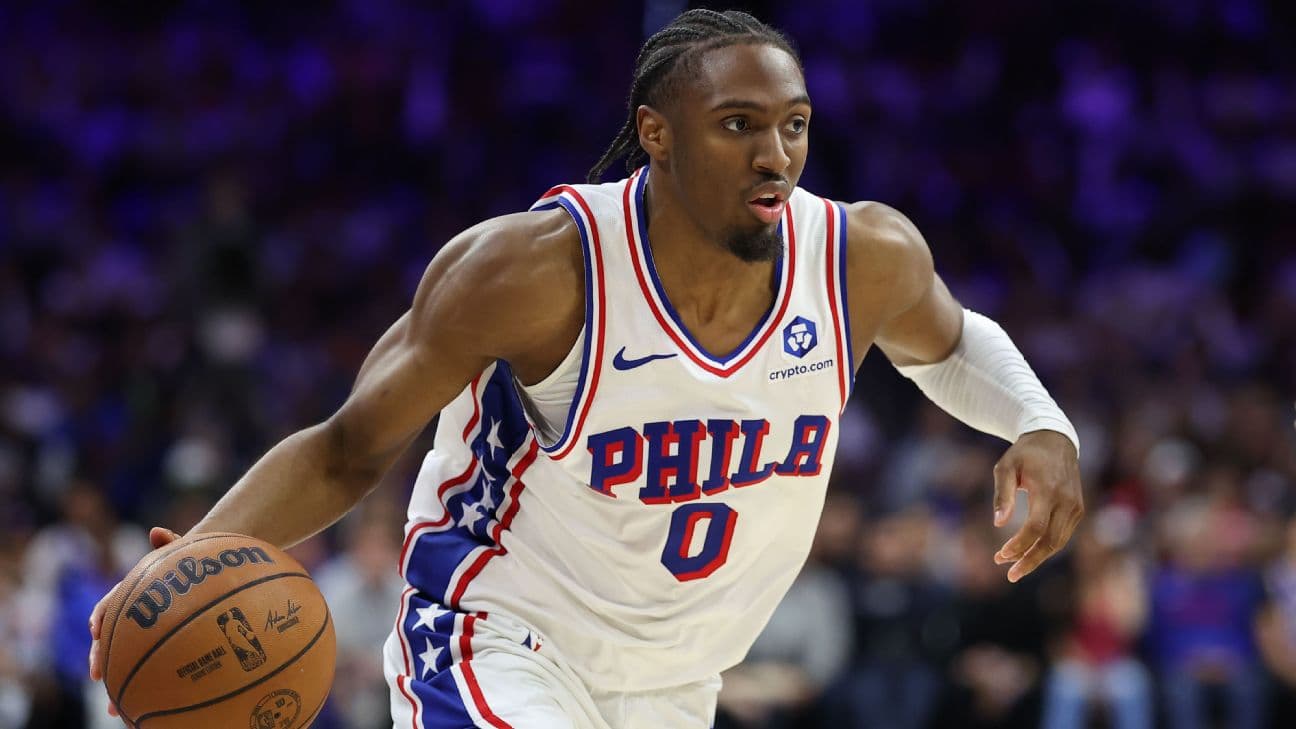
Philadelphia opens training camp in a little over two weeks with a starting five of Tyrese Maxey, VJ Edgecombe, Jaylen Brown, LeBron James and Joel Embiid. The 76ers acquired Brown from Boston during the offseason and signed James to a two-year deal worth roughly eight million dollars in late July, a contract that represented an enormous financial sacrifice for a player who earned close to fifty-three million last season.
The basketball question is whether that group contends. The fantasy question is more specific and more urgent for anyone drafting this month: four of those five players have spent their careers as primary offensive options, and there is exactly one ball.
The usage math
Usage rate is a zero-sum statistic. It measures the share of a team's possessions a player ends while on the floor, and the five players on the court must collectively account for one hundred percent of them. A lineup containing multiple players accustomed to usage rates near or above thirty percent cannot preserve all of those rates. Somebody's number falls.
Historically, the player whose usage falls the most in a situation like this is not the one fantasy managers expect. It is usually the second-best creator rather than the fourth, because the fourth option was already playing off the ball and has an established role that does not require possessions. The player who gets squeezed is the one whose value came from initiating offense and who now has to share that job.
Applied here, the risk is concentrated on the guards. Maxey has been a high-volume scorer who creates his own shot. Brown arrives from Boston where he was a primary option. James, even in his 24th season, remains a player whose offensive value is expressed through possessions, and he averaged close to 21 points and 7 assists across 60 games last season.
Who wins and who loses
Joel Embiid's fantasy value is the least threatened and the most fragile. Least threatened because a dominant center's production comes from efficiency and from the rim, not from creating against a set defense, and because his usage when healthy has never been a question. Most fragile because health has been the entire story of his recent seasons. He is the highest-variance selection in any draft this fall, and no amount of roster context changes that.
LeBron James is likely to see the smallest decline in per-minute production and the largest decline in minutes. A team with four other capable offensive players has every reason to manage the workload of a player entering his 24th season, and Philadelphia has publicly built a roster that does not require him to play heavy minutes. His counting statistics should fall. His efficiency should rise.
Tyrese Maxey is the fade. That is the uncomfortable conclusion. His fantasy value has been built on volume, and volume is the thing this roster takes away. He will be drafted on last season's usage in a lineup that cannot support it.
Jaylen Brown is the most interesting value. He arrives with the reputation of a primary option and the game of a complementary one. Brown has always been efficient off the catch and capable in transition, which are exactly the possessions a team with multiple creators generates. If his draft price falls because of the crowding concern, he is the one to take.
VJ Edgecombe is the deep-league flier. A second-year player starting alongside four established scorers is the definition of a low-usage, high-efficiency role. In category leagues that reward percentages and defensive counting statistics, that is a usable profile at a minimal cost.
The Verdexed model take
Verdexed's basketball projections start from role rather than from reputation, which is the correct framing for this roster and the one most draft boards fail to apply. The model allocates expected possessions across a lineup and then computes individual production from that allocation, rather than carrying forward last season's rates and hoping they survive a roster change.
Run that way, Philadelphia produces a distinctive output: four players projected in the same broad range, none of them projected as a top-fifteen fantasy asset, and a team-level offensive projection that is considerably stronger than the sum of its individual fantasy values.
That is the trap. A very good real-life team can be a poor source of fantasy production, because winning basketball distributes possessions and fantasy scoring rewards concentrating them. Philadelphia in 2026-27 is the clearest example of that principle on any roster in the league.
The model's specific guidance is to draft exactly one Philadelphia player and to prefer the one whose price has fallen furthest relative to his real role. At current market prices, that is Brown. The player to avoid at his current cost is Maxey, whose draft position reflects a usage rate the model does not project him to retain.
On the betting side, the model's team projection for Philadelphia is strong, with the caveat that Embiid's availability drives a wider outcome distribution than any other single input on the roster. The over on the season win total is defensible. The championship price is not, because it already reflects the optimistic version of a health question that has not gone the optimistic way in several years.
What's next
Media day and the first week of camp will provide the first real information, and the thing to listen for is not who says the right things about sacrifice. It is the closing lineup. The five players a coach uses in the final four minutes of a close preseason game tell you more about the possession hierarchy than any quote will.
Watch also for early minutes restrictions on James, which would confirm the workload management thesis, and for any indication of how Philadelphia intends to stagger its creators. A team that plays all four together for heavy minutes will produce fewer usable fantasy assets than one that splits them across the rotation. For drafters, that structural question is worth more than any individual projection.