 NFL2026-09-01
Mike Washington Jr. Is the Raiders' Week 1 Plan if Ashton Jeanty's Ankle Is Not Ready
By Verdexed Fantasy Desk
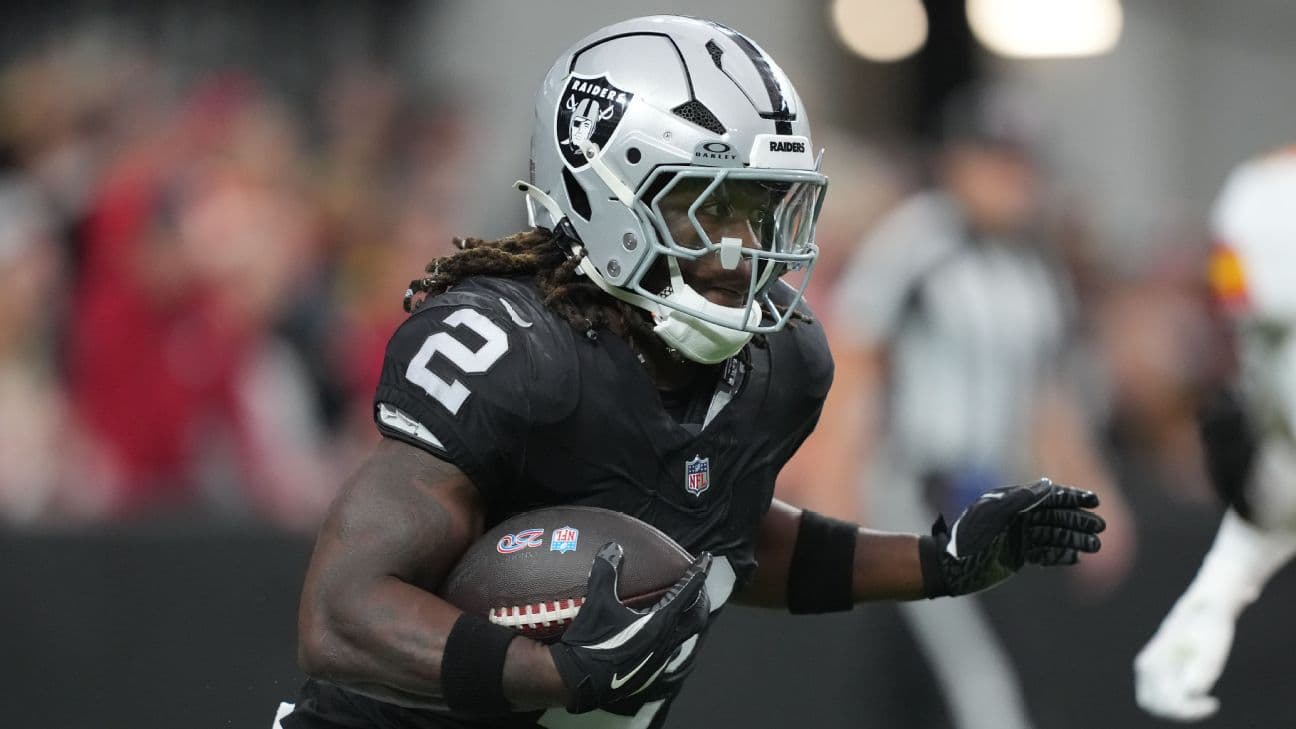
Ashton Jeanty's status for the Raiders' opener remains unsettled after he sprained his ankle in practice, and the coaching staff has publicly framed the next week as an evaluation window rather than a recovery timeline. The injury has been reported as a low ankle sprain rather than the high variety, which is the better of the two outcomes, but low sprains still routinely cost players one to three weeks depending on how much cutting the position demands. Running back demands a lot.
Behind Jeanty on the Raiders depth chart sits Mike Washington Jr., with Dylan Laube third and Chris Collier already on injured reserve. That is a short list, and it makes Washington one of the few genuinely actionable handcuffs left in drafts that are still happening this week.
What the staff has actually said
The public messaging has been measured. The Raiders have another week to evaluate how the ankle responds and have said they are counting on Jeanty for the opener against Miami, which is the standard framing for a player a team expects but cannot promise.
That framing is worth reading precisely. "Counting on him" is not "he will play." Teams that are confident say so plainly. Teams managing a genuine uncertainty describe a process, and a process description twelve days out from kickoff usually resolves into a game-time decision.
Why the backup matters more here than elsewhere
Most handcuff situations are messy. Committee backfields split work three ways, teams sign veterans off the street, and the player who replaces an injured starter is rarely the player listed second in August.
Las Vegas does not have those options. The room behind Jeanty is thin, one of its members is already on injured reserve, and there is not a veteran on the roster who profiles as a bell-cow replacement. If Jeanty cannot go, the touches concentrate rather than scatter, and Washington is the primary beneficiary.
That concentration is the entire value proposition of a handcuff. A backup who inherits 60 percent of a lead back's work in a committee is a flex play. A backup who inherits nearly all of it in a run-oriented scheme is a weekly starter.
The scheme context
The Raiders' offensive system under their current play-caller is built on outside zone and play-action off it, a scheme that has historically produced usable fantasy production from whichever back is healthy rather than requiring a specific skill set. That is good news for a replacement.
It is also why Jeanty was drafted where he was in fantasy leagues this summer: the projected volume in this offense is substantial, and volume in a defined scheme is the most transferable fantasy asset there is. If the workload transfers to Washington for even two games, it transfers with most of its value intact.
The Verdexed model take
Our model prices handcuffs on two variables: the probability the starter misses time, and the share of the vacated workload the backup captures. Most handcuffs fail on the second variable, not the first.
Washington scores unusually well on the second. With Collier on injured reserve and Laube profiling as a passing-down specialist rather than a between-the-tackles option, the model assigns Washington a workload-capture share near the top of the league's backup running backs, conditional on Jeanty missing time.
On the first variable, a low ankle sprain suffered in late August with a Week 1 game roughly two weeks out produces a meaningful but not dominant probability of a miss. Combine the two and Washington's expected value across the first three weeks lands above where he is being drafted in most rooms, which is often not at all.
The betting read follows the same logic. Las Vegas is not a team that can absorb the loss of its featured back without a change in offensive identity. If Jeanty is ruled out, the Raiders' team total should move down more than the market typically moves for a running back injury, because there is no comparable replacement to absorb the loss.
What to do in your league
If you are drafting this week and you took Jeanty, Washington is a mandatory late-round pick. Not a maybe. The concentration of the backfield makes him one of the highest-leverage handcuffs available, and he will cost you a pick in the final two rounds.
If you did not draft Jeanty, Washington is still worth a last-round flier in leagues with deep benches. A backup running back one injury away from a featured role in a run-heavy scheme is a better use of a final roster spot than a fifth wide receiver who needs three injuries to see the field.
In leagues that have already drafted, check whether Washington is on waivers right now. In most 12-team leagues he is, and he will not be if Jeanty is downgraded on the first official injury report.
The DFS angle
Hold off. Jeanty's status will not clarify until the game-week injury reports, and Washington's salary will be set before that clarity arrives. If Jeanty is ruled out late in the week, Washington becomes one of the better value plays on the Week 1 slate, because a minimum-priced back with a projected featured workload is the single most efficient way to unlock salary elsewhere in a lineup.
The trap is rostering him before the ruling and getting a Jeanty who plays through it on a full workload. Wait for the news.
What's next
The first official injury report of the regular season is the checkpoint. A Jeanty who practices in full early in game week plays and Washington goes back to the bench. A Jeanty limited into Friday means a game-time decision, and a game-time decision at running back on a Sunday afternoon slate is exactly the scenario a handcuff exists for.