 NHL2026-08-24
Macklin Celebrini Turned Fantasy Hockey's Big Four Into a Big Five
By Verdexed NHL Desk
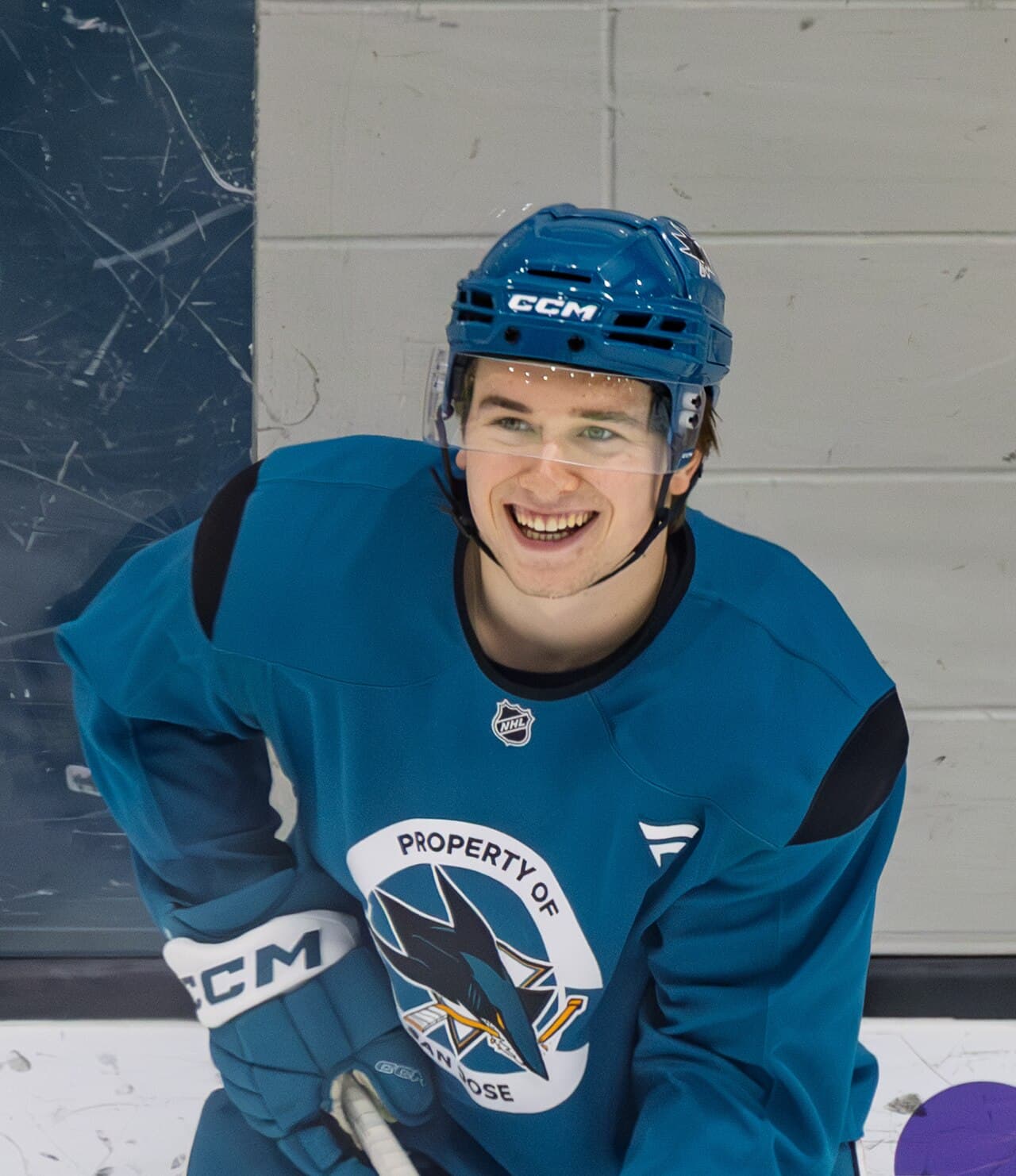
Fantasy hockey drafts open in the next few weeks with a top tier that has expanded for the first time in years. Macklin Celebrini's 2025-26 season, in which he set a Sharks franchise record with 115 points on 45 goals and 70 assists across all 82 games, moved him from the outer edge of the elite group into the middle of it.
The result is a genuine disagreement at the top of the board, which is unusual. CBS Sports has Connor McDavid leading its top 100. ESPN's rankings open with Nathan MacKinnon, followed by McDavid, Nikita Kucherov and Celebrini. Most boards have McDavid, MacKinnon, Kucherov and Leon Draisaitl as the players capable of comfortably clearing 100 points, with Celebrini now added to that group.
Why the disagreement exists
Ranking disputes at the top of a fantasy board almost always come down to format assumptions rather than player evaluation.
In points-only leagues, the argument is close to arithmetic: whoever projects for the most points goes first. That favors McDavid, whose ceiling in that category is unmatched.
In category leagues, goals, shots, power play production and plus-minus all matter, and the calculation shifts. MacKinnon's shot volume is a genuine category-league advantage, and it is the most common reason a board puts him first.
Celebrini's case is different from both. A 45-goal, 70-assist season is balanced across categories in a way that few elite producers are, and balance is worth more in nine-category formats than a lopsided profile with a higher total. That balance, combined with his age, is why he has moved up faster on category boards than on points boards.
The second tier is where the draft is won
The top five will be gone in the first five picks of any competent draft, which means the actual decisions start in the second round. Two situations define that range.
Connor Bedard's shoulder. Bedard underwent left shoulder surgery in early July after an awkward fall during an offseason training session. The Blackhawks announced a timeline of at least four months, which rules him out for all of training camp and roughly the first month of the season. The NHL season begins September 29, which puts his projected return in the early-to-mid November range. The team physician indicated he is expected to make a full recovery.
For a redraft league, that is a straightforward downgrade: a player who misses roughly a month of games loses roughly a month of production, and there is no way to recover it. For dynasty and deep leagues, he is a hold and a buy-low, because a full recovery is expected and shoulder surgeries in young forwards do not typically cost long-term production.
Goaltending. Andrei Vasilevskiy led the league with 39 wins in 2025-26 and will likely be the first goalie off the board. The perennial question of when to take a goalie has a slightly different answer this year, because the schedule is changing.
The calendar change nobody is pricing
Two structural changes shape this season. Training camps are shorter, and the regular season is longer. Both matter for fantasy in ways that go beyond the obvious.
A shorter camp means less time for coaches to sort out lines and power play units, which means more uncertainty at draft time and more in-season role churn. That argues for drafting proven producers early and speculating late, rather than the reverse.
A longer regular season means more games, which means more counting stats, which means the value of durability rises relative to the value of per-game rate. A player who plays every game in an 82-game season is valuable. In a longer season, he is more valuable, and injury-prone stars are correspondingly more expensive.
The Verdexed model take
Our projections handle the top of the board by simulating each player's season rather than projecting a point total, which produces a distribution rather than a number.
Run that way, McDavid has the highest ceiling in the league and the widest band, because his production has historically depended on linemate configuration and health. MacKinnon has the narrowest band of the elite group, which makes him the safest first overall pick in category formats even when he is not the highest projection.
Celebrini's distribution is the interesting one. Our model gives him a lower median than the four established stars, which is appropriate for a player with fewer elite seasons on record, but a higher upper tail than any of them except McDavid. A young player coming off a franchise-record season with an ascending role has more room above his median than a 30-year-old with a stable production history.
That combination makes Celebrini the correct pick at four or five and the wrong pick at one, which is close to where the consensus has landed.
On Bedard, our model applies a games-played discount that puts him outside the top 40 in redraft formats and inside the top 15 in keeper formats. That is a large gap, and it means the correct answer to "where do I take Bedard" depends entirely on the format rather than on the player.
What to do in your league
Take the elite five in whatever order your format dictates, and do not overthink it. In points leagues take McDavid. In categories take MacKinnon or Celebrini depending on whether you want the safer floor or the higher tail.
Let Bedard fall in redraft leagues. Someone in your draft will take him in the third round on name value, and that pick will cost them a month of production they cannot recover.
And do not draft a goalie early on the strength of last season's win total. Wins are the least predictable goaltending category, and a goalie ranked first because he led the league in them is being priced on the statistic most dependent on his team.
What's next
Camps open in the coming weeks, and the two things worth watching are power play unit assignments and line combinations, both of which will be less settled than usual because of the shortened camp. Daily Faceoff's line combination tracking becomes the most valuable fantasy resource of the preseason, and the managers who check it before their draft rather than after will find two or three players whose roles have changed since last season ended.