 NFL2026-09-11
Kaelon Black Out-Carried Christian McCaffrey in Melbourne and the 49ers Never Explained Why
By Verdexed Fantasy Desk
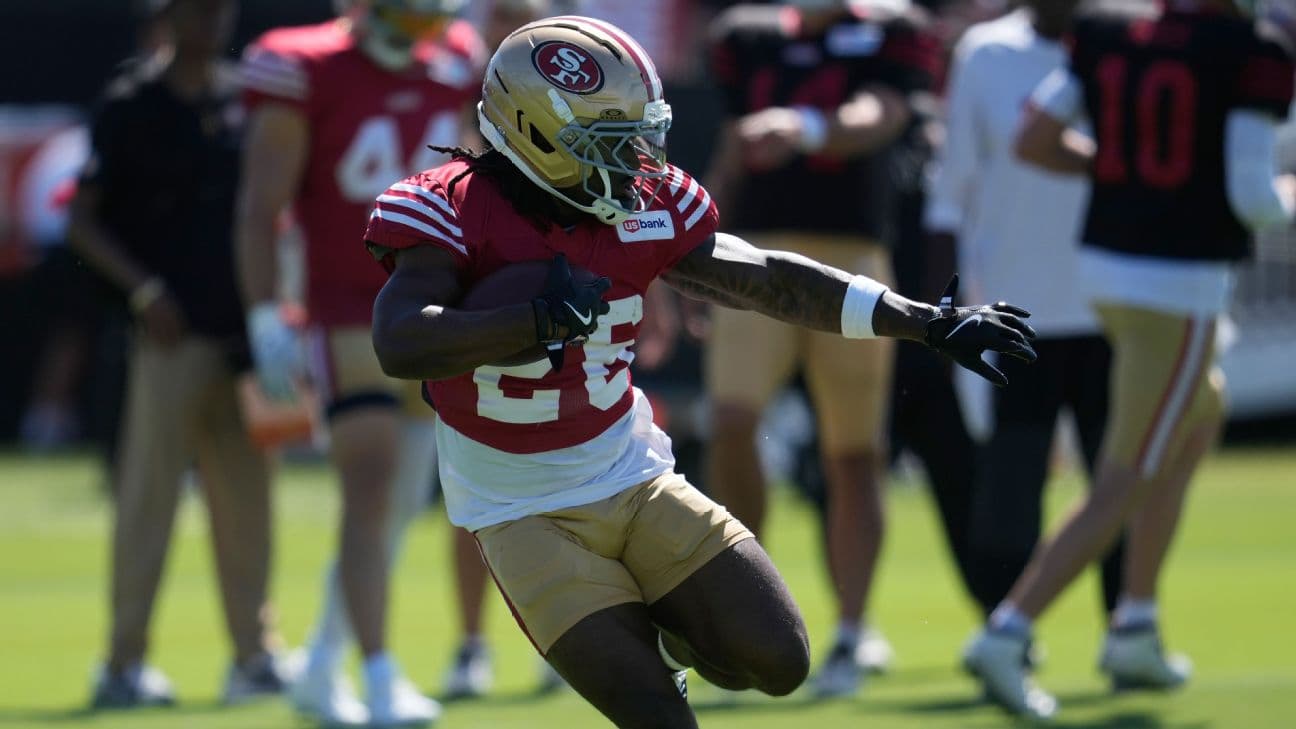
Kaelon Black carried the ball 14 times in San Francisco's 27-7 win over the Rams at the Melbourne Cricket Ground, and for long stretches of the first half the rookie was the 49ers' primary running back. Christian McCaffrey finished with 15 touches for 88 yards, a perfectly respectable line, but the distribution underneath it is the story fantasy managers woke up to on Thursday morning.
Through the first four drives, the snap counts were 16 for Black and 15 for McCaffrey. In the first half Black had eight total touches to McCaffrey's seven, and on the ground the split was seven carries to three. Kyle Shanahan did not announce a committee before the game. He simply played one.
What the usage actually showed
The important detail is not that Black got work. Rookies get work in blowouts, and San Francisco led comfortably for most of the second half. The important detail is when he got it. Black was on the field early, in competitive game script, on first and second down, and he was the back taking the early-down carries that have historically defined McCaffrey's value.
That distinction matters because McCaffrey's fantasy case has never rested on efficiency. It rests on volume, and specifically on the kind of volume where he is the only back who plays. Any week where a second back takes 14 carries is a week where the ceiling on McCaffrey's rushing production is capped before the game starts.
There is a benign reading. McCaffrey is 30 years old, is coming off a preseason in which he missed practice time with what the 49ers described as general tightness, and was playing a game roughly 10,000 miles from home on a short turnaround. Managing his early-season workload in a game San Francisco controlled is exactly what a coaching staff protecting an asset would do. The 49ers did not need him in the fourth quarter and did not use him there.
There is also a less benign reading. Shanahan has a long history of finding and promoting cheap running backs, and Black, who arrived from Indiana, spent the preseason building a case. Coaches do not hand a Week 1 workload to a rookie they are not planning to use again.
The receiver room lost a body
The other Melbourne development that will shape the 49ers' offense is the injury to De'Zhaun Stribling, who led San Francisco's wide receivers in snaps before leaving the game. The 49ers have been thin at the position all summer, and Mike Evans, who caught six of seven targets for 49 yards and a touchdown in his first game with Brock Purdy, is now carrying an even larger share of the passing game than the team drew up.
A thinner receiver room usually pushes targets toward the backfield, which cuts against the pessimistic McCaffrey read. His receiving role is the part of his profile least likely to be handed to a rookie. If San Francisco is managing his carries but keeping his routes, he remains a top-12 fantasy back. If the receiving work also drifts, the calculation changes.
One more piece of context on the offense: Purdy was not sacked on 34 pass attempts. An offensive line that clean produces efficient neutral-script football, which is the environment where a running back rotation is easiest to sustain because neither back has to grind out a comeback.
Fantasy fallout
Black is the highest-priority waiver claim of the week in leagues where he is unowned, and it is not close. A rookie who out-carried a future Hall of Famer in Week 1 is either the handcuff to one of the game's most injury-prone stars or a standalone flex, and both outcomes justify a significant bid. In leagues using FAAB, this is a double-digit percentage claim, not a one-dollar flier.
McCaffrey managers should not panic-sell into the news cycle. The trade market will price him off the snap count and the age, and the return will be poor relative to what he still is. He produced 88 yards on 15 touches in a game where he was managed, which is a fine baseline. Hold him, start him, and watch Week 2 closely.
The tell to watch is the early-down split in a close game. If San Francisco plays a competitive fourth quarter and Black is still taking first-down carries, the committee is real and McCaffrey's weekly range drops to a low-end RB1 with volatile outcomes. If McCaffrey handles that situation alone, Melbourne was workload management and nothing more.
The Verdexed model take
Running back models weight opportunity share far more heavily than efficiency, because carries are stable week to week and yards per carry is not. A back who loses even 25 percent of his early-down work loses more projected fantasy points than a back who drops a full yard per carry. That is why a snap split is worse news for McCaffrey's projection than a bad rushing line would have been.
The model reads San Francisco's backfield as a two-man committee with McCaffrey holding the passing-down role and a slight edge on early downs, which lands him near the back of the RB1 tier rather than inside the top five. Black projects as a flex-viable back with weekly RB2 upside in any week San Francisco is favored by a touchdown or more, which, given this offense and this offensive line, will be a lot of weeks.
For betting purposes, the same logic applies to rushing props. A backfield that splits work makes both backs' rushing yardage lines harder to clear on the over, and the market has not fully repriced McCaffrey's number after one game. The cleaner angle is on team rushing totals rather than either individual.
What to do this week
Claim Black. Start McCaffrey. Do not trade either one at this week's price, because the market is reacting to a single game played in an unusual environment and the information is incomplete.
And set a reminder for Sunday afternoon in Week 2. One game is a data point. Two games of the same split is a role.