Joel Embiid Had a Normal Offseason and Fantasy Drafts Have to Decide
By Verdexed NBA Desk
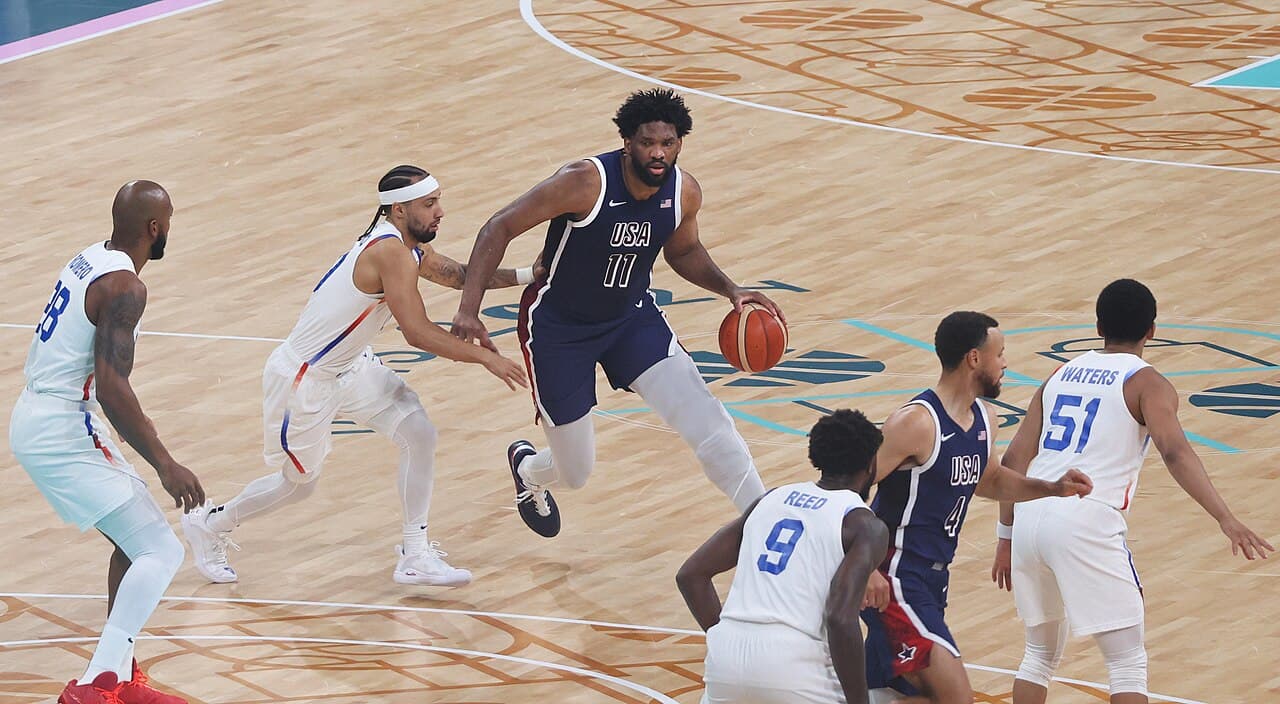
The 76ers' front office has spent August delivering a message it has not been able to deliver in several years: Joel Embiid is healthy, has trained without restrictions, and did not enter this offseason with a procedure scheduled. Team executives have described him as lifting and working in the gym normally, in a good place mentally, and on track for training camp in late September.
That is a meaningful update, and it arrives just as fantasy drafts begin. It is also the exact update that has preceded several Embiid seasons that ended in the training room, which is why the question for managers is not whether the news is good. It is how much a good August is worth.
What last season actually cost
The 2025-26 season was a compounding series of problems rather than one catastrophic injury. Embiid dealt with an oblique strain, then required an emergency procedure for appendicitis shortly before the playoffs, and then played through multiple ailments in a second-round series. None of those are chronic conditions. All of them cost games.
That distinction is the crux of the fantasy argument. A player with a degenerative knee problem carries a different risk profile from a player who had bad luck with unrelated injuries in consecutive seasons. Embiid's history contains both, which is why reasonable projections for his games played this season range from the high 40s to the mid 60s depending on how much weight the modeler puts on the last three years versus the last five.
The absence of a scheduled offseason procedure is the single most encouraging detail in the update, because Embiid's recent summers have generally included one. A full offseason of unrestricted conditioning is the input most correlated with availability for big men with his injury history.
Fantasy fallout
Embiid's per-game production, when he plays, has been the best in fantasy basketball at the center position and among the best at any position. Nobody disputes that. The entire debate is games played, and the entire debate is therefore about format.
In head-to-head category leagues with weekly matchups, Embiid is worth a first-round pick if he falls there, because a healthy Embiid wins blocks, points, free-throw percentage and rebounds by himself, and because a missed week can be absorbed by a deep bench. The variance cuts both ways but the ceiling is championship-winning.
In roto leagues, he is a different asset entirely. Roto punishes missed games mechanically across every counting category, and a 50-game season from a first-round pick is close to unrecoverable. Take him only at a price that already includes a durability discount, which in most roto formats means the back half of the first round or later.
In points leagues with daily lineups, he is somewhere in between, and the deciding factor is your bench depth. If you can stream a replacement center on the nights he sits, the risk is manageable.
The practical rule: do not draft Embiid as your only source of blocks or your only elite big. Build the roster so that his absence is a downgrade rather than a hole.
The Verdexed model take
Our projection carries Embiid at a games-played figure well below a full season, in line with his three-year average rather than his career average, and still ranks him among the most valuable per-game assets in the league.
The output that matters for draft strategy is not his overall rank but the spread. Embiid's projected finish has one of the widest distributions of any player in the top 30: a healthy season places him in the top three, and a season at his recent availability rate places him outside the top 40. Very few players carry that much variance, and variance is a feature in some formats and a defect in others.
On the betting side, Philadelphia's win total is the market that most reflects this uncertainty, and it is priced with an appropriate haircut. The more interesting number is Embiid's regular-season games-played prop, if a book posts one. Those lines are typically set close to the recent average, and a genuinely unrestricted offseason is the kind of input that argues for the over, because the base rate for big men who complete a full summer of conditioning is materially better than the base rate for those who do not.
His MVP price is a separate matter. Awards voting now effectively requires a games-played threshold, and any Embiid MVP ticket is really a bet on availability rather than on production. At the prices those tickets typically carry, that is a reasonable lottery ticket and a poor core position.
What to watch
The first checkpoint is the start of camp in late September. A player who participates fully in the first week of practices, in contact work, has cleared the most predictive hurdle available before the season.
The second is preseason minutes. Philadelphia has managed Embiid's exhibition workload aggressively in recent years, and that will happen again. What matters is not how many minutes he plays but whether the club describes the limitation as planned management or as a response to something.
The third is the first back-to-back of the regular season. Embiid's availability on the second night of back-to-backs has been the clearest leading indicator of how a season is going to go, and the answer usually arrives in the last week of October.
Draft him for what he is: the highest per-game asset in the sport at a discount the market has already applied, in a season where, for once, the summer went according to plan.