 NFL2026-09-06
Jeremiyah Love's High Ankle Sprain Puts the Cardinals Opener in Doubt and Tyler Allgeier in the Lineup
By Verdexed NFL Desk
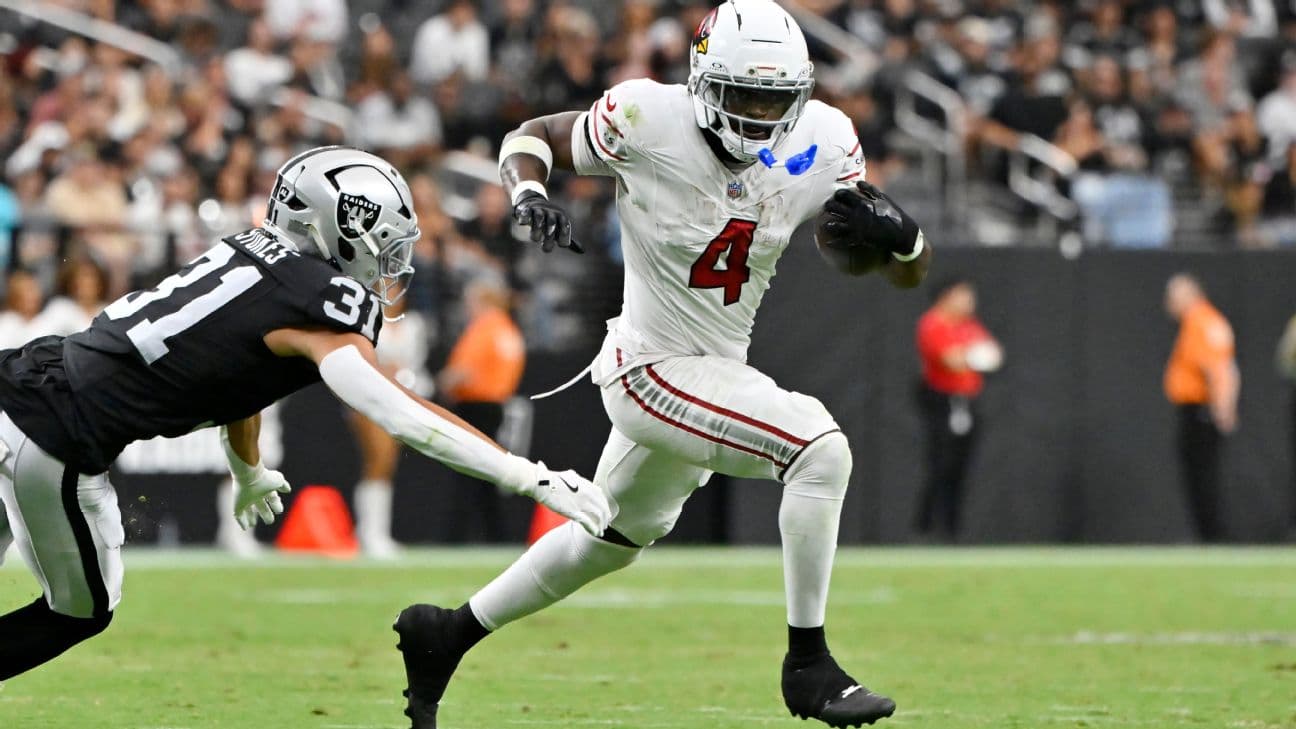
Jeremiyah Love's status for Arizona's September 13 opener against the Chargers remains genuinely unresolved. The rookie running back suffered a high ankle sprain in a preseason game against the Raiders, missed the Cardinals' final two exhibitions, and has been described by head coach Mike LaFleur as progressing rather than as ready. Arizona is hoping he plays. Hoping is not the same as expecting.
The one piece of good news is structural. Love's injury did not require surgery, which removes the worst-case outcome that would have cost him most of his rookie season. High ankle sprains are still the injury type that most often gets underestimated in September, because the recovery is not linear and because backs who return early frequently return without the burst that made them valuable.
Why this matters more than a normal rookie injury
Arizona's backfield was already reorganized before Love got hurt. James Conner was placed on injured reserve with a foot injury and a designation to return, which means he must miss a minimum of four games. That removed the veteran who had been the Cardinals' primary back and left the job to be sorted between a rookie and a bruising veteran backup.
The team's first published depth chart listed Tyler Allgeier as the No. 1 running back with Love second, and Bam Knight further down. Depth charts released in August are notoriously conservative, and teams routinely decline to list a rookie as a starter until he has taken a regular-season snap. But the ankle changed the practical question from who was going to win the job to who is going to be available for it.
If Love is out or limited, Allgeier is the Cardinals' lead back against Los Angeles by default. Allgeier is a known quantity: a downhill runner who has produced when handed volume and who does not need a ramp-up period. He is not a receiving back, which caps his ceiling in full-point-per-reception formats, but a lead early-down role in a functional offense is startable.
Fantasy fallout
The market has been slow to move here, and that is the exploitable part. Love was drafted through most of the summer as a rookie with a clear path to touches, and his average draft position reflected that. The injury news has trimmed the price but has not repriced the risk, because drafters look at the depth chart and see a first-round talent rather than a player who has not practiced fully in weeks.
Allgeier is the actionable side of the trade. In leagues drafting this weekend, he is available late and carries a realistic path to being the Cardinals' primary back for the opener and potentially longer. In leagues already set, he is a waiver-wire priority in any format where the roster has room, and the claim should go in before the Friday injury report rather than after.
Managers who already roster Love should hold. The absence of surgery and the coach's progression language both point to a player who is available in September rather than October, and a rookie who misses one game because of an ankle is not a rookie whose season is compromised. What Love managers should do is add Allgeier as insurance if they can, which turns a single uncertain asset into a covered position.
Bam Knight is the third name to know and the one worth almost nothing until something else happens. He is a deep-league stash only.
The betting angle
Arizona opens at home against the Chargers on September 13, and the running back situation is exactly the kind of variable that moves rushing prop markets late in the week rather than early. If Love is ruled out on Friday, Allgeier's attempts line will be posted with limited history behind it, which is where soft numbers appear.
The team-level implication is smaller than the player-level one. Arizona's offense runs through the passing game, and the Cardinals recently locked up Michael Wilson on an extension that confirmed a two-man passing structure alongside Trey McBride. A backfield reshuffle changes who gets the carries far more than it changes the Cardinals' team total.
The Verdexed read
Verdexed's injury framework separates soft-tissue and low-ankle injuries, which follow reasonably predictable timelines, from high ankle sprains, which do not. High ankle sprains produce a wide distribution of return dates and a wider distribution of post-return effectiveness, and the model discounts both availability and per-touch production for several weeks after the return, not just up to it.
Applied to Love, that means the correct projection is not a binary in or out for Week 1. It is a reduced expectation across the first month even in the scenario where he suits up on September 13. The Cardinals have every incentive to protect a first-year back they intend to build around, and a team with a competent veteran alternative and a four-week Conner absence to manage has no reason to rush.
What to do in your league
Add Allgeier wherever he is available, and do it before the injury report lands. Hold Love if you have him, and do not pay a healthy-rookie price for him on the trade market. Treat Knight as a name to file rather than a name to roster.
If you are drafting today, the correct move is to let someone else take Love in the round where his talent belongs and take Allgeier several rounds later. That is the same backfield at a fraction of the cost, with the added benefit that the veteran is the one who is actually practicing.