 NFL2026-08-26
Ja'Marr Chase Hyperextended His Knee and Said He Could Play Tomorrow
By Verdexed NFL Desk
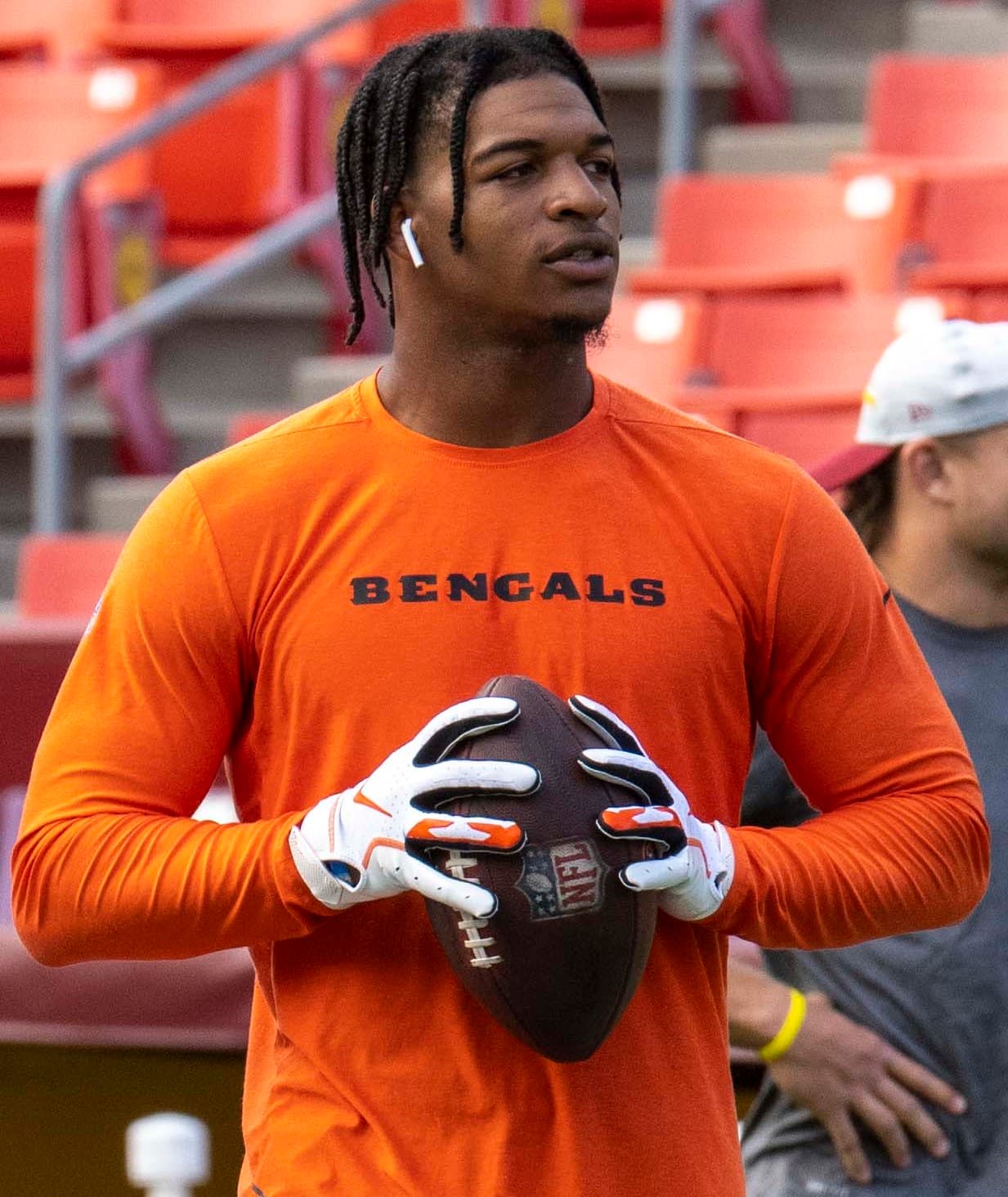
Ja'Marr Chase left a Cincinnati Bengals practice this week after landing awkwardly at the end of a deep route and grabbing at his left knee. He walked off under his own power, spoke with trainers on the sideline, and did not return to the session. Afterward, Chase told local media the knee was hyperextended, that he felt he could have gone back in, and that the team pulled him as a precaution.
For a fantasy market that has spent all of August absorbing receiver injuries, this was the scare that did not become a story. It is worth understanding why, and what it changes about how you should be drafting the top of the position.
What actually happened
Chase went up the field on a deep route, came down awkwardly, and stayed on the ground briefly. He got up on his own, and reporting from the practice field indicated he remained on the field afterward rather than heading inside for treatment. ESPN's Bengals beat reporting noted he was not receiving treatment while practice continued.
That combination of details is the useful part. Players who walk off, stay on the field, and are not immediately routed to the training room are almost never dealing with structural damage. A hyperextension is a joint moving past its normal range, and while it can involve ligament strain, the presentation here does not match a serious knee injury.
Chase's own framing, that he would play if there were a game the next day, is not medical clearance. It is, however, consistent with everything observable.
Why the Bengals will still be careful
Expect Cincinnati to limit Chase's practice reps over the coming days, and expect him to sit the preseason finale. That is not a signal of concern, it is standard operating procedure for a team whose entire offensive ceiling runs through one player, in the final week before roster cuts, in a game that does not count.
The trap for fantasy managers is misreading precaution as diagnosis. A limited practice designation in late August for a player who was already never going to play in a preseason game tells you nothing. The designation that matters is the first official injury report of the regular season, and Cincinnati will not file one for another two weeks.
Fantasy fallout
Chase's draft position should not move. He is a first-round receiver whose case has never depended on health history, and a single-practice hyperextension that produced no treatment and no timeline is not a reason to slide him behind receivers with worse situations.
Where this does matter is at the margins of your draft board. Every August injury scare produces a small window in which a top-12 player gets discounted by managers who saw a headline and did not read the follow-up. If you are drafting in the next few days and Chase falls even half a round, that is the market paying you to have read the second paragraph.
The secondary read is on Tee Higgins and the rest of the Cincinnati pass catchers. Their value is partly a function of Chase drawing coverage, and the version of this offense in which Chase misses time is not one where the other receivers simply absorb his targets at full efficiency. Defenses reallocate. That is why "handcuffing" a receiver rarely works the way it does at running back.
The Verdexed model take
Verdexed's injury model separates availability risk from performance risk, and it only moves a player's projection when the reported mechanism, the observed response, and the team's practice behavior all point the same direction. Here they do not. The mechanism is minor, the response was a player who stayed on the field, and the team's behavior is indistinguishable from what it would be in a healthy week.
The model's projection for Chase is unchanged. What did change is the confidence interval around Cincinnati's team total, and only very slightly, because any late-August contact event on a player who accounts for this large a share of an offense's projected production widens the distribution even when the expected value holds.
That is the sophisticated way to hold both ideas at once. Nothing about Chase's expected 2026 got worse. The range of outcomes got marginally wider for about a week, and it will narrow again the moment he takes full-speed team reps.
The betting angle
The Bengals open the season in one of the highest-total games on the Week 1 board, with the Tampa Bay matchup posted at the top of the slate. If that number softens on Chase injury noise, it is a buy. Totals move on skill-position availability, and the market is not always fast to distinguish between a player who is questionable and a player who took a precautionary day off in August.
Chase's season-long receiving yardage and touchdown markets are the other place to watch. Those lines are set months in advance and adjusted slowly, and a brief scare occasionally produces a stale number on the over.
What to do in your league
Draft him where you were going to draft him. If you are in a league with managers who react to headlines, quietly note that Chase may come off the board a few picks later than his ranking, and be ready to take him.
If you already roster Chase in a dynasty or best-ball format, do nothing. There is no trade to make here, because anyone willing to buy at a discount is pricing in a risk that the evidence does not support, and anyone willing to sell at full price is not offering you a discount.
What's next
The concrete checkpoints are simple. Watch whether Chase is a full participant when Cincinnati returns to the practice field, and watch the first regular-season injury report. If he practices in full and appears on no report, this was a one-day story. If he shows up as limited into the season's first week, revisit.
Until then, the correct read on a player who hyperextended a knee, walked off, skipped treatment, and said he would play tomorrow is that nothing changed.