 NHL2026-07-27
Florida's Remade Top Six After the Brady Tkachuk Trade: The Fantasy Order in a Loaded Lineup
By Verdexed NHL Desk
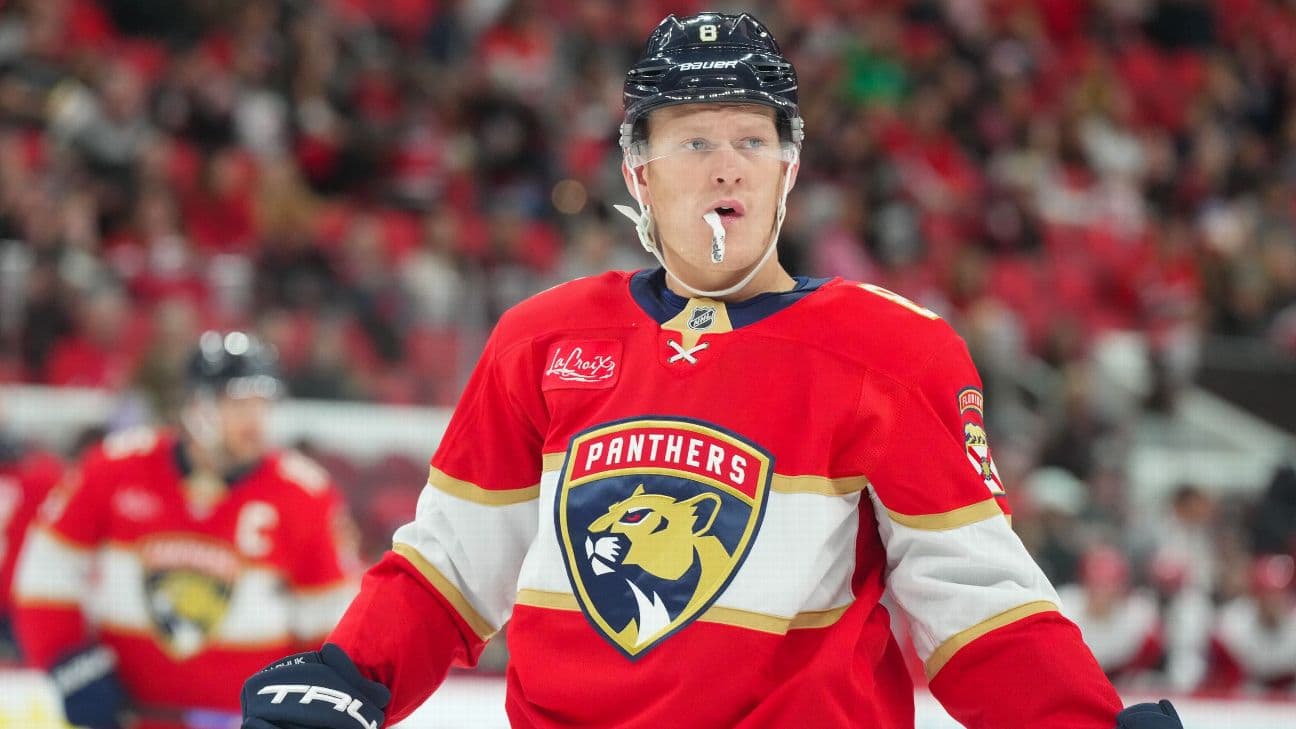
The Florida Panthers acquired Brady Tkachuk from the Ottawa Senators for a package built entirely of draft capital: the ninth and 25th picks in the 2026 draft, a conditional first-rounder in 2029, and a second-round pick in 2027. No roster players went the other way. The back-to-back champions bought a first-line power forward with pure futures, and their general manager has since indicated the club is not finished making moves.
For fantasy managers heading into 2026-27 drafts, this is the most important forward-group change in the league, and the interesting part is not whether Florida is good. It is how a lineup this deep distributes its scoring.
The trade, and why Ottawa made it
Tkachuk gave Ottawa a four-team list he would accept: Florida, Carolina, Minnesota and Vegas. The reporting indicates he had also told the Senators he had no plans to re-sign once his contract expired, which is the piece that forced the front office's hand. Ottawa's decision-makers have said publicly that they do not intend for the club to take a step back.
Tkachuk carries two years remaining at $8.2 million annually, which is what made him worth a package of premium picks rather than a rental price. He watched his brother win consecutive Stanley Cups and, by his own account, wanted the chance to compete for one himself.
The depth problem for fantasy
Florida's forward group is now arguably the deepest in hockey, and depth is a double-edged input for fantasy production. The upside is obvious: more talent means more goals, more power-play efficiency, and more favorable matchups because opponents cannot match lines against everyone.
The downside is dilution. A team can only assign so much first-unit power-play time, and Florida now has more players who deserve it than slots to award. Power-play production is where fantasy points concentrate, and second-unit time is worth a fraction of first-unit time.
The specific combination that has drawn the most attention pairs the Tkachuk brothers with Sam Bennett at center, a line that would be genuinely difficult for any defensive pairing to handle. If that trio holds and draws first-unit power-play time, all three become premium fantasy assets. If Florida instead splits the brothers across two lines to spread scoring, the individual ceilings compress while the team's floor rises.
Coaching staffs on championship teams tend to prioritize the second option. That is the risk fantasy managers should be pricing.
How to value the pieces
Brady Tkachuk should be drafted for what he has always provided: goals, shots, hits and penalty minutes in volume. His multi-category profile is what makes him valuable, and none of those inputs depend on where he slots in Florida's lineup. He will shoot and he will hit regardless. The upgrade is in the quality of his linemates and the likelihood of playing meaningful games in April.
Matthew Tkachuk is the trickier valuation. Adding a second high-volume forward to the same lineup does not typically reduce an established star's production, but it can shift his deployment. Draft him at his established price rather than at a premium for the reunion narrative.
Aleksander Barkov remains the organizational center of gravity and a two-way asset whose value has never been purely offensive. A deeper forward group is a mild negative for his raw point totals and a positive for his plus-minus and ice-time efficiency.
Sam Bennett is the leverage play. If he centers the Tkachuk line, his point production takes a step forward from a price that has never reflected first-line usage.
The Verdexed model take
Our projection system allocates team-level expected goals across a lineup using ice time and power-play deployment rather than raw talent, and Florida's model output illustrates why deep teams are a mixed bag for fantasy. The team's total projected goal output is at or near the top of the league. The projected output for its individual leading scorer is not correspondingly at the top, because the distribution is flatter than it is on a team with a clear top line and nothing behind it.
The practical translation: Florida players are excellent bets to be efficient and to be productive, and poor bets to lead the league in anything. That is the profile you want in a category league with per-game rate considerations and the profile you want less in a points league where a single dominant scorer wins weeks.
Our model treats the line-combination question as unresolved and carries a wide distribution for Bennett specifically, since his projection swings more on deployment than any other Panthers forward.
Betting angle
Florida's Stanley Cup and division markets have already absorbed this trade, and there is no stale price left. The team's regular-season point total is the more interesting market, because championship teams with deep rosters frequently manage workload through the regular season in ways that suppress point totals relative to talent.
Individual scoring props for Panthers forwards are where the market is most likely to be inefficient. Books price stars off prior production, and the entire lineup's deployment is about to change.
What's next
Florida's general manager has indicated the club is not done, which means the forward group described here may not be the one that opens the season. Any further addition compresses the fantasy ceilings further.
Watch training camp line rushes. That is the only reliable source of information about whether the Tkachuk brothers actually play together, and it will be available weeks before most fantasy drafts.