 NHL2026-09-05
Filip Gustavsson Will Miss the Start of the Wild's Season and Jesper Wallstedt Has the Crease
By Verdexed NHL Desk
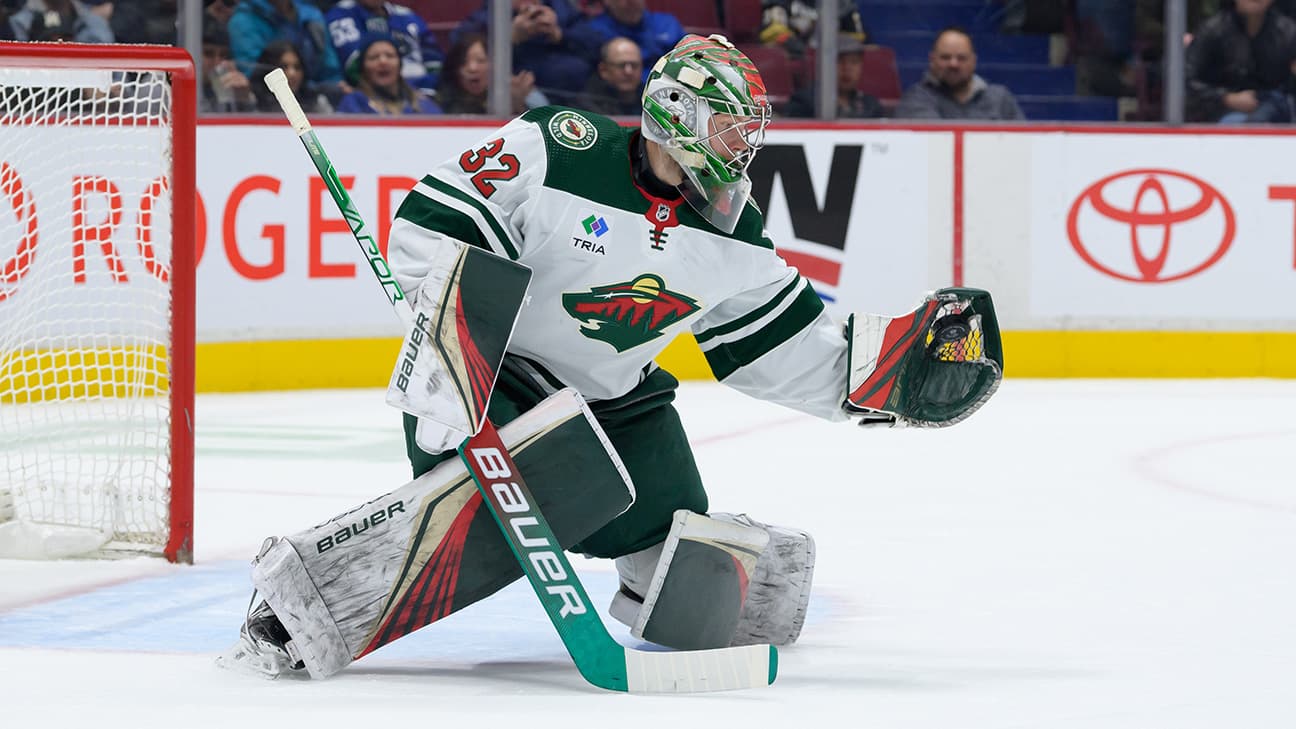
Filip Gustavsson remains in physical therapy following offseason hip surgery and will not be ready for Minnesota Wild training camp, putting his return somewhere in the first month of the 2026-27 season. The team's general manager indicated he would not expect Gustavsson back in the opening couple of weeks, and when asked whether the goaltender might be available roughly a month into the season, allowed that it was possible. Gustavsson has had no setbacks and remains on his original timeline.
That leaves Jesper Wallstedt as the Wild's starting goaltender to open the season, a job he has already effectively won once. For fantasy managers about to draft, this is the clearest starting-goalie situation resolution of the offseason, and the market has not fully priced it.
Wallstedt already took the job when it mattered
Head coach John Hynes turned to Wallstedt as Minnesota's starter for the 2026 playoffs, and the 23-year-old delivered. He went 4-2 with a .924 save percentage and a 2.05 goals-against average in the opening round against Dallas, numbers that would be strong for an established starter and are exceptional for a goaltender making his postseason debut.
Playoff sample sizes are small and should not be treated as predictive on their own. What matters more is the decision that preceded them. A coaching staff choosing a young goaltender over an established starter in the playoffs is making a statement about who it believes gives the team the best chance to win, and that belief carries into the following season.
Gustavsson's absence removes the only obstacle to Wallstedt opening the year as the unambiguous number one.
The contract angle nobody is talking about
Wallstedt is in the final year of a two-year contract and will be a restricted free agent at its conclusion. That is a meaningful fantasy input, not a piece of trivia.
Goaltenders playing for their next contract in a season where they have been handed the starting job tend to get every opportunity to run with it. There is no service-time management, no load-management philosophy, and no incentive for the team to split starts once the incumbent returns unless performance forces it. Wallstedt has both the opportunity and the motivation to take 55-plus starts.
Fantasy fallout
Wallstedt should be drafted as a low-end starting goaltender in twelve-team leagues and a solid one in deeper formats, and his cost has not caught up to his situation because Gustavsson's name is still attached to the Wild crease in most rankings.
The specific case: a young goaltender with strong underlying numbers, a coaching staff that already trusted him in the postseason, an incumbent who will miss at least the season's first several weeks, and a contract year. That is close to the ideal profile for a goaltender you draft late and start immediately.
The risk is what happens when Gustavsson returns. Minnesota's general manager has indicated Gustavsson should see a normal share of work once healthy, which means the best-case outcome for Wallstedt managers is a hot start that makes a timeshare untenable, and the worst case is a split that damages both goaltenders' fantasy value. Goalie tandems are the fastest way to waste a roster spot.
Gustavsson himself is a stash rather than a draft-and-start asset. If you carry three goaltenders, taking him in the final rounds is reasonable, because a healthy Gustavsson has been a legitimate starter and the November version of this situation could look nothing like the October version.
The broader Minnesota context is worth noting. The Wild acquired Quinn Hughes and have been working toward an extension with him, which improves the team in front of whichever goaltender is playing. A better defensive structure lifts save percentage and win totals for both.
The Verdexed model take
Verdexed's goaltender projections weight three things above all else: projected starts, team defensive quality measured by expected goals against, and the goaltender's own save-percentage baseline adjusted for shot quality.
Wallstedt's projection improves sharply on the first input and modestly on the second. The model now assigns him a starts distribution centered in the mid-40s for the season, with a meaningful upper tail if he plays well enough in the first month to hold the job outright. That alone moves him from a streaming option to a rosterable starter in standard formats.
The model is more conservative on his save percentage than his playoff numbers suggest, and deliberately so. Six playoff games against one opponent is not a sample from which to project a season, and the model regresses it heavily toward his regular-season and minor-league baseline. The result is a goaltender projected as league-average in quality with above-average volume, which in fantasy terms is a perfectly good number-two goaltender.
Betting angle
Minnesota's season win total is the market most affected here, and the effect is smaller than the headline suggests. Goaltending changes move team win totals less than fans expect, because the gap between a good starter and an average one is worth only a few wins across a full season, and the Wild's roster additions on defense offset a portion of the downgrade.
The more interesting market is Wallstedt's individual awards and games-started props, if available. A goaltender handed the job in September, in a contract year, on a team that has improved its blue line, is a live candidate for the kind of counting-stat totals that these markets often price conservatively.
What to do in your draft
Move Wallstedt up your goaltender board and take him a round or two before consensus, because his situation is better than his name recognition. Draft Gustavsson only in leagues deep enough to carry three goaltenders, and treat him as a November asset rather than an October one.
And watch the first two weeks closely. If Wallstedt opens strong, this stops being a timeshare question and becomes a case of a young starter who took a job and kept it. If he struggles, Gustavsson's return date suddenly becomes the most important thing on the Minnesota calendar.