 NFL2026-08-27
DJ Moore Is Josh Allen's No. 1 Receiver and Buffalo Finally Has a Target Hog
By Verdexed Fantasy Desk
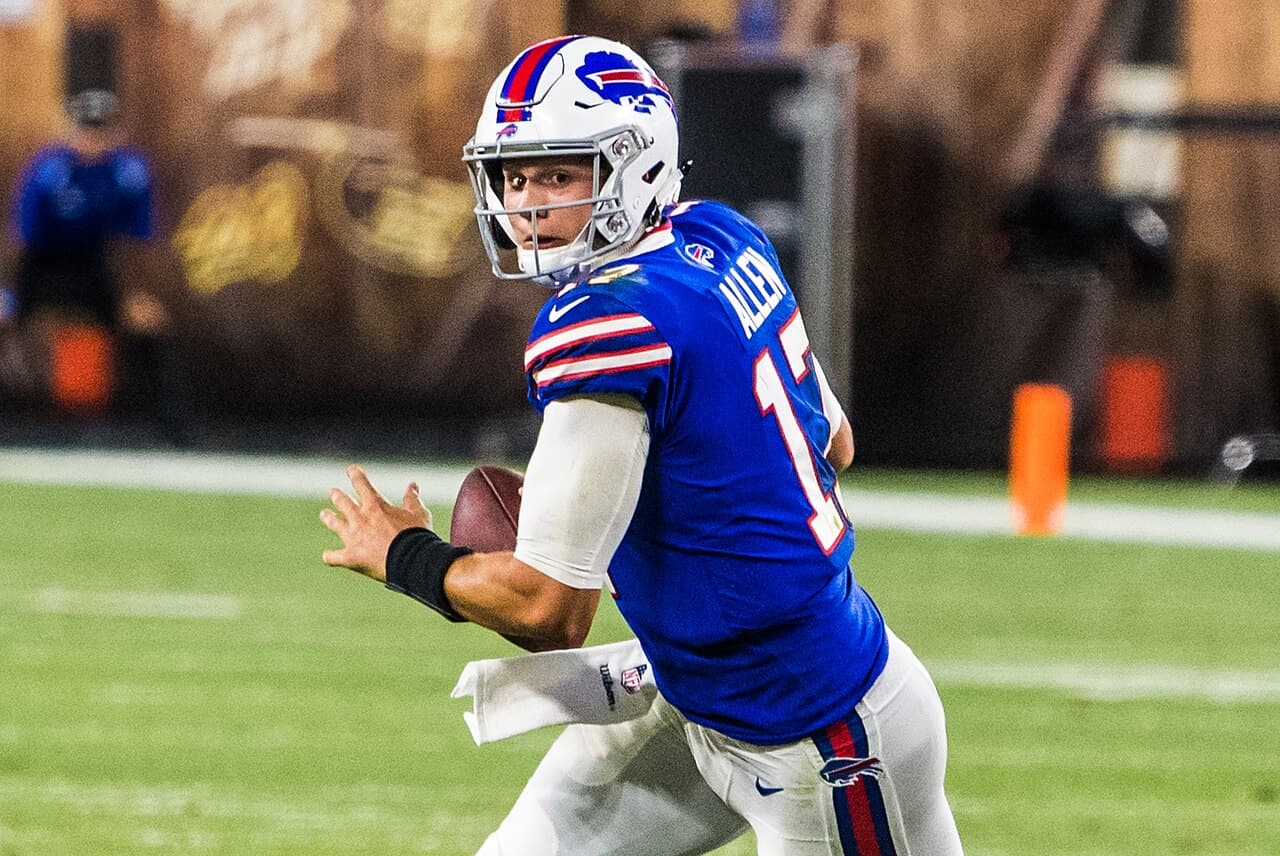
Buffalo acquired DJ Moore from Chicago for a second-round pick this offseason, and with the opener less than two weeks away, he has spent the entire summer at the front of the Bills receiver depth chart. That is the single most consequential change to the Josh Allen passing game in years, and it reshapes the fantasy value of every pass catcher on the roster.
Moore had a brief scare in Buffalo's preseason opener against Carolina, appearing to hurt his leg after an 18-yard reception near the left sideline. He finished that outing with three catches for 61 yards across two series with Allen. Bills coaches said afterward that Moore was fine, that he had been scheduled to come out at that point in the drive regardless, and that he was good to go. He has not been listed with anything meaningful since.
Why this trade mattered more than the price suggested
A second-round pick is a modest cost for a receiver of Moore's caliber, and the reason it was available is that Chicago was in a different phase of its roster cycle. Buffalo's calculation was simpler. Josh Allen has carried an offense without a true alpha receiver for most of his prime. Khalil Shakir has led the Bills in targets and receptions each of the last two seasons, which is a compliment to Shakir and an indictment of the room around him. Shakir is an excellent slot player. He is not a player defenses game-plan to erase.
Moore is. He wins from the outside, from the slot, on screens, on digs, and on the intermediate crossers that Buffalo's offense leans on. He has posted 1,000-yard seasons with a wide range of quarterback play, which is the most reliable signal available that his production is not a function of a specific situation. Putting that player with Allen is the kind of upgrade that changes an offense's target distribution rather than just adding a body.
The depth chart, as it stands
In three-receiver sets, the Bills have lined up Moore and Joshua Palmer on the outside with Shakir in the slot. Keon Coleman is the fourth in that grouping and has been described by the team with confidence, but the alignment reality is that he is competing for the snaps that remain after three other receivers are accounted for. Buffalo did not draft a receiver before the fourth round this year, which tells you the front office believed the room was already fixed.
For fantasy, the ordering is what matters. Moore is the target leader. Shakir keeps the volume that comes with playing the slot in an Allen offense, but the ceiling shrinks because he is no longer the receiver who gets the manufactured targets when a drive stalls. Palmer is a low-volume outside player whose fantasy relevance depends almost entirely on touchdowns. Coleman is a bet on talent and a bet that one of the three ahead of him gets hurt.
Fantasy fallout
Moore should be drafted as a WR2 with WR1 upside. The volume case is straightforward: he is the best receiver on a team whose quarterback is a perennial MVP candidate and whose offense generates red-zone trips at an elite rate. The concern is the same one that has capped every Bills receiver since Stefon Diggs left, which is that Allen distributes the football broadly and runs it himself near the goal line. Buffalo has finished with a genuinely dominant fantasy receiver exactly once in Allen's career.
That risk is real, but it is priced in. Moore has consistently gone at a discount relative to receivers with comparable projected target shares, precisely because drafters remember what Buffalo's offense did to Diggs' touchdown equity in his final Bills season. Our view is that the discount overshoots.
Shakir is the player to fade. His per-target efficiency has been outstanding, but efficiency does not survive a target-share reduction. He should be treated as a WR4 with PPR-specific appeal rather than the weekly starter he was last year.
Coleman is the late-round dart. If Moore or Palmer misses time, Coleman is one snap from an outside role in a high-scoring offense, and his size makes him a natural red-zone target. That is exactly the profile you want in the final rounds.
The Verdexed model take
Our target projections give Moore roughly a quarter of Buffalo's total targets, with Shakir in the high teens and Palmer and Coleman splitting the remainder. That puts Moore's receiving yardage projection comfortably inside the top 20 at the position and his reception projection near the top 15, with touchdown variance being the swing factor between a WR2 and a WR1 finish.
The model likes Buffalo's team total as much as any offense in the AFC, which is the underlying reason we are more optimistic on Moore than the market. The Bills project to be among the league leaders in offensive drives that reach the opponent's 30-yard line, and Moore is the receiver most likely to be on the field for all of them.
On the betting side, our board flags Moore's season-long receiving yardage market as the most attractive Bills receiving prop, and Shakir's as the one worth fading. Anyone building season-long correlated positions on Buffalo should be pairing an Allen passing-yards position with Moore rather than with the rest of the room.
What to do in your league
Take Moore in the third or fourth round in a 12-team league and do not overthink the Bills tax. He has the target profile of a receiver drafted a round earlier.
Move Shakir down. He is now a complementary piece in a room with a genuine No. 1, and his 2025 usage will not repeat.
If you are stacking Buffalo in DFS or in best-ball, the Moore correlation with Allen is the play. Buffalo's offense has never had a receiver this clearly positioned as the primary read, and the ownership on Moore will lag his role for at least the first month of the season.