 NFL2026-08-26
Deshaun Watson Won the Browns Job and Inherited a Receiver Room Built on Rookies
By Verdexed Fantasy Desk
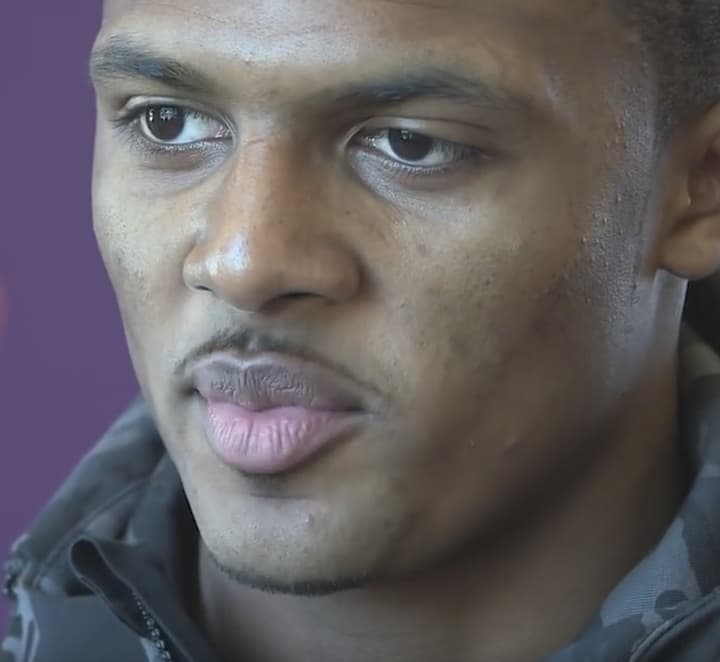
The Cleveland Browns named Deshaun Watson their Week 1 starting quarterback this week, ending a four-way competition that included Shedeur Sanders. The quarterback decision has taken up all the oxygen in Cleveland, and understandably so. The more consequential fantasy question is the one nobody is asking: who is Watson going to throw to.
The answer is a receiver room where one player has an established NFL track record and the rest are recent draft picks trying to establish one.
The room as it stands
Jerry Jeudy is the veteran and, per the team's unofficial depth chart, remains the primary option on the perimeter to open the season. Behind him, Cleveland is leaning on youth. KC Concepcion has been working in the slot, and Denzel Boston, selected 39th overall in the 2026 draft, has been sitting no higher than third in the pecking order. Isaiah Bond, Cedric Tillman, and others round out the group.
At tight end, Harold Fannin Jr. is the name that matters for fantasy purposes, and he has been discussed around the league as a mid-range TE1 rather than a dart throw.
Boston did show up in the preseason opener against Chicago, drawing a pair of targets and converting a roughly 15-yard catch and run from Watson. That is a small sample and it is preseason, but it is at least evidence that the connection exists.
Why the depth chart may not hold
Projections around the Browns' room suggest the season-opening order and the season-ending order will look different. Multiple public evaluations expect Boston to finish the year as Cleveland's top receiver, with Concepcion second and Bond third, which would mean Jeudy is currently sitting atop a depth chart he is not projected to hold.
That gap between the current order and the projected order is the entire fantasy opportunity here. Markets price the current order. Rosters that win price the projected one.
The complicating factor is Watson himself. He is making his first regular-season start since 2024, when he tore an Achilles that he subsequently re-tore. There is no recent data on what this version of him looks like, which means there is no reliable data on the receivers who play with him either.
Fantasy fallout
Jeudy is the safest of the group and the least interesting. He should be projected as a low-end WR3 with a defined role, and he is a player you draft for stability rather than upside. If Cleveland's offense functions at all, he catches passes. If it does not, his ceiling is capped anyway.
Boston is the target. A second-round rookie who is projected to finish the season as the No. 1 receiver, currently priced as the third option, is exactly the shape of asset that returns multiples on a late-round pick. He is a stash in redraft and a genuine buy in dynasty.
Concepcion occupies the slot, which is the most stable route-participation role in most offenses. That gives him a higher floor than Boston and a lower ceiling, and it makes him the better pick in points-per-reception formats.
Fannin is the one Cleveland pass catcher whose projection does not depend on winning a positional battle. Tight end is thin enough in fantasy that a player with a defined role and a mid-range TE1 evaluation is worth a middle-round pick.
The Verdexed model take
Verdexed's model treats a quarterback returning from consecutive Achilles injuries as one of the widest uncertainty inputs in football, and it propagates that uncertainty to every pass catcher on the roster rather than absorbing it at the quarterback position alone.
The practical effect is that Cleveland's receivers all carry wider projection bands than their depth chart positions would suggest. That is a reason to prefer the cheap, high-variance options over the expensive, stable ones. If the entire room's outcome distribution is wide, you want to be paying rookie prices for that variance, not veteran prices.
The model's read on Cleveland's team passing volume is modest, which caps everyone. Within that cap, it prefers the players whose role is likely to grow over the players whose role is likely to shrink, which points at Boston and Fannin over Jeudy.
The betting angle
Cleveland's season win total and Week 1 markets are quarterback stories, not receiver stories, and both are already priced for skepticism about Watson.
The receiver-level angle is season-long touchdown and yardage props on Boston, which will be set off his draft position and his current third-string listing. If the projection that he finishes as the team's leading receiver is anywhere close to right, those are stale numbers.
What to do in your league
Draft Boston late in every format and hold him through a slow September. Take Fannin in the middle rounds if you are punting the position. Take Jeudy only if he falls past his ranking, because there is no scenario where he is the reason you win your league.
Avoid the temptation to draft Cleveland receivers in bulk. Stacking a passing offense you do not trust is a way to lose several roster spots at once.
What's next
Watch two things. The first is Watson's mobility in the season's opening weeks, because a quarterback coming off two Achilles injuries who cannot extend plays produces a very different receiver distribution than one who can. The second is Boston's snap share. If he is on the field for a majority of offensive snaps by the end of September, the projections that have him finishing as Cleveland's top receiver are on schedule, and the window to acquire him cheaply will have closed.