 NFL2026-07-22
De'Von Achane's Shoulder Surgery Is a Fantasy Non-Issue: Miami's RB1 Is Tracking for Week 1
By Verdexed Fantasy Desk
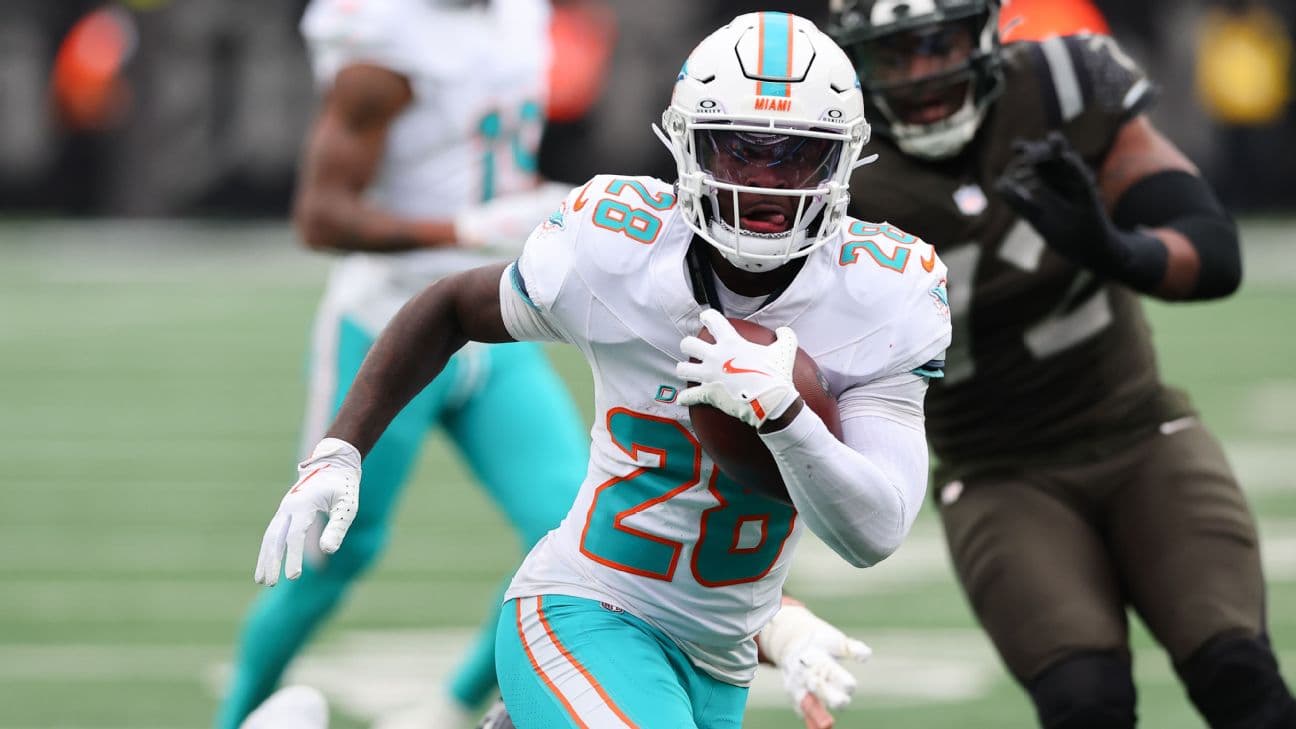
De'Von Achane underwent minor shoulder surgery this offseason to address the injury that sidelined him for Miami's final game of 2025, and the early word from the Dolphins is that it should be a non-event for his 2026 availability. New head coach Jeff Hafley has indicated he expects Achane to avoid setbacks and be ready for the start of the season, which keeps one of fantasy's most explosive backs firmly in the early-round conversation.
For a player whose value is built on big-play upside and a heavy receiving role, the most important fantasy question is simply whether he is on the field, and every indication points to yes. A minor procedure with a full offseason of runway is the best-case version of an injury report, and managers should treat this as a monitor-only situation rather than a red flag.
Why Achane's profile travels
Achane is a rare fantasy asset because his production is driven by explosiveness and pass-game usage rather than pure volume. A back who catches passes at a high rate carries a PPR floor that holds up even when the rushing work is split, and Achane's speed gives him a home-run element on any given touch that most backs cannot match. That combination is why he profiles as a first-round fantasy pick even in a Miami offense that is undergoing change at the top.
The receiving role is the anchor. In an offense that features its back in the passing game, Achane can post a usable fantasy line without a bell-cow rushing workload, and any negative game script that forces Miami to throw actually plays into his hands. That is the profile of a back you can trust weekly, and the shoulder surgery does nothing to alter it as long as the timeline holds.
The coaching-change wrinkle
The one genuine uncertainty in Miami is the new coaching staff. A change at head coach can shift a team's pace, run-pass balance, and how heavily a back is featured, and those are the variables that will define Achane's exact ceiling. A staff that wants to play fast and spread the ball keeps Achane's touch count high; a more conservative, ball-control approach could cap his upside slightly. This is worth watching through camp, but it is a ceiling question, not a floor question.
The bigger picture is that Miami has a clear lead back with a defined skill set, and new coaching staffs tend to build around their most dynamic weapon. Achane is comfortably that player in this offense, and there is no obvious threat to his workload on the roster. The surgery, the coaching change, and the general offseason noise all sit below the simple fact that he is the featured back in a scheme that should still throw it to him.
The Verdexed model take
Verdexed's model keeps Achane in its top-12 running back tier, and the shoulder procedure produces only a minor confidence adjustment rather than a value downgrade, because minor offseason surgeries with clean timelines rarely cost a player early-season availability. The receiving projection is the load-bearing input: our framework treats a back with Achane's target profile as having an elevated PPR floor that insulates him from the usual volatility of a boom-or-bust rusher.
The variables our model is watching are pace and game script under the new staff. A faster offense with more total plays raises Achane's touch ceiling, while the run-pass split determines how much of his value comes through the air versus on the ground. The injury itself is the least of the concerns; the model's uncertainty here is almost entirely about scheme, not health.
The pace and target-share watch
The homework on Achane is entirely about usage under the new staff, and there are two numbers to track through camp and the preseason. The first is his snap share on passing downs, because his receiving role is the foundation of his PPR floor; any sign that the new staff wants to rotate in a pass-catching complement would trim his ceiling. The second is the team's projected pace, because a faster offense with more total plays raises his touch count across the board.
The encouraging baseline is that new coaching staffs almost always build around their most dynamic returning weapon, and Achane is unquestionably that player in Miami. There is no obvious threat to his workload on the roster, and his skill set (speed, receiving ability, big-play juice) is exactly what modern offenses want to feature. The shoulder surgery simply does not move the needle against that backdrop. Draft him where his talent says, monitor the camp reports for scheme signals rather than injury red flags, and treat the preseason usage patterns as the real tell on whether his ceiling is RB1-strong or league-winning.
What to do in your league
Draft Achane as a first-round or early-second-round running back and treat the shoulder surgery as background noise unless a camp report signals a setback. His pass-game role gives him one of the safer floors among high-upside backs, and the explosiveness gives him weekly league-winning potential. The only real homework is tracking how the new Miami staff wants to use its backfield through August, because that will tell you whether Achane is a strong RB1 or a genuine positional cheat code. Until then, the takeaway is straightforward: the injury is not the story, and Achane belongs near the top of your board.