Christian Kirk's Calf and a Thinning 49ers Receiver Room: Mike Evans Gets Bigger
By Verdexed NFL Desk
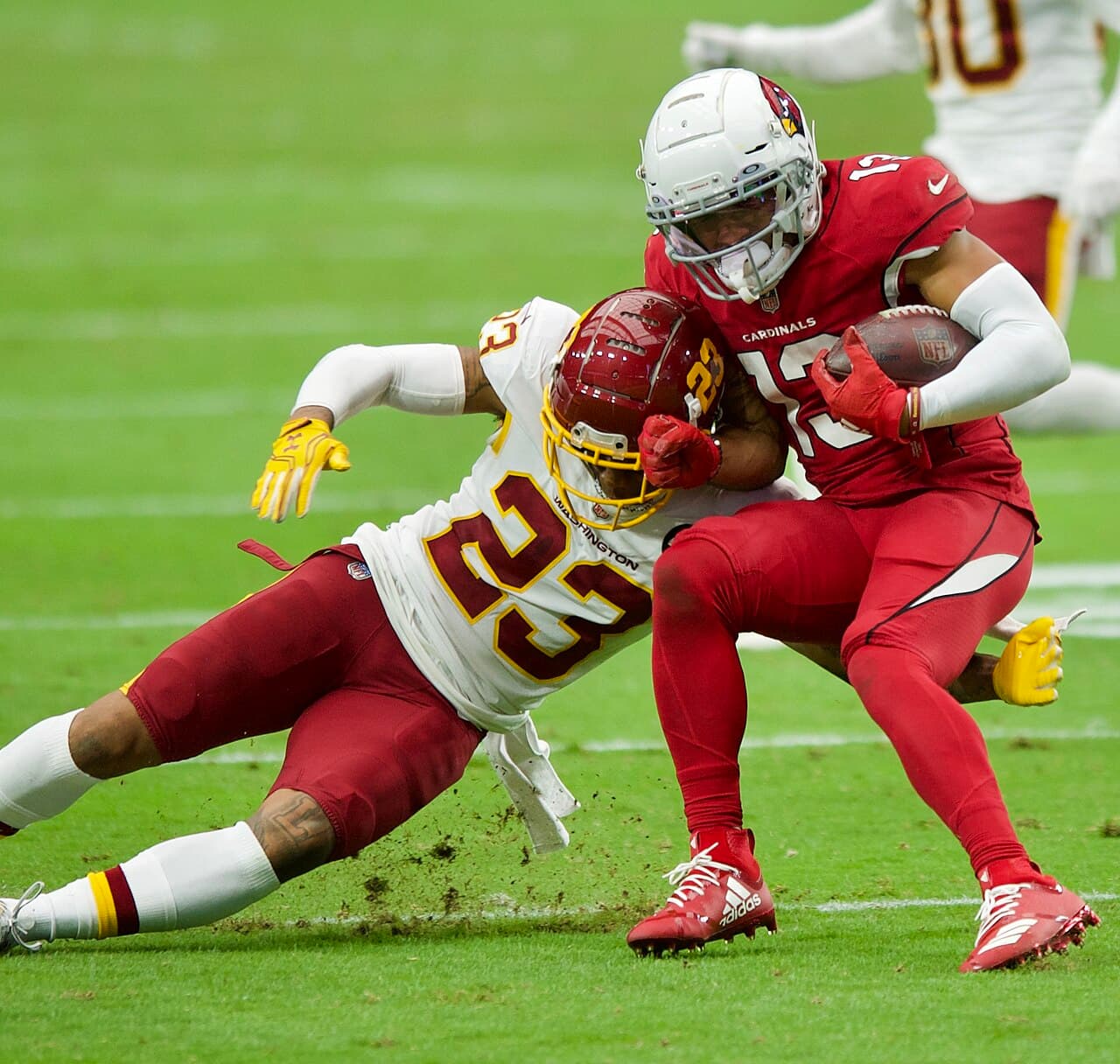
San Francisco's receiving corps has lost two of its projected contributors inside of a week. Ricky Pearsall will have PCL surgery and is headed to season-ending injured reserve, general manager John Lynch confirmed to reporters, and Christian Kirk left the first day of training camp with a calf strain and was described as day to day.
The two injuries are not equivalent. Pearsall's is season-ending and settled. Kirk's is the kind of soft-tissue problem that reads as minor in July and quietly costs a player the first month of the season. Calf strains are notoriously slow to heal and prone to reinjury, and a player who returns before the tissue is fully recovered often ends up missing more time than one who sits an extra two weeks.
What it does to the depth chart
San Francisco signed Mike Evans in free agency on a three-year deal reported at up to $60.4 million, ending a twelve-year run in Tampa Bay in which he became the franchise's all-time leading receiver with 13,052 yards. Evans arrived off an injury-shortened 2025 in which he played eight games and failed to reach 1,000 receiving yards for the first time in his career.
Deebo Samuel is back in the building as well, a return that took on a different weight once Pearsall's knee turned out to be worse than initially feared. Between Evans, Samuel, and whichever young receivers step up while Kirk rehabs, the 49ers have a receiving room that is top-heavy, veteran, and carrying a meaningful amount of injury history.
The other half of this offense matters too. San Francisco's passing game has historically distributed heavily to the tight end and the backfield, which means the receiver-room churn does not necessarily translate into a proportional shift in target share. It does concentrate whatever share the wideouts get.
Fantasy fallout
Evans is the direct beneficiary and the obvious play. He was already the presumptive alpha and is now the presumptive alpha with two of the three players who might have taken red-zone looks either out for the year or working back from a calf. Evans has been one of the most reliable touchdown producers of the last decade, and touchdown-dependent receivers get materially better when the competition for goal-line targets thins out.
The age concern is real and should not be dismissed. Evans turns 33 this month and is coming off the least productive season of his career. But the specific thing that went wrong last year was availability, not effectiveness, and the market has priced him closer to a decline case than the tape supports.
Samuel is the harder call. His usage in this offense has always been schemed rather than earned through route volume, which makes him matchup-dependent and difficult to start with confidence. He is a flex play whose ceiling depends entirely on how much manufactured touch volume the staff decides to give him.
Kirk is a bench stash until there is a return date. Do not draft a receiver with a calf strain as a starter in August.
The Verdexed model take
The model moves Evans up into the WR2 tier with a touchdown projection at the high end of his post-2023 range, driven by concentration of red-zone opportunity rather than by any assumption about volume growth. The projected target share increase is modest. The projected end-zone target share increase is not.
For San Francisco as a team, the model does not move the offensive projection much. This is a scheme-driven offense whose efficiency has historically survived personnel churn better than most, and the yards lost to a receiver injury tend to reappear at tight end and running back rather than disappearing.
Betting angle
Evans's receiving touchdown prop is the number worth attacking. Books priced it off an eight-game 2025 and a new team, and neither of those inputs accounts for two competitors for goal-line work being removed from the equation in the last week.
The 49ers' team total should be left alone. The market has not overreacted to the Pearsall news, which is correct, and there is no edge in fading a correctly priced number.
What to do in your league
Move Evans up your board. The combination of an alpha role, a thinned depth chart, and a market price built on last year's injury is exactly the shape of a value that resolves in the first month of the season.
Leave Kirk on your watch list and check the injury report through the middle of August. If he is practicing in full by the joint-practice window, he is draftable as a late-round WR. If the 49ers are still describing him as day to day in two weeks, that is a player who will start the season limited.
What's next
The 49ers open in Melbourne, Australia against the Rams, a Week 1 assignment with a travel component that adds a variable to every availability question on this roster. Any player still managing a soft-tissue injury in late August is a candidate to be held out of that game, and the fantasy managers who plan for it will have a cleaner Week 1 than the ones who do not.
Why calf strains are the injury to fear in August
Of the common soft-tissue injuries a receiver picks up in camp, the calf is the one with the worst risk profile relative to how it is reported. Hamstrings are treated with appropriate caution by teams and by the market. Calves get labeled day to day, the player returns in ten days, and then he reaggravates it in Week 2 and misses a month.
The mechanism is straightforward: the calf is under load on every stride, so there is no way to partially rest it while still practicing. Independent medical commentary on Kirk's specific case has flagged a multi-week return window and the reinjury risk that comes with rushing it, which is the standard read on the injury rather than anything unique to him.
Applied to draft strategy, that means treating any camp calf strain as a two-tier downgrade rather than a one-tier one, and refusing to pay a starter's price for a player whose Week 1 status will not be known until the final week of preseason.