Caleb Williams Was Carted Off With a Hamstring Injury and Tyson Bagent Is Next
By Verdexed NFL Desk
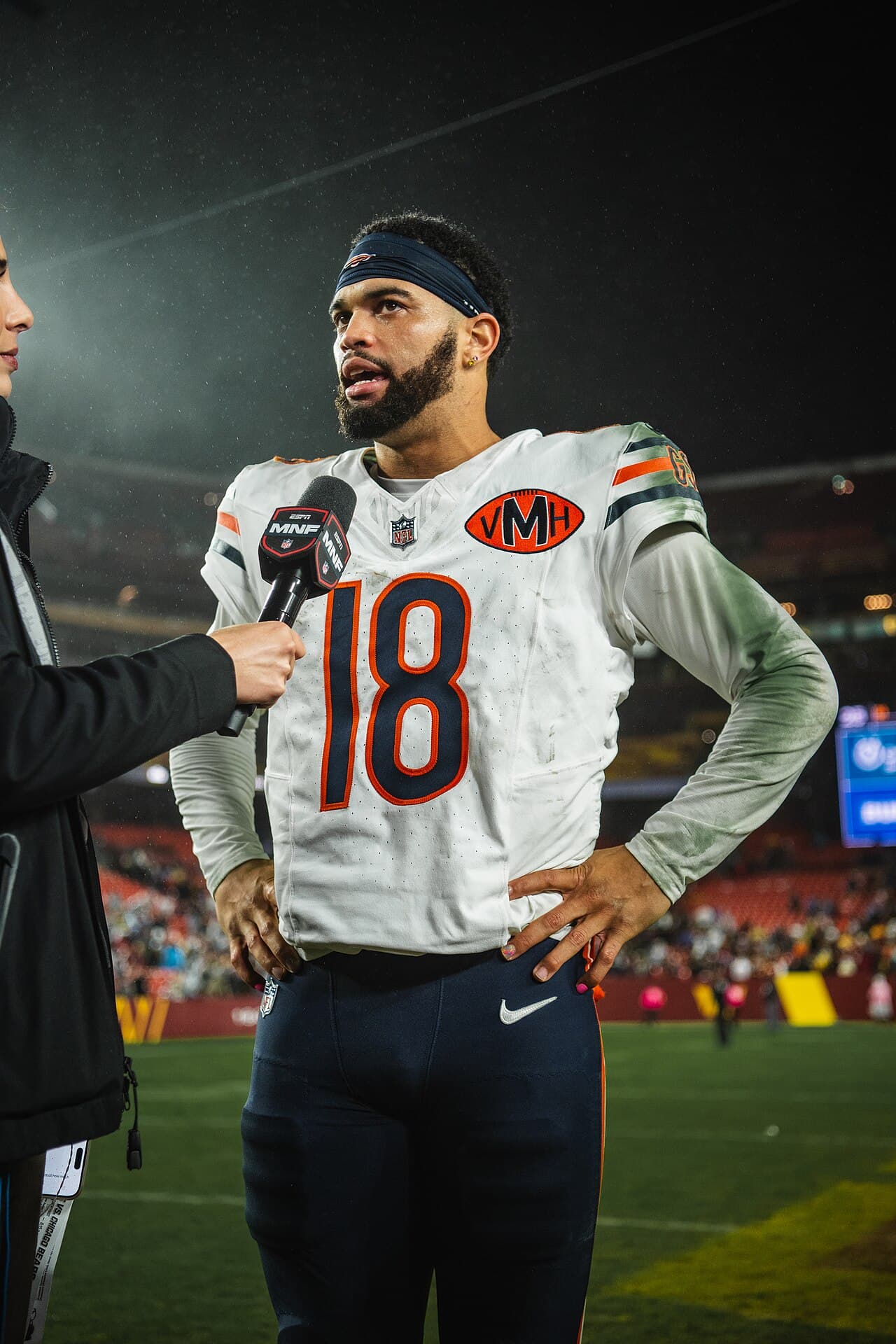
Caleb Williams was carted off Soldier Field late in Chicago's 9-3 loss to Minnesota on Sunday after pulling up with a non-contact hamstring injury on a fourth-quarter scramble. Williams grabbed the back of his leg while escaping pressure, went to the ground, and was helped off before being carted to the locker room. He did not return. Tyson Bagent finished the game. The Bears have an MRI scheduled, and the early word out of Chicago was cautious optimism that the strain may be on the milder end of the scale.
The play and the early read
Williams was scrambling left out of the pocket looking for a go-ahead score in a game that had produced exactly one touchdown between the two teams. He pulled up mid-run, reached for his hamstring, and did not get up on his own. Non-contact hamstring injuries in that pattern, a full-speed acceleration followed by an immediate stop, are almost always a strain rather than anything structural, and the grading is what determines everything that follows.
The optimistic scenario being floated locally is a grade one strain, which is the lowest classification and typically costs a player somewhere in the one-to-three-week range depending on position and how a team handles it. A grade two pushes toward a month. Until the MRI is read, both remain possible, and anyone telling you otherwise on Sunday night is guessing.
Hamstrings are also the injury type most prone to recurrence when a player is rushed back, and quarterbacks with a mobility component to their game are the worst candidates to rush. A quarterback who cannot push off his back leg loses velocity, loses the scramble drill, and loses the ability to escape a collapsing pocket. Chicago has every reason to be conservative.
The Bears offense was already the problem
Strip out the injury and the more alarming fact about Sunday is that Chicago scored three points. The offense produced one field goal against a Minnesota defense that is aggressive but beatable, and Williams was hurt chasing a touchdown the Bears could not manufacture through structure.
That context matters for the fantasy read. This was not a high-functioning offense that just lost its engine. It was a stalled offense that now has a backup quarterback. The distinction is the difference between a roster you buy the dip on and one you avoid entirely.
Fantasy fallout
**Tyson Bagent** becomes a deep-league name and nothing more. He is a competent emergency starter who has handled NFL snaps before, but he has never been a fantasy asset and there is nothing in Chicago's Week 2 output to suggest he becomes one. In superflex leagues with 24 or more quarterbacks rostered, he is a defensible add. In single-quarterback leagues, leave him alone.
**Rome Odunze** takes the biggest hit. Odunze came into Week 2 healthy after a calf issue and had already been operating behind other options in target priority, running 49 percent of the snaps at his position in the opener and catching two of three targets. A receiver who was fourth in line in a run-heavy offense with the starting quarterback does not improve when the backup takes over. He is a flex-or-bench call in Week 3, not an automatic start.
**Kyle Monangai** is the one Bears asset whose outlook improves. Backup-quarterback offenses run the ball, shorten possessions, and protect the passer with early-down handoffs. If Williams misses time, Chicago's run game absorbs the volume, and the back who gets the early-down work becomes a usable flex play regardless of how ugly the offense looks.
**Chicago's defense and special teams** get a small bump in DFS and streaming contexts, not from their own quality but from game scripts that will feature more punts and more short fields for opponents who have to keep grinding.
The Verdexed model take
The Week 3 line is where this gets interesting. Chicago drew Philadelphia, and early opening-line reports had the Bears sitting close to a pick'em at home before Sunday's injury news landed. That number is now stale.
A starting-quarterback downgrade of this magnitude is worth multiple points of spread on its own, and the market will move it. The Verdexed view is that the initial move will overshoot. That is the consistent pattern with Monday-morning quarterback repricing: the number lurches, the public piles onto the healthy favorite, and the closing line drifts back toward the middle by Friday once the injury report clarifies whether the starter has a real chance to play.
If you want Philadelphia, you needed to bet it Sunday night. If you want Chicago and points, wait. The better play right now is the total. Chicago produced three points with Williams; the projection with Bagent under center against a Philadelphia defense that travels well is not a number that supports an over, and totals in games featuring a backup quarterback have historically been slower to adjust than spreads.
One more angle worth tracking: if the MRI comes back grade one and Chicago lists Williams as limited on Wednesday, the market will treat him as likely to play and the line will snap back. That is the moment to take the other side if you believe, as we do, that a mobile quarterback on a fresh hamstring in a cold-weather stadium in late September is a bad bet to be effective even if he is technically active.
What to do in your league
Hold Williams if you drafted him. A one-to-three-week absence does not justify dropping a quarterback with his ceiling, and the waiver alternatives available in most leagues are not meaningfully better than streaming for two weeks.
Do not chase Bagent unless your format forces you to. If you need a bye-week or injury-replacement quarterback this week, there are better options on the wire coming out of Week 2, including veterans who just inherited full-time jobs elsewhere.
If you roster Odunze, this is a sell-the-name window, not a panic-drop window. Somebody in your league still values the draft capital and the pedigree. If you can move him for a stable weekly starter at another position, that is a trade worth making before the Week 3 report confirms Williams is out.
And if you are streaming defenses, Philadelphia against a Bagent-led Chicago offense is the kind of matchup that wins a week quietly. Put it on the list now before the rest of your league reads the same injury report.