 NFL2026-07-08
Bijan Robinson Eyes a Record RB Extension: A Falcons Hold-In Watch as Camp Nears
By Verdexed NFL Desk
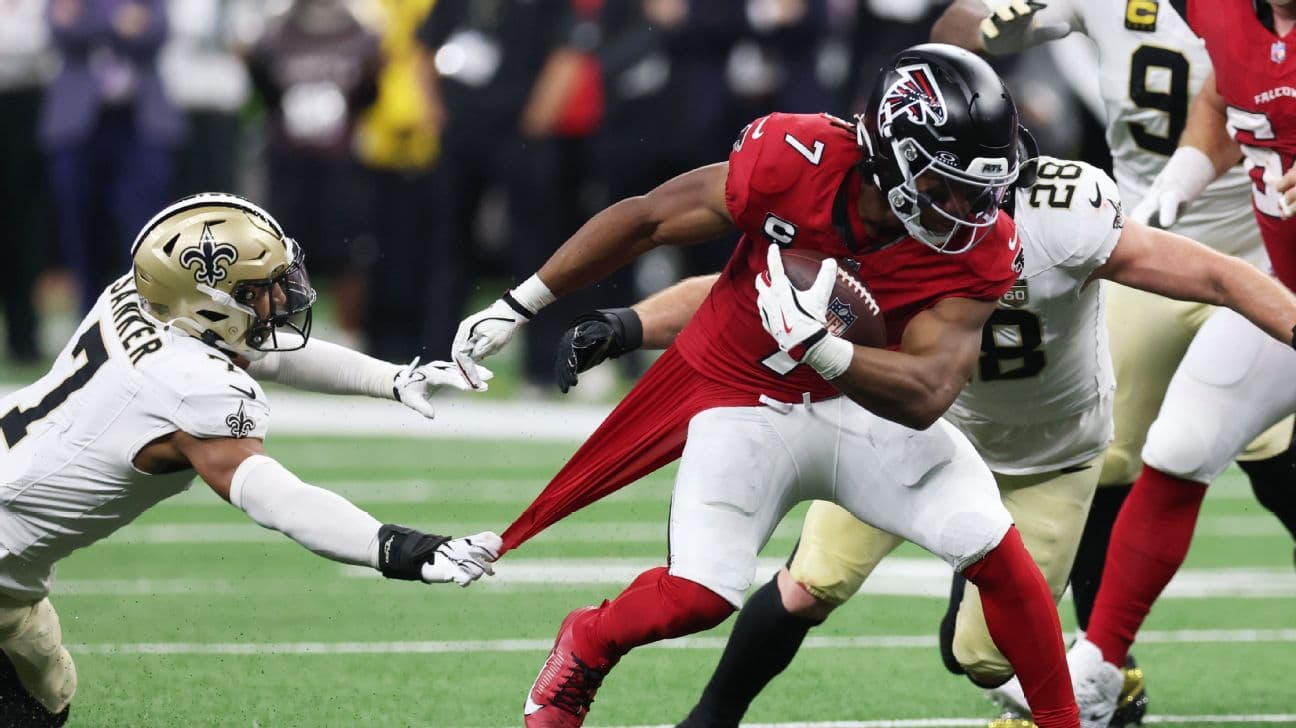
Bijan Robinson wants to be paid like the best running back in football, and the timing is getting tense. With Atlanta's veterans due to report for training camp in late July, Robinson is seeking an extension that would push him toward the top of the position's market, and a hold-in (reporting to camp but limiting practice reps while a deal gets worked out) is squarely on the table. For fantasy managers deciding whether to spend a top-three overall pick on him, the situation is worth tracking closely.
The news is not that Robinson is unhappy with football. It is that the business around him has moved. He is still on his rookie contract, carrying a bargain cap number for 2026 and a fifth-year option in 2027 that pays a fraction of what his production is worth. Meanwhile, the running back market has reset, and Atlanta has already handed out major guaranteed money elsewhere on offense. Robinson has watched the position's ceiling rise while his own deal sits untouched, and he is pushing to fix that before another season of wear and tear.
The market case
Robinson entered 2026 as the consensus No. 1 running back in the league, narrowly ahead of Detroit's Jahmyr Gibbs in the industry rankings informed by executives, coaches, and scouts. That is the argument in a nutshell: if you are the best back in football, you should be paid like it. Reporting around his situation has floated a target in the neighborhood of $25 million per year, likely starting in 2027 to replace the fifth-year option. That number would clear Derrick Henry's deal, top Christian McCaffrey's, and challenge Saquon Barkley for the highest annual average at the position.
The friction point is that Atlanta has already committed big guaranteed money to receiver Drake London and tight end Kyle Pitts this offseason, and Robinson, the most productive weapon of the group, is the one still waiting. That is the kind of dynamic that turns a quiet negotiation into a public one. The Falcons hold leverage because Robinson is under control through 2027, but every game he plays on a rookie deal is a game that adds risk to a back the franchise clearly wants to build around.
Why a hold-in, not a holdout
A true holdout carries escalating fines and rarely benefits a player under contract, which is why the modern move is the hold-in: show up, avoid the fines, and simply not take full-contact reps until the sides make progress. For a running back with Robinson's workload, there is an added wrinkle. Atlanta's staff would likely be fine with him watching August practices from the sideline anyway to keep him fresh and healthy for Week 1. In other words, a hold-in and normal load management can look nearly identical from the outside, which lowers the temperature on this one relative to a contract fight at a more replaceable position.
That matters for fantasy. A hold-in is not a Week 1 availability threat the way a lingering injury is. The base case remains that Robinson opens the season as Atlanta's featured back with a massive three-down role. The extension noise is about long-term dollars, not about whether he suits up in September.
Fantasy fallout
Robinson is a top-three overall fantasy pick and nothing in the contract situation changes that. He combines elite volume, receiving work, and goal-line usage in an offense that runs through him. If anything, an eventual extension reinforces his fantasy floor by cementing him as the centerpiece Atlanta pays to feed. The players to monitor are behind him: Tyler Allgeier remains the handcuff with standalone value in a run-heavy scheme, and his price stays low precisely because Robinson is expected to dominate touches.
The scenario that would actually move Robinson's fantasy value is a prolonged standoff that bleeds into September, but that remains the low-probability outcome. Drafters should treat the current noise as a reason to stay informed, not a reason to slide him down boards. If his cost dips even slightly in a home league because a manager is spooked by the headlines, that is a buying opportunity, not a warning.
The Verdexed model take
Verdexed's model still slots Robinson at the top of the running back projections, and the extension talk does not meaningfully dent his expected touch share. The model's read is that Atlanta's offensive structure, with a defined lead back and heavy usage in the red zone, is one of the most fantasy-friendly running back situations in the league regardless of when the paperwork gets signed. The projection treats a hold-in as a near-zero risk to regular-season volume.
Where the model does flag caution is durability, which is the same reason Robinson wants his money now. High-workload backs carry injury variance that the projection bakes in, and that is the real argument for holding his handcuff late in drafts rather than the contract situation. The edge for managers is simple: draft Robinson at the top with confidence, then grab Allgeier several rounds later as cheap insurance on the position's most valuable feature back.
What's next
The next checkpoint is the report date for camp, when Robinson's approach will tell the story. If he shows up and eases into practice while talks continue, this is a business-as-usual hold-in with no fantasy consequence. If a deal gets done before Week 1, it removes the last sliver of uncertainty and locks him in as the RB1 overall. Either way, the actionable takeaway is to keep Robinson at the top of your board and let a nervous leaguemate be the one who blinks.