 NFL2026-07-13
Bijan Robinson Extension Watch: The Falcons' Reset RB Market and What It Does to His Fantasy Price
By Verdexed NFL Desk
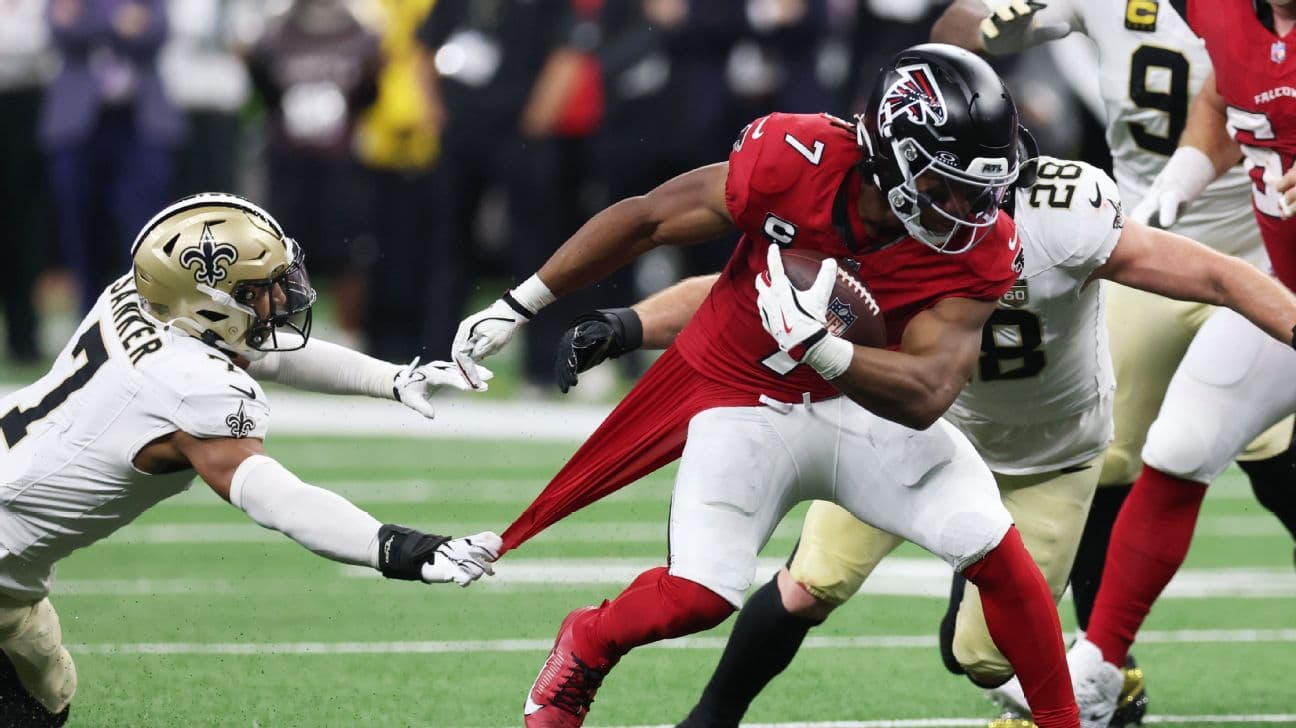
Bijan Robinson is the best running back in football and he is about to get paid like it. After locking up Drake London and Kyle Pitts earlier this offseason, the Atlanta Falcons have made clear that Robinson is next on the list, and a Falcons beat reporter recently indicated an extension is expected to get done before long. For fantasy managers, this is not idle contract chatter. Whether Robinson signs before camp, how the money is structured, and what it signals about Atlanta's willingness to keep feeding him are all inputs into a player who already sits at the very top of draft boards.
The state of the negotiation
Robinson enters 2026 having been named First Team All-Pro after a season in which he handled 287 carries for 1,478 yards and seven touchdowns while also functioning as a full-time receiving threat. ESPN's annual poll of executives, coaches and scouts ranked him the No. 1 back in the league. That resume puts him above the current market benchmarks: Derrick Henry's roughly $15 million per year, Christian McCaffrey near $19 million, and Saquon Barkley's $20.6 million average annual value, which currently tops the position.
Reporting around the negotiation points to a deal that pushes into the $25 million per year neighborhood, which would make Robinson the highest-paid running back in NFL history. The complication is the cap. Atlanta's estimated space sits around $28 million after the London and Pitts extensions, so the structure, signing bonus, and how much new cash hits in 2026 will matter as much as the headline number. None of that is finalized, so treat the specific figures as the expected range rather than a done deal.
Why the contract matters for fantasy
A team does not commit record money to a running back to scale back his workload. If anything, a Robinson extension cements what fantasy managers already assume: he is a bell-cow with three-down usage, goal-line work, and a passing-game role that gives him a weekly floor few backs in the league can match. Volume is the single most predictive input for fantasy running back scoring, and Robinson's volume is not in question.
The extension also removes a small but real tail risk. An unsigned star back heading into a contract year can become a hold-in candidate, and any noise about a player withholding practice reps in August creates uncertainty about early-season conditioning and usage. A signed Robinson is a clean, worry-free first-round pick. That certainty is worth something when managers are deciding between him and the elite wide receiver tier at the top of drafts.
Fantasy fallout
Robinson is a consensus top-three overall pick in PPR and a candidate for the 1.01 in many formats. The extension does not change his ranking, but it does firm up the case for taking a running back first in a year when the position's depth is thinner than the wide receiver group behind Puka Nacua and Ja'Marr Chase. Managers who prefer the zero-RB build will still fade him, but the argument for anchoring a roster with the position's safest workhorse is stronger when that workhorse is locked in long term.
The ripple effects in Atlanta's backfield are minimal for now. Tyler Allgeier remains a handcuff with standalone value only in the event of a Robinson injury, and his role is unlikely to expand simply because Robinson gets paid. If the Falcons wanted to protect their investment with a lighter early-down committee, that would be a storyline to monitor in camp, but nothing in the reporting suggests Atlanta plans to take touches out of its best player's hands.
The Verdexed model take
Verdexed's model treats Robinson as the highest-floor running back in the projection set, and the extension nudges his usage confidence interval even tighter. His projected touch share, red-zone opportunity, and receiving volume all sit in the elite band, and the model's range of outcomes for him is narrower than for the boom-or-bust backs drafted around him. In practical terms, that means Robinson is the pick when a manager wants to minimize variance at the top of a draft rather than chase a wide receiver ceiling.
The betting angle is subtler. Robinson is a live candidate for rushing yardage and total touchdown props, and a fresh extension that signals continued heavy usage supports the over on his season-long rushing total in most books. His Offensive Player of the Year and even MVP longshot odds are also worth a look for bettors who believe Atlanta's offense takes a step forward with London and Pitts locked in around him.
What to do in your league
Draft Robinson with full confidence at the top of the first round and do not overthink the contract noise. If you land him, prioritize pass-catching depth and a stable quarterback situation around him rather than spending an early pick on his handcuff. If you are picking just behind the 1.01 and Robinson is gone, the elite wide receiver tier is the correct pivot rather than reaching for the next running back down.
For dynasty managers, an extension is a meaningful positive. It removes the contract-year and potential-franchise-tag uncertainty that can cloud a young back's long-term outlook and confirms Atlanta's commitment to building the offense around him. Robinson was already a cornerstone dynasty asset, and locking in his situation only strengthens that hold.
What's next
Watch for the timing. A deal signed before the Falcons report to camp would be the cleanest outcome and would end any lingering hold-in speculation. If negotiations drag into late July, monitor whether Robinson participates fully once veterans report. Nothing in the current reporting suggests a standoff, but the difference between a signed superstar and an unsigned one heading into August is the kind of detail that separates a worry-free first-round pick from one carrying a small asterisk. For now, the arrow points toward a resolution, and toward Robinson staying exactly where he belongs: at the top of the board.