 NFL2026-07-14
Ashton Jeanty's Year-Two Breakout: Why a New Raiders Scheme Makes Him a 2026 Fantasy Value
By Verdexed Fantasy Desk
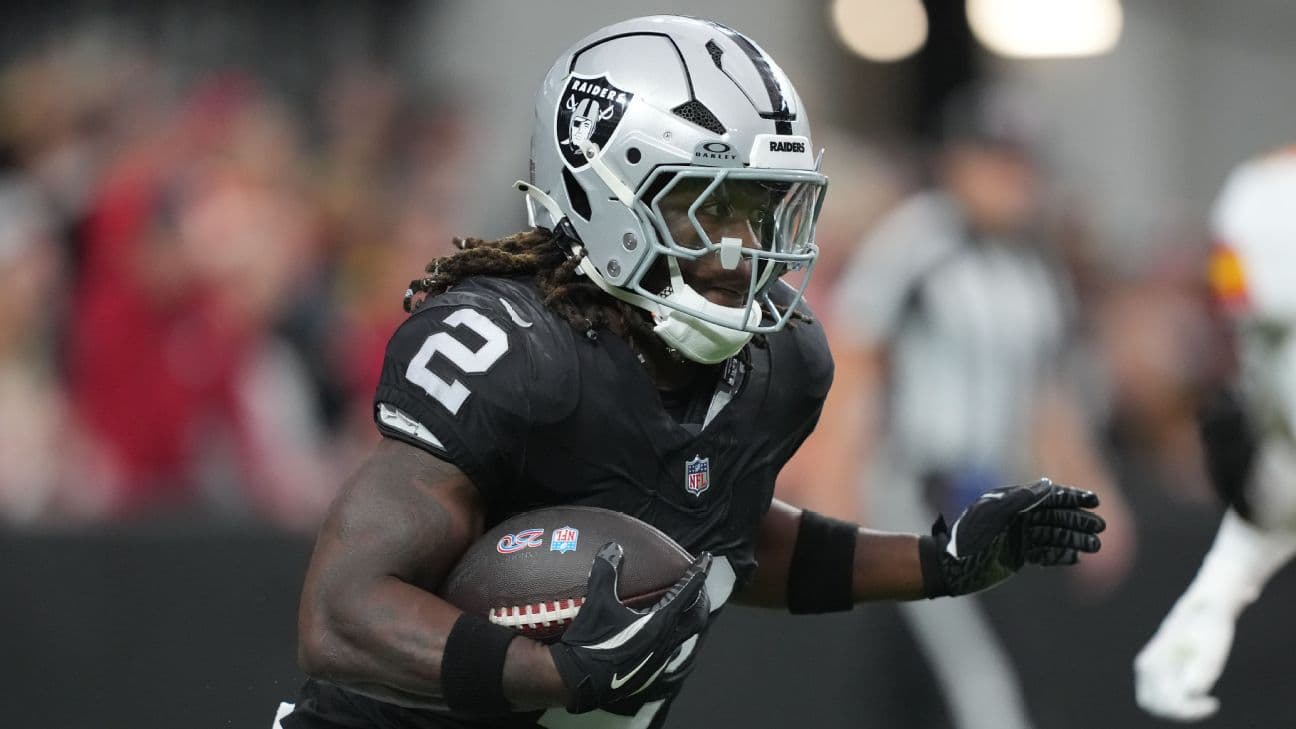
Ashton Jeanty's rookie season delivered the volume without the efficiency. He led all rookie running backs in rushing yardage, but a modest yards-per-carry number and an RB16-ish per-game finish left some fantasy managers wanting more. Year two is set up to close that gap. A new coaching staff, a scheme built for his skill set, and an upgraded offensive line have Jeanty positioned for the kind of second-year leap that wins fantasy leagues, and his draft cost has not fully caught up.
The rookie year in context
Jeanty arrived in Las Vegas as a high-pedigree back and immediately handled a workhorse load, pacing rookie running backs in rushing yards. The catch was efficiency: he averaged under four yards per carry behind a line that struggled to open lanes, and the touchdown equity did not match the workload. That is a common rookie outcome for a talented back in a poor blocking situation, and it is exactly the kind of profile that rebounds when the environment improves.
The important part for fantasy is that the usage was never the problem. A back who commands a lead role as a rookie has already cleared the hardest hurdle. When the yards-per-carry is the complaint rather than the touches, the fix is usually blocking and scheme, both of which are trending in Jeanty's favor.
A scheme built for his game
The Raiders hired Klint Kubiak as head coach, bringing a zone-blocking scheme that is a natural fit for a back with Jeanty's vision and burst. Zone concepts reward patience, one-cut decisiveness, and the ability to hit a crease at full speed, all traits that were already part of Jeanty's college and rookie tape. Kubiak's system has a track record of producing efficient, high-volume rushing production, and Jeanty is the centerpiece.
Las Vegas also invested in the offensive line, addressing the unit that dragged down his rookie efficiency. Better blocking plus a scheme designed to spring one-cut runners is the combination that turns a high-volume back into a high-efficiency one. The coaching staff has publicly emphasized developing Jeanty as a three-down workhorse, which points toward the passing-game usage that lifts a back's floor in PPR formats.
The quarterback picture and why it does not sink him
The Raiders drafted quarterback Fernando Mendoza with the No. 1 overall pick, but the team has signaled a patient approach, bringing in veteran Kirk Cousins to compete and, by early indications, lead the offense to open the season while Mendoza develops. That stability at quarterback is a quiet positive for Jeanty. A veteran presence keeps defenses honest and reduces the risk of the offense stalling in a way that caps a running back's opportunities.
Whichever quarterback starts, the offensive identity runs through Jeanty. A developing rookie passer would only lean on the run game more, while a veteran keeps the offense functional enough to sustain drives and generate goal-line chances. Either path supports the same conclusion: Jeanty is the engine, and the volume is not in doubt.
Fantasy fallout: a top-six upside at a discount
Jeanty is being valued around the back half of the RB1 tier, and industry rankings have placed him inside the top six running backs in PPR formats. That is a strong price, but the upside case sits above it. A workhorse back in a zone scheme with improved blocking and three-down usage is the exact template for a top-five fantasy running back season. The rookie efficiency dip gives managers a small discount relative to that ceiling.
The floor is also sturdier than most backs at his cost because the role is locked in. Jeanty does not have to win a camp battle or fend off a committee for touches. That combination, a high floor from guaranteed volume and a high ceiling from an improved environment, is what makes him a value rather than merely a solid pick.
The Verdexed model take
Verdexed's running back model weights projected touches, blocking quality, scheme fit, and passing-game involvement, and Jeanty grades up across the board in year two. The model reads his rookie efficiency as environment-driven rather than talent-driven, which is the profile that projects positive regression. Improved line play and a zone scheme both push his projected yards-per-carry and touchdown rate upward from the rookie baseline.
The cleanest signal the model offers is role certainty. Jeanty's projected workload sits among the highest at the position, and volume is the most predictive input for fantasy running back scoring. The result is a projection that treats him as a high-floor RB1 with a genuine path to a top-five finish if the efficiency rebounds as the environment suggests it should.
What to do in your draft
Draft Jeanty as a foundational back and be comfortable taking him a tick ahead of his current cost if the value is there. The role is secure, the scheme fits, and the blocking has improved, which is the recipe for a second-year leap. If a leaguemate is fading him over the rookie yards-per-carry, that is the manager to draft ahead of.
What's next
Training camp will confirm the pieces: the quarterback pecking order, the shape of the offensive line, and how much passing-game work Jeanty absorbs. None of those questions threaten his workload, and most point toward improvement. The rookie season built the volume. The 2026 environment is built to add the efficiency, and that is the exact combination fantasy managers should be buying.