Amen Thompson's Extension Is the Rockets' Last Piece of Business and It Will Not Be a Max
By Verdexed NBA Desk
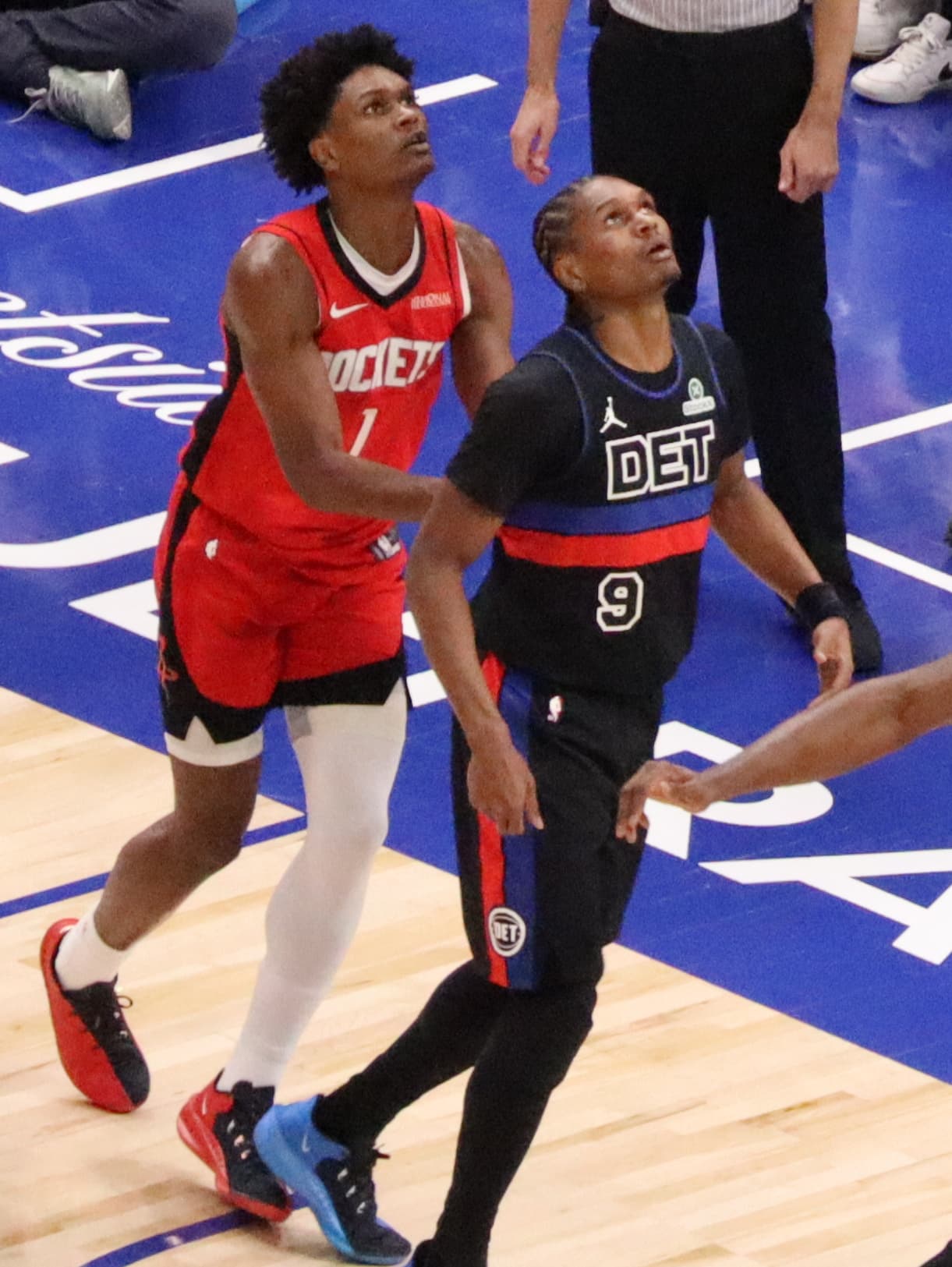
Amen Thompson remains extension-eligible until the day before the 2026-27 regular season begins in October, and his rookie-scale extension is the last significant piece of unfinished business on Houston's offseason ledger. Reporting through August has pointed consistently toward a deal getting done, and just as consistently toward it landing below the full five-year maximum.
The framing from those covering the team is that a deal in the range of 20 to 22 percent of the salary cap, rather than the 25 percent maximum, is the more likely structure. Nothing has been agreed publicly, and the specific figures being discussed are projections rather than reported terms.
What Thompson did to earn the conversation
Thompson broke out last season, averaging 18.3 points, 7.8 rebounds, 5.3 assists and 1.5 steals across 79 games. The counting stats are impressive on their own. The context around them is what makes the extension a genuine question rather than a formality.
He was named to the All-Defensive First Team in 2024-25, which is the rare honor that separates a good young player from a foundational one, and he did it as a perimeter defender capable of guarding across positions. Players who combine that defensive ceiling with a 79-game season and near-triple-double-adjacent production do not usually get below-max offers.
The counterargument is the shot. Thompson's offensive game has been built on athleticism, transition, and downhill pressure rather than on shooting, and teams paying maximum money to a non-shooter are betting on a skill developing rather than on one that exists. That is the tension the negotiation is resolving.
Fantasy fallout
For fantasy basketball managers, an extension resolution matters less for what it pays than for what it signals about role. A team that commits nine figures to a 23-year-old is a team planning to build its offense through him, and offense-through-him is what turns a strong per-game line into a top-20 fantasy asset.
Thompson's fantasy profile is already unusual and already valuable. The steals and rebounds from a perimeter player are the rare categories that are genuinely scarce, and a player who supplies both while also handling the ball is a roster-construction cheat code in category leagues. The 79 games played last season is the part that gets underpriced most.
The risk in his profile is the free throw and three-point volume, which drag on percentage categories in the formats that count them. That is a roster-construction problem rather than a reason to avoid him, and it is solvable by pairing him with efficient shooters.
The extension itself does not change any of that. What would change it is an indication that Houston plans to reduce his role, and nothing in the team's offseason suggests that. The Rockets' summer has been about depth rather than about acquiring another primary creator: they re-signed Tari Eason on a five-year deal reported around $81.5 million, brought back Marcus Smart on a short-term contract, and filled out the roster with veteran minimum additions including Bogdan Bogdanovic and Jae'Sean Tate.
The Verdexed model take
Verdexed's fantasy basketball projections estimate usage as a function of roster context rather than of prior-year usage alone, which is why extension news is a genuine model input rather than a business story. A team's contract commitments are the most honest signal available about how it intends to distribute the ball.
Houston's summer has been additive at the margins and unchanged at the top, which means the model projects Thompson's usage to hold or rise rather than to compress. Eason's extension is a depth commitment rather than a competing-usage commitment, and Smart's role at this stage of his career is defensive and organizational rather than offensive.
The output is a rest-of-career-arc projection that treats Thompson as a rising usage player on a team with a stable role structure, which is the profile that most reliably outperforms an average draft position built on last season's box score. The below-max extension, if it lands there, is a positive for Houston's cap flexibility and neutral for his fantasy outlook.
The broader extension deadline
Thompson is one of a larger group still eligible for rookie-scale extensions, with more than 20 players from his draft class facing the same October deadline. That deadline is a recurring and underused fantasy signal.
Players who sign large extensions before the season tend to see role stability. Players who reach the deadline unsigned and head toward restricted free agency sometimes see the opposite, because a team with an unresolved contract question occasionally becomes a team exploring a trade. Neither outcome is deterministic, but the correlation is strong enough to be worth tracking in dynasty formats where a change of scenery can swing a player's value by two rounds.
Betting angle
Houston's win total and its conference futures were priced during a summer in which the roster's top end never changed. That stability is the argument for the Rockets as a live futures play: teams that add depth without subtracting from their core are the ones whose projected win totals tend to be set off last season's record rather than off this season's roster.
Thompson is the swing variable in that projection. A defensive first-teamer entering his age-23 season with expanding offensive responsibility has one of the widest outcome ranges of any player on a projected playoff team, and win totals do not price individual variance well. The extension will not move the number when it is signed, which means anyone who wants exposure to a Thompson leap should take it before the market has a reason to think about him again.
The award markets are the cleaner expression. Most Improved Player prices for a player who already averaged 18 points are usually unattractive, but All-Defensive and Defensive Player of the Year markets reward exactly the profile Thompson has already established, and those are priced off name recognition more than off tracking data.
What's next
The deadline is the day before Houston's opener in October, which leaves roughly two months. Rookie-scale extensions overwhelmingly get finalized in the final two weeks before that deadline rather than in August, so silence between now and late September should not be read as a breakdown.
The signal to watch for is not the total value but the structure. A deal with player options and a shorter term indicates a player betting on himself and a team hedging. A five-year deal with team-friendly escalators indicates the opposite. For dynasty managers, the term length is the number that matters, because it determines how long Thompson's fantasy environment stays fixed.