Alexander Nikishin and the Hurricanes Are Stuck, and a Trade Is the Only Other Exit
By Verdexed NHL Desk
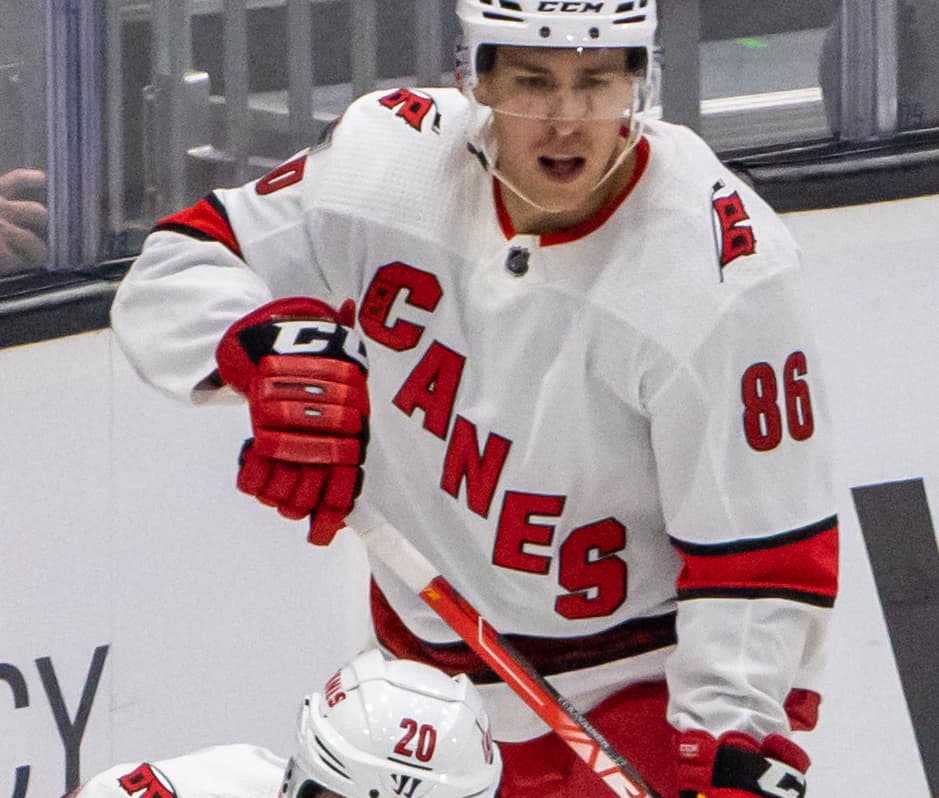
Alexander Nikishin remains unsigned in Carolina with training camps roughly six weeks out, and the structural details of his situation explain why the standoff has lasted this long. The 24-year-old defenseman finished a two-year entry-level contract reported at $1.85 million total, did not have arbitration rights this summer, and is ineligible to receive an offer sheet. That combination removes every mechanism that normally forces a restricted free agent negotiation to a conclusion.
The result is a negotiation with two exits and no clock: sign with Carolina, or get traded. Nothing in the collective bargaining agreement compels either outcome by any particular date.
The gap
Reporting has placed Nikishin's ask in the range of $8 million annually, and the player has since suggested publicly that the figure understates what he is looking for. Whether that is a genuine number or an opening position is unknowable from the outside, but the direction is clear enough.
The context that makes the ask defensible is the market around him. Macklin Celebrini signed the richest contract in league history at a reported $18.8 million annually. Leo Carlsson's situation reset the young forward market. Every young player with leverage this summer has watched the ceiling move, and defensemen who project as top-pair anchors have been the beneficiaries of that inflation as much as forwards.
The context that makes it aggressive is the sample. Nikishin's NHL résumé is shorter than the players setting these comparables, and Carolina has historically been among the most disciplined organizations in the league about paying for production it has actually seen rather than production it expects.
The trade market
Insider reporting has linked the Rangers to Nikishin, with St. Louis also mentioned as a team in the mix. Both fit the profile of a club willing to bet term and dollars on a young defenseman who has not yet fully established himself, and both have organizational reasons to want one.
A trade would not resolve the contract question so much as move it. Any acquiring team would have to sign him, which means the number that Carolina finds unacceptable becomes somebody else's number to accept or negotiate. That is why these situations often take longer to resolve than they appear they should.
Fantasy fallout
For fantasy hockey purposes, Nikishin is a player whose value is entirely dependent on deployment, and deployment is entirely dependent on where he plays.
In Carolina, he is competing for power play time on a team with an established blue line and a system that distributes offensive production broadly among defensemen. That is a good environment for a defenseman's shot and block totals and a mediocre one for point production, because the top power play unit is not easily displaced.
On a team with a thinner blue line, he would slot into first-unit power play minutes immediately, and power play time is the single largest driver of fantasy production for defensemen. The difference between a defenseman on the first unit and one on the second is often 20 or more points across a season.
That is why the trade question matters more than the contract question for fantasy managers. Where he plays determines whether he is a top-20 fantasy defenseman or a depth piece with peripherals.
The Verdexed model take
The model projects defensemen using two dominant inputs: even-strength ice time and power play unit assignment. Everything else, including individual shot generation and possession metrics, is secondary because it does not survive the deployment filter.
For Nikishin, the model's projection is bimodal in a way few players' projections are. The Carolina outcome produces a solid but unspectacular line built on volume peripherals. The traded outcome, on most of the teams plausibly involved, produces a substantially higher point projection driven by power play time.
The model does not attempt to weight the probability of each outcome, because there is no deadline to anchor a probability estimate to. What it flags instead is that this is one of the widest projection ranges of any rostered defenseman in fantasy hockey right now.
What to do in your league
In redraft leagues, do not reach for Nikishin. A player whose fantasy range spans from waiver-wire filler to a top-20 defenseman should be drafted at the low end of that range, not the middle.
In dynasty and keeper leagues, the calculus flips. Acquire him now if the price reflects the uncertainty, because the resolution is a binary that either leaves you where you started or hands you a significant asset. Uncertainty is the cheapest thing to buy in dynasty.
In deep leagues with an injured reserve or holdout slot, he is a reasonable stash regardless.
Betting angle
Carolina's season win total and Stanley Cup futures have been priced assuming a roughly intact roster, which is the correct default. Losing a young defenseman in a trade for futures would matter modestly. Losing him for a roster player would be closer to neutral.
The team-level angle worth watching is on the acquiring side. A club that lands a top-four defenseman in August without giving up NHL roster talent improves its projection more than the market typically prices, because summer trades get less attention than deadline trades and books adjust more slowly.
What's next
The forcing mechanism, such as it is, arrives when camps open. A player without a contract cannot practice, and every day missed is a day behind. That pressure has broken standoffs like this one before.
If a trade comes first, the acquiring team is the whole story for fantasy managers. Check the depth chart on the blue line and the power play usage from last season, and price him accordingly.