 NFL2026-08-23
Vita Vea's Trade Request Is Softening Into Extension Talks and Tampa Bay's Defense Depends on It
By Verdexed NFL Desk
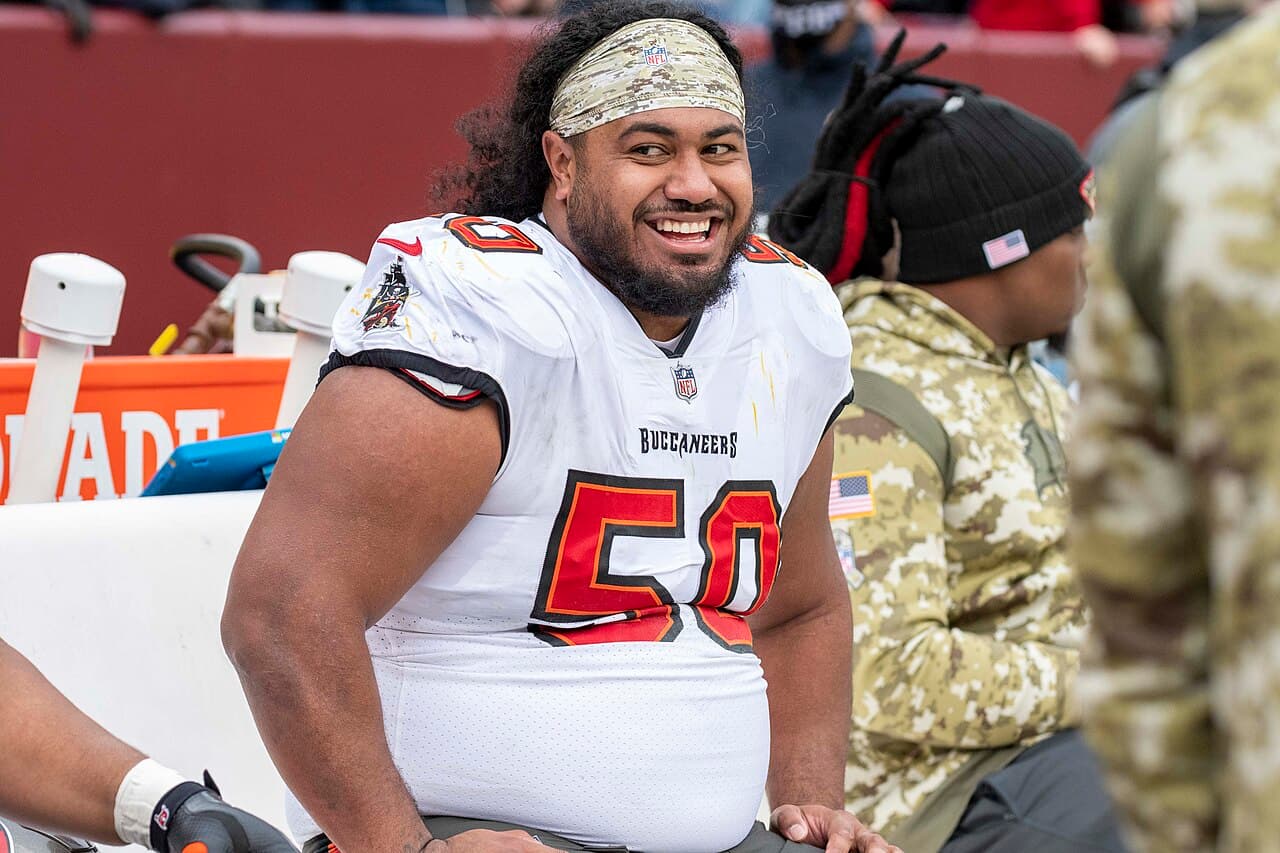
Vita Vea's standoff with Tampa Bay appears to be moving toward a resolution that keeps him in Tampa. After holding in during mandatory minicamp in June and then formally requesting a trade when extension talks stalled, the veteran defensive tackle has reportedly shifted his position, with ESPN reporting describing a change from Vea wanting a trade to Vea wanting a deal done. Nothing is signed, and Vea himself has declined to publicly acknowledge the trade request.
The timing matters. Tampa Bay has to cut to 53 players by 6 p.m. ET on August 30, and the Buccaneers open the season against Cincinnati in a game carrying the highest total on the Week 1 board at 50.5. A team preparing for that opener needs to know whether its best interior defender is playing.
The money problem
Vea is in the final season of a four-year, $71 million contract signed in 2022, earning $17.75 million annually. The market has moved underneath him. Jalen Carter reset the interior defensive line ceiling at north of $38 million per year, and a player of Vea's caliber looking at that number and at his own is going to conclude he is underpaid. That is the entire dispute.
Tampa Bay's position is the standard one for a team with a productive player in his thirties on an expiring deal: the on-field value is not in question, the length and structure of a new commitment is. Reported destinations of interest for Vea have skewed toward his home state of California, with Las Vegas also mentioned as a fit he would accept.
The shift toward a deal is the more likely outcome for a simple structural reason. Trading a high-salary veteran in late August is difficult. The acquiring team absorbs the remaining cap hit at a point in the calendar when almost every roster is tight against the number, and the compensation a contending team is willing to give up for one season of a player who wants a new contract is rarely enough for the selling team.
Betting angle
This is the story's real relevance to a Verdexed reader, because Vea has almost no direct fantasy value in standard formats.
Tampa Bay's Week 1 total of 50.5 against Cincinnati is the highest on the board, and interior defensive line play is one of the largest hidden inputs into whether a game with a high total actually gets there. An interior rusher who collapses the pocket forces quarterbacks off their spot faster than edge pressure does, which suppresses deep passing and shortens drives. Losing that player has a measurable effect on an opponent's expected scoring.
The market has been pricing that Tampa Bay game as a shootout on the strength of both offenses. If Vea is absent or limited, the case for the over strengthens. If he signs and plays, the total is more vulnerable than it looks, because Tampa Bay's front is the mechanism by which a high-scoring projection turns into a competitive defensive game.
Tampa Bay's season win total, which sits atop the NFC South board, carries the same dependency in smaller form. A team favored to win its division on the strength of a complete roster is more exposed to a single defensive absence than the market usually accounts for, because division win totals price offense more heavily than defense.
Fantasy fallout
For fantasy managers, the actionable consequences are indirect and mostly concern IDP leagues and team defenses.
Tampa Bay's defense is worth streaming in matchups against poor offensive lines if Vea plays, and considerably less so if he does not. The Buccaneers' edge rushers are the beneficiaries of interior pressure, and their sack production has historically tracked with the quality of the push in front of them. An IDP manager holding a Tampa Bay edge defender should be watching this negotiation closely.
The more useful cross-application is the reverse one: opposing quarterbacks and pass catchers facing Tampa Bay. A Buccaneers front without Vea is a materially more streamable matchup, and Week 1 against Cincinnati is the first place that shows up. Managers deciding between two similar options in Week 1 should let this resolve before locking a lineup.
The Verdexed model take
Our defensive projections weight interior pass rush more heavily than most public models, because pressure generated up the middle correlates better with quarterback efficiency loss than edge pressure at equivalent rates. Vea is one of a small group of players whose individual absence moves a team's projected defensive efficiency by an amount the model considers material.
Running Tampa Bay with and without him produces a swing in projected points allowed per game large enough to affect both the Week 1 total and the season win total. Our current team projection assumes he plays, on the reasoning above about the difficulty of an August trade, but the model flags the Buccaneers as carrying one of the widest defensive projection bands in the league until the situation resolves.
The model's read on the negotiation itself: a signed extension is the most likely outcome, a trade is a live secondary branch, and a holdout that extends into the regular season is the least likely of the three. Vea has already reported and worked, which historically correlates strongly with an eventual deal.
What's next
Cutdown day on August 30 is not a hard deadline for this, but it is the point at which Tampa Bay has to build the roster it intends to open with. An extension announced before then is the cleanest outcome for the team and the one the current reporting points toward.
For bettors, the practical instruction is to hold off on the Tampa Bay Week 1 total until the situation is settled. A 50.5 in a game where one team's best defensive player may or may not participate is a number with more uncertainty in it than a 50.5 usually carries, and the value is in waiting for the news rather than guessing at it.