 NBA2026-08-26
Shaedon Sharpe Tore His Meniscus and Portland's Guard Logjam Just Solved Itself
By Verdexed NBA Desk
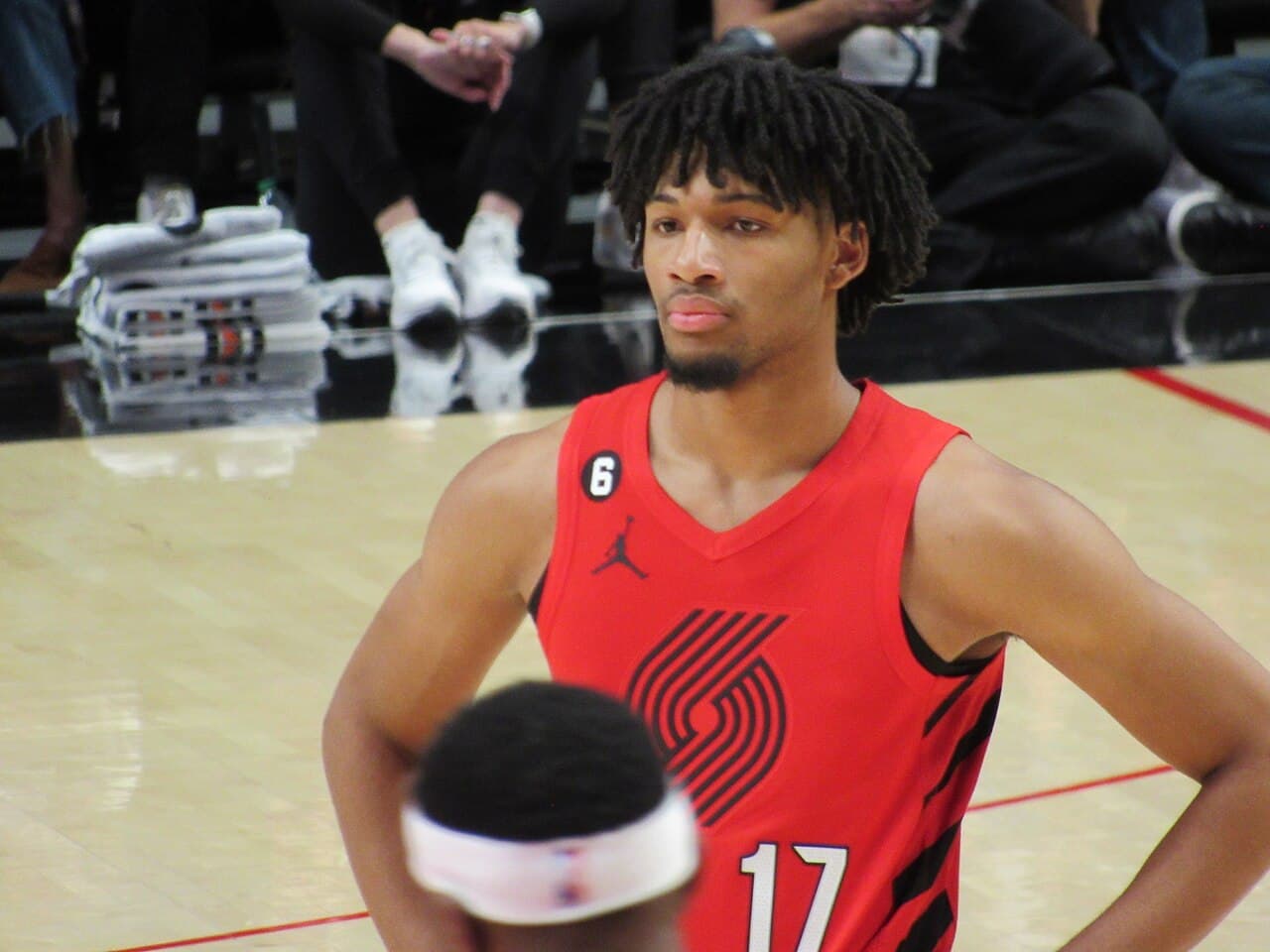
Portland Trail Blazers guard Shaedon Sharpe tore the meniscus in his right knee during an offseason workout and is expected to miss roughly six months, according to reporting from ESPN's Shams Charania. Surgery was expected this week. If the timeline holds, Sharpe would return somewhere around the All-Star break, having missed the large majority of the 2026-27 season.
Portland spent the summer building the most crowded backcourt in the league. It just got one player less crowded in the worst possible way.
The player Portland loses
Sharpe averaged 20.8 points per game last season, which made him one of the more productive young scorers in the Western Conference. He also missed a significant chunk of that season with a stress fracture in his left fibula.
That is the part that turns this from a bad break into a pattern. A 23-year-old with consecutive seasons interrupted by lower-body injuries, now facing a knee procedure with a six-month runway, is a player whose durability has become a real input rather than a footnote.
Meniscus recovery timelines vary considerably depending on whether the tear is repaired or trimmed. A six-month projection is on the longer end, which usually indicates a repair rather than a debridement. Repairs take longer and tend to hold up better, so the length of this timeline is arguably good news about the eventual return, even though it is bad news about this season.
What it does to Portland's rotation
Before the injury, Portland's guard situation was the most unresolved rotation in the NBA. The Blazers acquired Ja Morant this offseason and added him to a roster that already had Damian Lillard, Jrue Holiday, and Scoot Henderson, with Sharpe alongside them. That is five players with legitimate claims to significant minutes and, in several cases, to starting jobs.
First-year head coach Micah Nori inherited that problem, and nobody expected it to be publicly resolved before training camp.
Sharpe's injury does not solve it, but it does simplify it. Removing one high-usage guard from a five-way competition converts an unsolvable problem into a difficult one. Morant, Lillard, and Holiday now have a clearer path to the minutes that were going to be fought over, and Henderson's role becomes easier to define.
Fantasy fallout
Sharpe falls off draft boards in redraft formats entirely. A six-month absence means he is not a stash, he is a player you take in the final round of a dynasty draft or acquire off waivers in February.
Ja Morant is the largest beneficiary. He was always going to have the ball, but the minutes ceiling in a five-guard rotation was the biggest threat to his projection. That threat is reduced.
Damian Lillard and Jrue Holiday both gain, and Holiday gains more in category leagues than in points leagues. His value comes from steals, three-pointers, and efficiency, all of which scale directly with minutes.
Scoot Henderson is the interesting one. He was arguably the player most at risk of being squeezed out of the rotation entirely. He is now more likely to have a defined bench role, which raises his floor without doing much for his ceiling.
The general principle: when a high-usage player is removed from a crowded rotation, the beneficiaries are not distributed evenly. The players who share the same role gain the most, and in Portland that means the ball-handlers rather than the wings.
The Verdexed model take
Verdexed's rotation model allocates projected minutes probabilistically across a roster rather than assigning a fixed depth chart, and Portland carried one of the widest minutes distributions in the league before this news.
Removing Sharpe narrows that distribution meaningfully. The model's revised projections raise Morant's expected minutes and usage more than any other Blazer, with Holiday second, and it materially reduces the probability of the outcome that most threatened Portland's fantasy assets, which was a genuine five-man committee where nobody cleared 30 minutes a night.
At the team level, the model's read on Portland's win total moves down, but by less than the loss of a 20-point-per-game scorer would suggest. That is a function of redundancy. A team with five capable guards absorbs the loss of one better than a team with two.
The betting angle
Portland's win total is the market to watch. If the number drops by a full game or more on this news, that is likely an overcorrection given the depth behind Sharpe. The Blazers were not a team whose season hinged on him, precisely because of how much guard talent they accumulated.
Sharpe's own season-long props, if any remain posted, should be treated as void rather than as value.
The more interesting derivative is Morant's scoring and assist markets. A player whose minutes projection just improved is a player whose season-long counting-stat lines are stale until books adjust.
What to do in your league
Remove Sharpe from your redraft board. Move Morant up, Holiday up modestly, and Henderson up slightly. Do not overreact on Lillard, whose role and minutes were the most secure in the group regardless.
In dynasty leagues, this is a buy-low window on Sharpe specifically. He is 23, he was productive, and the acquisition cost from a manager who just lost most of a season is the lowest it will ever be. That is a bet on the calendar rather than on the knee.
What's next
The concrete checkpoint is surgery confirmation and the post-operative timeline, which is usually more precise than the initial report. A repair confirmed at six months means a February return and a season best treated as a write-off. Anything shorter would be a meaningful upgrade to his dynasty outlook.
The second checkpoint is Portland's opening-night starting lineup, which will now be easier to project than it was 48 hours ago.