 NFL2026-08-23
Nick Chubb Retired at 30 and the Last Argument for Drafting Old Running Backs Went With Him
By Verdexed NFL Desk
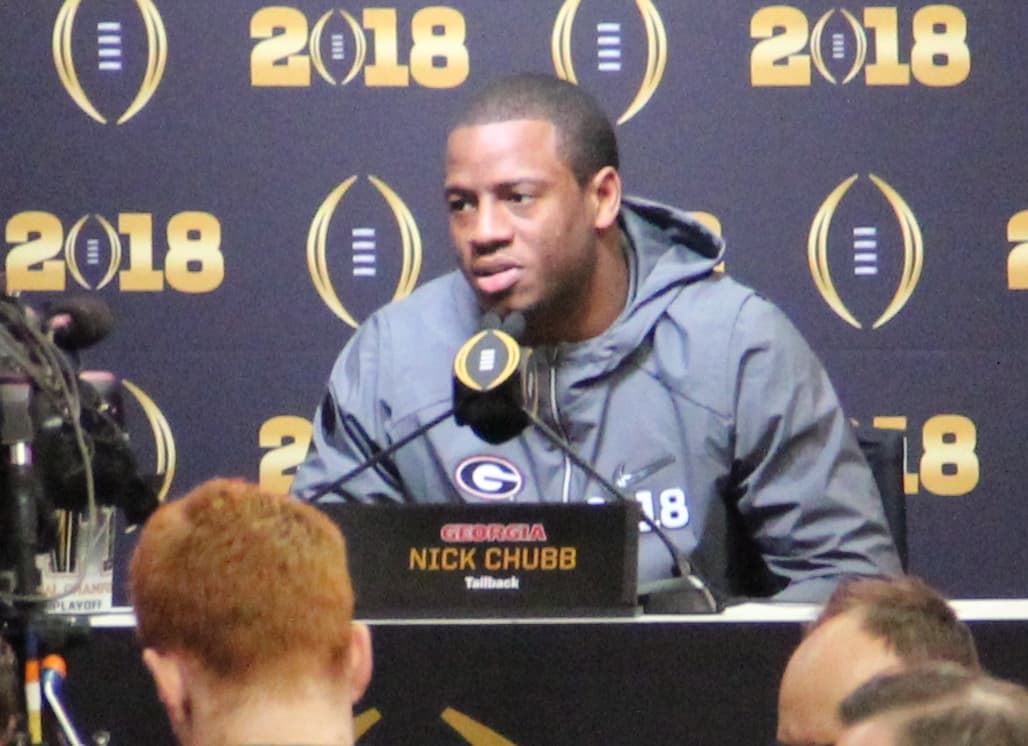
Nick Chubb announced his retirement on Friday, ending an eight-season career that produced 7,349 rushing yards, 54 touchdowns and four Pro Bowl selections. He is 30. A second-round pick of Cleveland in 2018, Chubb spent seven seasons with the Browns and one with Houston, where he rushed for 506 yards in 15 games last season. The knee injury he suffered at Pittsburgh on a Monday night in Week 2 of 2023 ended that season and, in the way these things get measured afterward, ended the version of Chubb that was on a Hall of Fame trajectory.
The fantasy relevance is not the tribute. It is the market. Chubb was one of the last remaining free-agent running backs with a genuine track record, and his retirement removes the veteran floor that has been quietly holding up the back half of every NFL depth chart heading into cutdown day on August 30.
What this settles in Houston
Chubb had been listed atop Houston's preseason depth chart in earlier iterations, but the situation had already moved past him. The Texans acquired David Montgomery from Detroit and have spent August splitting first-team backfield work between Montgomery and second-year back Woody Marks. NFL Network reporting has described the two as splitting reps as the lead back, with Montgomery favored for early-down volume and Marks positioned for passing-down work.
Marks made his case in the preseason loss to Las Vegas, turning four carries into 37 yards and a 20-yard touchdown on a busy opening drive while adding a reception. That is the kind of usage pattern that survives into the regular season, because it reflects a role rather than a hot hand.
Chubb's retirement removes the last plausible scenario in which Houston's committee became a trio. For fantasy purposes the Texans backfield is now a two-man split with a clear early-down back and a clear passing-down back, and both are draftable at their current prices for exactly what they are: neither is a bell cow, and neither should be paid like one.
The veteran running back market before cutdown day
Thirty-seven cuts per team arrive on August 30, with waiver claims clearing at 1 p.m. ET on August 31. Every year, that window produces a short list of experienced backs who become available to teams that lost someone in August. This year's August has produced more of those losses than usual.
Chubb coming off the board matters because he was the name teams could call. A player with his production history, even in decline, sets the reference price for what a veteran addition costs. With him retired, the teams that need a body in early September will be choosing from a thinner group, which means more opportunity flowing to rookies and second-year backs already on rosters and less late-August roster churn at the position.
For fantasy managers, that is a reason to value handcuffs more, not less. The replacement-level veteran who used to appear on a depth chart in Week 2 after an injury is a scarcer commodity now, and the next man up is more likely to be someone already in the building.
Fantasy fallout
Three practical consequences.
The first is for anyone still holding Chubb in a dynasty league. The roster spot is now free, and it should go to a young back with a path to volume rather than another aging veteran. The market has spent two offseasons proving that running backs who lose explosiveness do not get it back.
The second is for redraft managers evaluating the Houston backfield. Montgomery and Marks now split a defined pie with no third claimant. Montgomery's ceiling is capped by Marks' passing-down role, and Marks' floor is capped by Montgomery's early-down volume. Both are fine picks. Neither is a value at a price that assumes one of them wins the job outright, because neither is going to.
The third is about age curves generally. Chubb retiring at 30 after a knee injury at 27 is the modern running back arc in one sentence. Fantasy boards still routinely place backs in their late twenties in the same tier as backs in their early twenties with similar projected volume. That is a mistake the market keeps making, and it costs managers most in the weeks after an injury, when the older back does not come back the same.
The Verdexed model take
Our running back aging model applies a steepening penalty starting in a player's age-27 season, with an additional penalty for backs carrying a major lower-body injury in the preceding three years. Chubb cleared both thresholds, which is why our projections had him well outside relevance even before the retirement.
The more interesting model output concerns the market he leaves behind. We track the availability of experienced free-agent backs as an input to how much value we assign to a starter's direct backup, on the logic that a thin veteran market makes the rostered handcuff more likely to inherit real volume. That input has been trending toward scarcity all August. Chubb's retirement pushes it further.
The practical translation: our handcuff valuations for the backups behind high-volume starters are running above where the market prices them, and the gap widened this week. If you are drafting in the last week of August, the late-round backup running back is worth a pick earlier than a standard board says.
What it means
Chubb's career deserves the retrospective it is getting. What a fantasy manager or bettor should take from Friday is narrower and more useful. Houston's backfield is settled as a committee, and it should be drafted as one. The veteran safety net that teams have relied on to patch September injuries is thinner than it has been in years. And the handcuff running back, historically the most ignored pick on the board, is worth more in 2026 than it was in 2025.
The August 30 cutdown will show whether the market agrees. Watch which teams claim running backs on the waiver wire that Monday. Those are the rooms that know they are one injury from a problem, and their starters' backups are the ones worth stashing.