Mike McDaniel Lands as Chargers OC, a Scheme Boost for Herbert, McConkey and Hampton
By Verdexed NFL Desk
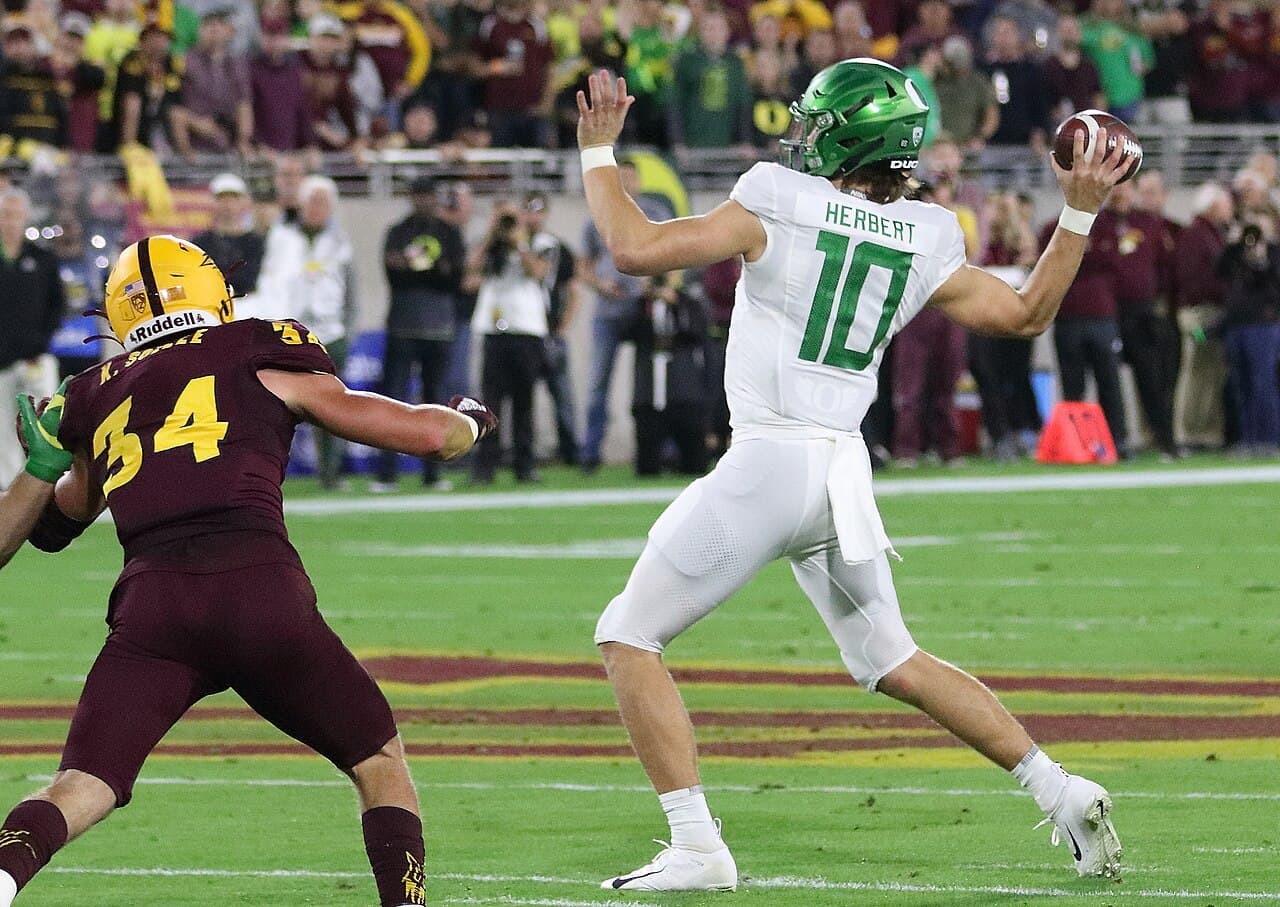
The Los Angeles Chargers officially hired Mike McDaniel as their offensive coordinator, adding one of the league's most distinctive offensive minds to Jim Harbaugh's staff for the 2026 season. The move pairs McDaniel with quarterback Justin Herbert and reshapes the fantasy outlook for a Chargers offense that now carries one of the more intriguing scheme-fit stories of the cycle.
McDaniel arrives in Los Angeles after four seasons (2022 through 2025) as head coach of the Miami Dolphins, where his offenses became synonymous with pre-snap motion, manufactured touches, and yards after the catch. As coordinator, he gets to pour that system into Herbert, and he has publicly framed his goal as helping Herbert own the position in a new way, a stated ambition that signals how central the quarterback is to the plan.
A coordinator carousel that reshaped the league
The McDaniel hire did not happen in isolation. The 2026 cycle featured heavy turnover across the league, with roughly 10 head-coaching changes and around 21 offensive coordinator changes. That churn reset schemes, play-callers, and offensive identities for a large chunk of the NFL, and it makes scheme-fit analysis more valuable than usual heading into draft season.
In that context, the Chargers landing an established, identity-defining offensive coach as a coordinator is a notable outcome. Many teams spent the offseason hiring first-time or unproven play-callers, while Los Angeles secured someone with four years of head-coaching reps and a clearly articulated system. For fantasy purposes, a known scheme attached to known personnel is easier to project than the guesswork surrounding many of the new hires elsewhere.
The scheme: motion, YAC, and explosives
McDaniel's offense is built around pre-snap motion and a heavy emphasis on yards after the catch. The system is designed to create easy completions, manufacture leverage for skill players in space, and generate explosive plays off well-timed concepts rather than asking the quarterback to win every rep from a static look. Historically, that approach has lifted target efficiency and the rate of chunk gains.
For Herbert, the appeal is obvious. A quarterback with his arm strength and accuracy operating inside a scheme that engineers open throws and YAC opportunities should see his efficiency narrative trend upward. The Chargers' team total and passing-game story both get a boost from the pairing, and McDaniel's stated goal of elevating Herbert's game reinforces that the offense will run through its quarterback.
Fantasy fallout: McConkey and Hampton
The most cited beneficiaries among fantasy analysts are wide receiver Ladd McConkey and running back Omarion Hampton, both core pieces of the Chargers' skill group. It is worth being precise: McConkey is a Chargers wide receiver and Hampton is a Chargers running back, and the projections tying them to McDaniel's arrival are analyst expectations rather than anything the team has stated about roles or usage.
With that framing, the logic is sound. McConkey profiles as exactly the kind of separation-and-YAC receiver McDaniel's motion-heavy system tends to feature, which supports the analyst view that he carries a WR1 ceiling in this offense. Hampton, meanwhile, stands to benefit from a scheme that has historically valued running backs as receiving threats, giving him a path to receiving-down usage that raises his floor in PPR formats on top of his early-down work.
The practical read for managers is to treat both as scheme risers whose draft cost may climb as the McDaniel narrative spreads. McConkey's case rests on a target-efficiency and explosive-play environment that fits his game; Hampton's rests on the receiving usage the system tends to generate. Neither role is officially defined, so these are bets on scheme fit, but they are well-grounded bets.
Betting angle: a Chargers offense trending up
The arrival of an identity-defining offensive coordinator typically nudges a team's offensive markets upward, and the Chargers fit that pattern. A motion-and-YAC system attached to a quarterback of Herbert's caliber supports a more optimistic passing narrative, which can filter into team-total and passing-prop markets as the McDaniel effect gets priced in.
The disciplined approach is to lean into the offensive shift without overpaying for a scheme that has not yet taken a live snap in Los Angeles. Herbert's outlook and the team's passing volume are the cleanest expressions of the upgrade. McConkey and Hampton offer the higher-variance angles, with their prop and ADP value tied to roles that camp will clarify. Getting ahead of the narrative on draft-day cost is the edge; chasing it after the market adjusts is not.
The Verdexed model take
The model treats the McDaniel hire as a genuine, projectable offensive upgrade rather than coordinator-change noise. The reason is the combination of a defined system and stable personnel: unlike many of the cycle's uncertain new play-callers, McDaniel brings a four-year track record and a clear methodology, which reduces the guesswork in forecasting the Chargers' offensive shape.
The model leans bullish on Herbert's efficiency environment and on the explosive-play rate the scheme tends to produce, while flagging McConkey and Hampton as scheme-driven risers whose exact usage remains an analyst projection until camp. The cleanest edge is acting on the scheme-fit logic before ADP fully absorbs it, then letting training camp confirm the role distribution.
What's next
The markers to watch are how McDaniel deploys McConkey and Hampton in OTAs and training camp, and whether early reporting confirms the receiving-down role for Hampton and the featured-target role for McConkey that the analyst projections assume. Herbert's command of the new system through camp will also signal how quickly the offense can hit its ceiling.
The actionable takeaway is to treat the Chargers as a scheme-riser target. Managers should value Herbert's efficiency upside, draft McConkey believing in his WR1 ceiling within this system, and view Hampton as a back whose PPR floor rises with McDaniel's pass-game usage. Bettors should monitor Chargers team-total and passing markets for the upgrade, then confirm the role split in camp before committing to individual props.