Mason Marchment Has a Path to Macklin Celebrini's Wing, and a Late Fantasy Draft Price
By Verdexed NHL Desk
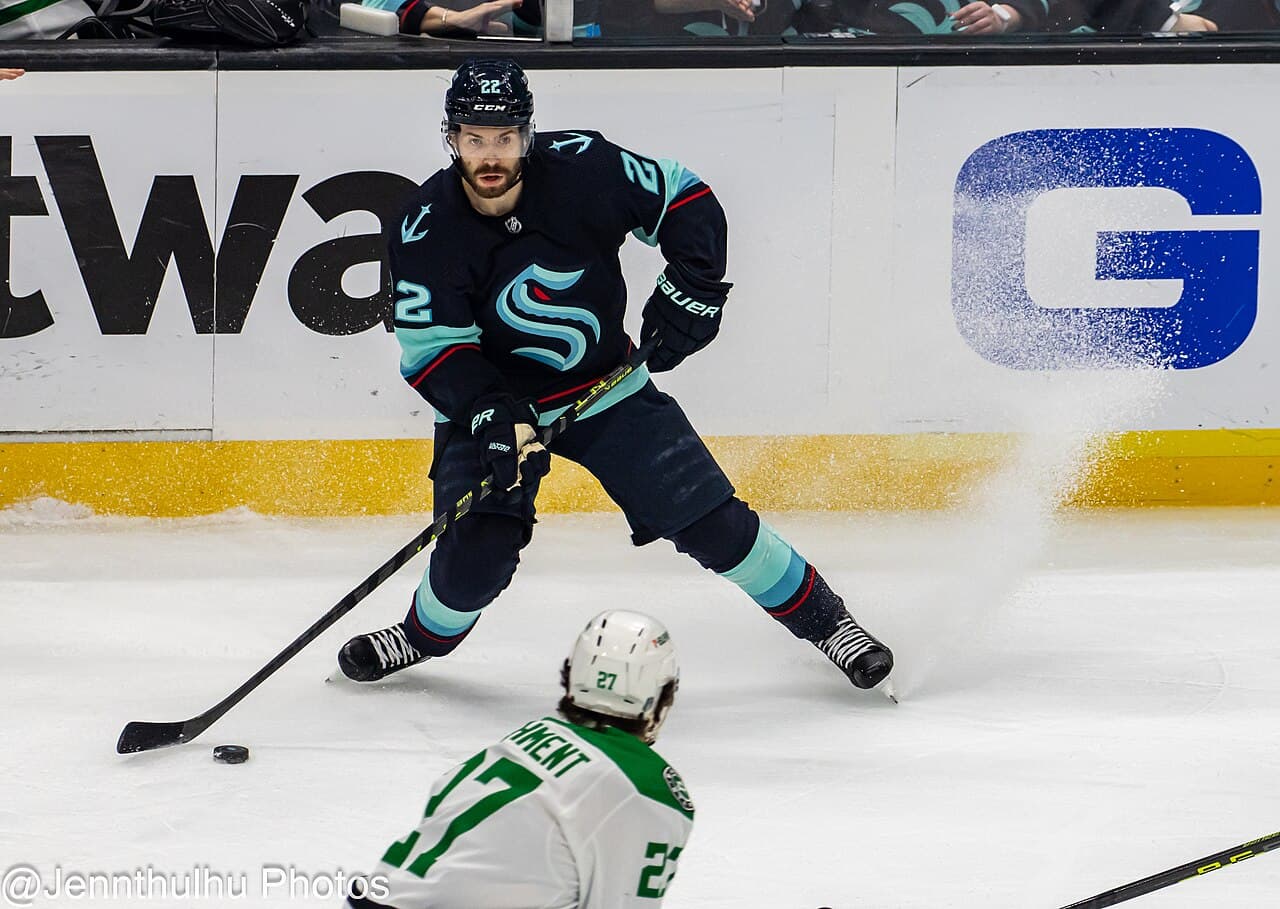
The San Jose Sharks signed Mason Marchment to a five-year contract worth $33.75 million in free agency, and the fantasy hockey market has largely filed it under depth signing. That is a mistake worth exploiting, because Marchment's most likely deployment puts him next to one of the highest-scoring young centers in the league.
San Jose's offseason had a clear shape: fortify a defense that had been overwhelmed for several seasons, and add finishing around a forward group built on young centers. Marchment is the second half of that plan. He is a large, physical winger whose game is built on forechecking pressure and net-front presence, which is precisely the complementary profile a skilled young center needs.
The deployment question
Projections out of San Jose have been split on where Marchment starts the season. Some have him on the top line alongside Macklin Celebrini. Others place him on the second unit with Michael Misa. Both outcomes are live, and the gap between them is the entire fantasy case.
Celebrini is coming off a season in which he produced 45 goals and 70 assists for 115 points in 82 games, breaking Joe Thornton's franchise record. The Sharks signed him to a five-year, $94 million extension in late July that will carry an $18.8 million average annual value when it begins in 2027-28, the richest deal in league history. That is not a player whose linemates are hard to project into value. Anyone taking regular five-on-five and power-play shifts with Celebrini is going to have opportunities.
The second-line outcome with Misa is meaningfully less valuable but not worthless. Misa is a high-end young center in his own right, and a Marchment who plays 16 minutes a night in a top-six role with second-unit power play time is still a useful fantasy contributor in deeper leagues.
Why the market is underrating him
Three things are suppressing Marchment's draft price, and only one of them is a real reason.
The first, and the legitimate one, is that his production has been inconsistent across his career. He has had strong stretches and quiet ones, and his best seasons have come in specific deployments rather than as a portable trait. That is a fair concern and it should be reflected in his price.
The second is that San Jose has been a bad team, and fantasy managers apply a blanket discount to players on bad teams. That discount is appropriate for goaltenders and defensemen whose value depends on team defensive structure. It is much less appropriate for forwards, whose scoring is driven by ice time and linemate quality, both of which are frequently better on rebuilding teams than on deep contenders. A top-six winger on a bad team often gets more opportunity than a third-liner on a good one.
The third is simple attention. Marchment signed on the first day of free agency, at which point the market was processing a much larger set of moves. Signings that land in that window get evaluated once and then largely forgotten, and his price has not been revisited as the projected line combinations have firmed up.
Fantasy fallout
Marchment belongs on every draft-day watch list as a late-round target in twelve-team leagues and a mid-round consideration in deeper formats.
The specific reason to want him over comparably priced wingers is the shape of his outcome distribution. Most late-round forwards have a narrow range: they are third-liners who might get a small bump. Marchment's range is wide in the direction you want, because the top-line outcome would push him toward a level of production his draft cost does not remotely account for.
The categories work too. Marchment's physical style generates hits and shots on goal, which are scoring categories in most multi-category formats and which do not depend on where he plays in the lineup. That gives him a floor even in the second-line scenario, which is exactly what you want from a late-round pick. A player whose floor comes from peripheral categories and whose ceiling comes from linemate quality is the ideal shape for a late selection.
The downstream note is that Celebrini's own value goes up slightly, which matters at the top of drafts. A center whose wingers include a net-front finisher is a center whose assist totals have more support. Celebrini was going to be a first-round pick regardless, and this is a small reinforcement rather than a repricing.
Betting angle
San Jose's team markets are the interesting expression here. The Sharks have carried among the lowest point totals in the league for several seasons, and the market's prior is heavily anchored to that.
What has changed is that this roster is materially different. The Sharks added veteran defensemen this offseason to stabilize a blue line that had been the primary source of their goals-against problem, and they have a legitimate top-line center entering his prime years with support around him.
That does not make San Jose a playoff team. It does mean that a points total set on the assumption of another bottom-three finish may be stale, and the over on a team that has genuinely improved its defensive structure is the kind of bet that pays when the market is pricing reputation.
Player props are the more precise play. Marchment's season-long point total, if it is set on his career average rather than on a projected top-six role in San Jose, is a candidate for the over. Shots on goal props for physical wingers moving into larger roles are consistently the softest market in hockey.
The Verdexed model take
Verdexed's model projects forward scoring primarily from projected ice time and linemate quality, with individual shooting talent as a smaller adjustment. That structure is why the model's read on Marchment diverges from the market's.
Run with the top-line assumption, the model produces a projection that would make him a comfortable everyday starter in twelve-team leagues. Run with the second-line assumption, it produces a useful but unspectacular contributor. Probability-weighted across both, the projection sits well above his current draft cost.
That is the cleanest kind of edge available in an August fantasy draft: a player whose worst realistic outcome roughly matches his price and whose better outcome is a multiple of it. You are not paying for the upside, which means you get it for free if it happens.
The model's flagged risk is health and consistency rather than opportunity. Marchment's physical style carries injury risk, and his career pattern includes seasons where his production did not match his role. Neither of those changes the draft-day math at his cost.
What to do in your draft
Take him in the last three rounds of a standard league. Take him earlier in a league that counts hits and shots. And in either format, monitor San Jose's line combinations through the preseason, because the reports out of training camp will settle the top-line question before most drafts happen.
If the preseason confirms him on Celebrini's wing, his price will move, and it will move fast. The window to buy is now, while the projected lineup is still described as uncertain.