 NHL2026-08-30
Gavin McKenna Is Toronto's No. 1 Pick and the Second Rookie Off Fantasy Boards
By Verdexed NHL Desk
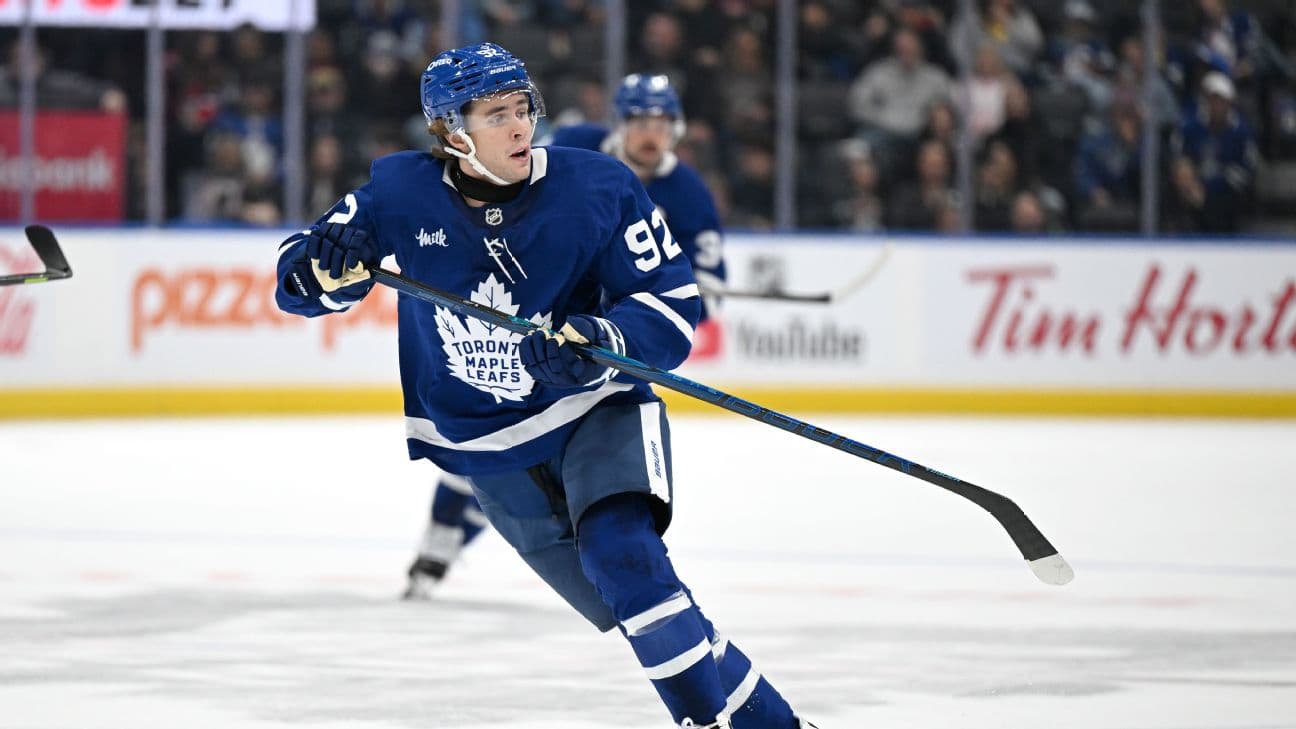
Gavin McKenna was selected first overall by the Maple Leafs in the 2026 NHL Draft and signed a three-year entry-level contract after one season at Penn State. With training camps opening in mid-September and the regular season starting September 29, the fantasy question is no longer whether he plays, it is where he plays and how quickly Toronto trusts him.
The college résumé is the strongest recent one for a No. 1 pick. McKenna put up 15 goals and 51 points in 35 games as a freshman, setting Penn State program freshman records in both assists, with 36, and total points. He turned 18 during that season. The scouting consensus on him has been unusually uniform, describing a player whose puck skill and creativity are the kind that do not need to be taught.
Not the Calder favorite, and that is the point
The interesting piece of the fantasy landscape is that McKenna is not the consensus top rookie on fantasy boards. NHL.com's fantasy rankings place him second among rookies, behind Porter Martone of the Flyers, and fourth among Maple Leafs skaters, in the general vicinity of 80th overall.
That ordering is defensible and it is also the source of the opportunity. Martone's case rests on a defined role in Philadelphia's top six. McKenna's case rests on a role Toronto has not publicly settled, and unsettled roles get discounted in preseason rankings regardless of talent.
The gap between a rookie who plays 14 minutes a night and one who plays 18 with power play time is enormous in fantasy terms, and it is decided in camp.
The line placement question
Toronto's obvious temptation is to put McKenna on the left side alongside Auston Matthews, which would maximize his offensive environment immediately. The counterargument, and the one that has been floated most often publicly, is that starting an 18-year-old in the hardest matchup on the team is not the way to develop him.
The more measured projection puts him on a secondary line with the freedom to move up as he adjusts, with an eye toward promoting him into the top six once the coaching staff has seen him against NHL competition. Toronto has a new coaching staff and a reshaped roster, which adds uncertainty in both directions.
Power play deployment is the variable that matters most. A rookie on the first unit in Toronto has access to elite finishers and a genuine path to 60-plus points. A rookie on the second unit is a depth fantasy asset.
Fantasy fallout
Public projections have landed in a reasonable range. One widely circulated estimate has McKenna at roughly 24 goals and 44 assists for 68 points if he holds top-six minutes and first-unit power play time for a full season. That is a projection built on the optimistic branch of the deployment question, and it should be read as a ceiling rather than an expectation.
The realistic redraft approach is to draft McKenna as a mid-round forward with genuine league-winning upside rather than as a safe contributor. He is the kind of player who is either a top-40 forward or a waiver-wire drop by December, and the distribution is bimodal rather than smooth.
The multi-category profile is the appeal. McKenna projects to generate assists and shots at a high rate, which supports value even in a season where the goal total lags. Rookies typically underperform their shooting percentage expectations, and assists are the more stable rookie category.
The Verdexed model take
Verdexed's model projects rookie forwards using a combination of draft pedigree, junior and college production adjusted for league quality, and a deployment estimate weighted toward what the team actually does in the first ten games rather than what it says in September.
Applied to McKenna, that produces a projection between the conservative public rankings and the aggressive 68-point estimate. The model has him as a clear positive-value pick at his current ranking, mostly because the ranking prices him as a player with uncertain deployment while the model gives high probability to a top-six role materializing quickly for a first overall pick on a team that needs scoring.
The model's specific flag is on the first ten games. Rookie deployment stabilizes fast in the NHL, and the difference between a McKenna who is on the first power play unit in October and one who is not is worth roughly 20 points of season-long projection. That is the single largest swing factor on any rookie in the league this year.
What to do in your league
Draft him where the rankings say, or one round earlier if your league rewards upside. Paying two rounds above his ranking is overpaying for a deployment outcome that has not happened.
In dynasty leagues he is a top asset regardless of the rookie season, and the correct move is to acquire before a hot October rather than after.
Track the first two weeks of ice time and power play usage closely. If McKenna is playing top-six minutes with the first unit by mid-October, his in-season trade value will never be lower than it is right now.
What's next
Camps open in mid-September and Toronto's season begins September 29 at home. The preseason games are the first real evidence: who he lines up with, whether he is on the top power play unit, and whether the coaching staff treats him as a rookie to bring along or a scorer to use immediately. Everything about his fantasy value follows from that answer.