DeVonta Smith Is the Eagles' WR1 Now: The Other Side of the A.J. Brown Trade
By Verdexed Fantasy Desk
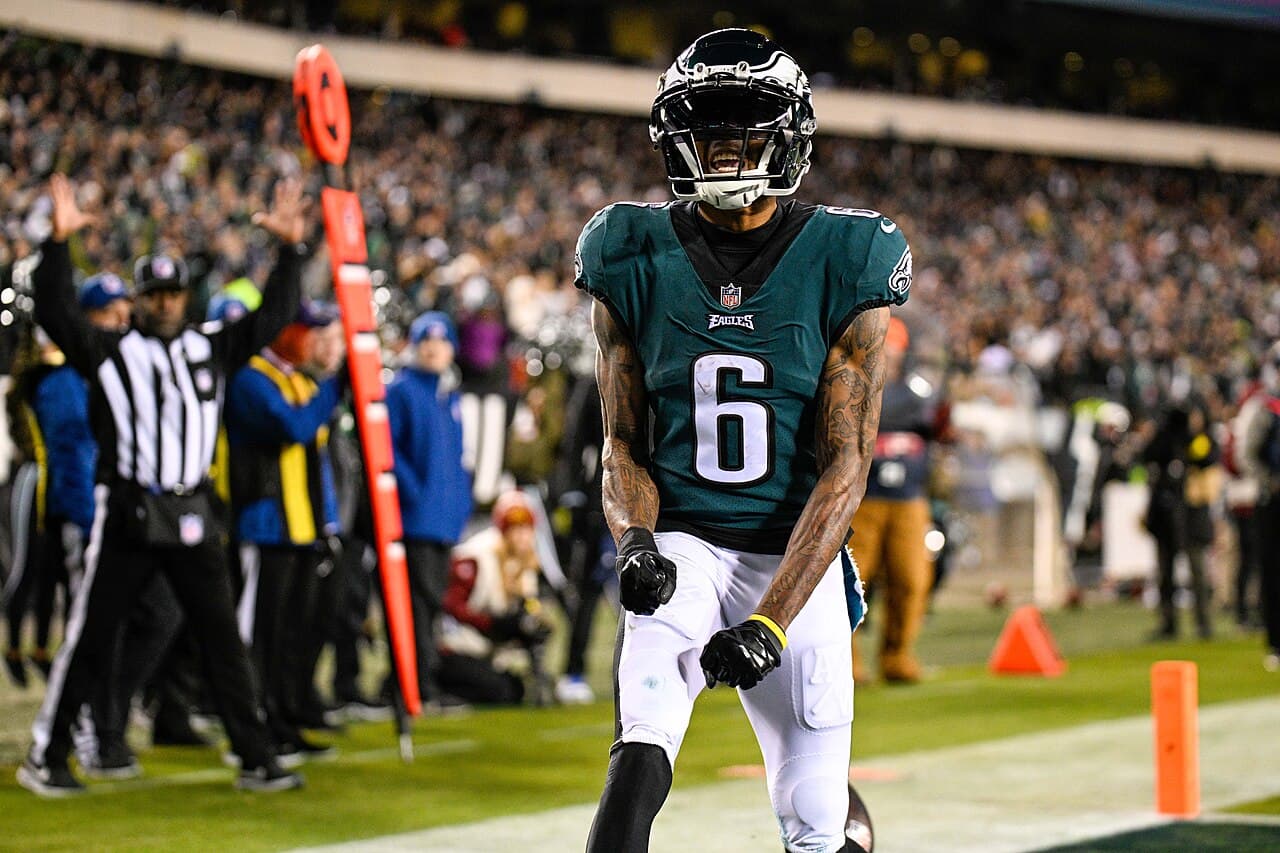
The A.J. Brown trade did more than reshape New England's passing game. It cleared the runway in Philadelphia for DeVonta Smith, who steps into an unambiguous No. 1 receiver role for the first time since his rookie year. For fantasy managers, that is the more actionable half of the deal, because Smith is going later in drafts than his new opportunity suggests he should.
The opening Brown's exit creates
For four seasons Smith played second fiddle to Brown, a dynamic that capped his target share even when his per-route efficiency screamed for more. That ceiling is gone. Smith is now the clear top option in an offense built around Jalen Hurts, and the target volume that used to flow to Brown has to land somewhere.
The split-game data tells the story. In the routes Smith has run with Brown off the field across recent seasons, his target rate and yards-per-route-run have spiked into front-end WR1 territory. That is not a projection; it is what Smith already does when he is the focal point. A full season of that usage is the bet, and it is a reasonable one.
He is coming off a down team year in which he still finished as a low-end WR2 despite an offense where, by most accounts, little went right in the passing game. Anchoring his floor to that disappointing baseline while layering on a clear bump in opportunity is how value gets created in June drafts.
The rest of the room
Philadelphia did not stand still. The Eagles added veteran speedster Hollywood Brown in free agency, acquired Dontayvion Wicks via trade, and drafted rookie Makai Lemon, who projects as the eventual No. 2. None of those additions threatens Smith's alpha status; if anything, the spread of complementary pieces makes it harder for defenses to bracket him on every snap.
The biggest secondary beneficiary may be tight end Dallas Goedert. In the snaps he has played without Brown on the field, Goedert's target rate and efficiency have been outstanding, the kind of usage that would have ranked among the best at the position. With Brown gone for good, Goedert moves up the tight end board as a mid-tier starter with a real target floor.
Rookie Makai Lemon is the dynasty name to file away. He is unlikely to command heavy redraft volume in year one behind Smith and the veterans, but the long-term path to targets is now wide open in an offense that throws to its receivers when it leans pass.
What it means for Jalen Hurts
Hurts loses his most explosive weapon, which is a genuine downgrade to the offense's downfield ceiling. But his fantasy value has always been propped up by rushing production and goal-line work, and that does not change. If anything, a receiver room with less established target gravity could mean a few more designed quarterback runs near the end zone, which is the most valuable fantasy real estate there is.
The efficiency question is real: Hurts now has to elevate a less proven set of pass catchers. That is a knock on his passing ceiling, not on his weekly floor, and it keeps him in the back-end QB1 conversation rather than dropping him out of it.
The Verdexed model take
The model views Smith as the cleanest value play to emerge from the trade. His usage profile without Brown is already that of a top-12 receiver, and the market has been slow to fully reprice him, leaving him available outside the top dozen wideouts in early drafts. That gap between projected role and draft cost is exactly the edge fantasy managers should be hunting in June.
The model is more measured on the Eagles' offense as a whole. Removing a defense-bending receiver lowers the unit's ceiling and nudges the team's projected pass efficiency down a notch, which is why Smith's bump is real but not unlimited. He is a strong WR2 with WR1 upside, not a guaranteed top-five option.
The alignment and matchup case
Smith's efficiency without Brown is not a small-sample fluke; it reflects a route-runner who separates against both man and zone and who can move inside or outside depending on the coverage. As the clear No. 1, he will draw more shadow attention, but the complementary pieces the Eagles added make full-time bracketing costly for defenses.
The alignment flexibility is the underrated part. A receiver who can win from the slot and the boundary is harder to game-plan against and tends to see steadier target volume week to week, which is exactly what fantasy managers want from someone they are drafting to start every week. That consistency is a big part of why his floor rose the moment Brown was dealt.
What to do in your league
Move Smith up your board and treat him as a high-end WR2 with a path to WR1 numbers. If he is sliding because drafters are anchored to last year's down finish, draft the opportunity, not the disappointing box score.
Bump Goedert into your mid-tier tight end group; the without-Brown usage makes him a sneaky floor play. Stash Makai Lemon in dynasty as a clear ascending asset, and keep Hurts in your QB1 mix on the strength of his rushing, while acknowledging his passing ceiling took a hit the day Brown was dealt.
Of all the players touched by this trade, Smith is the one whose arrow points most clearly up. He gets the targets, the alignment freedom, and a quarterback who has thrived with him before, all at a draft cost that still reflects an old, crowded depth chart. That gap between price and opportunity is the cleanest edge the deal created, and it is the one fantasy managers should move on first.