 NFL2026-08-26
Chuba Hubbard Is on Track for Week 1 and Carolina Is Still Splitting the Backfield
By Verdexed Fantasy Desk
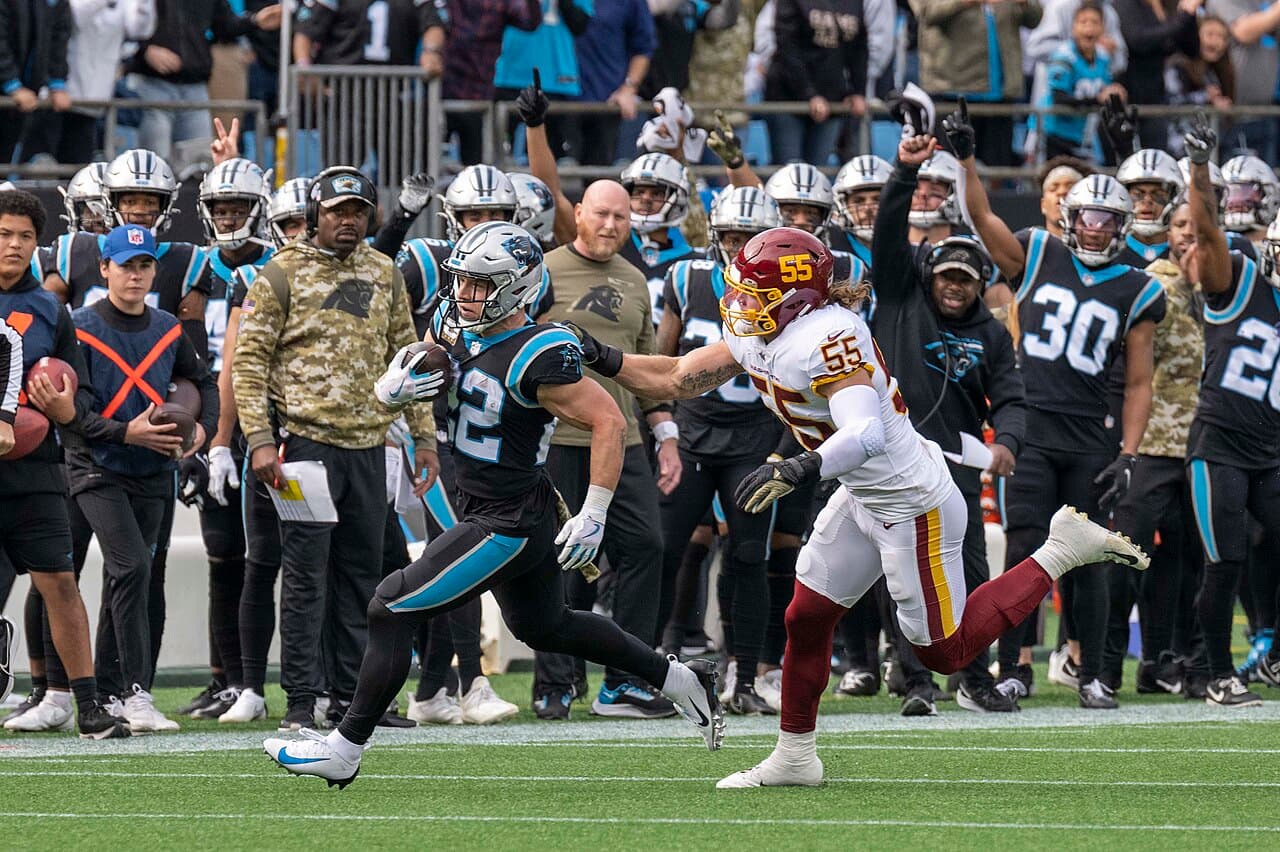
Carolina Panthers head coach Dave Canales told reporters this week that Chuba Hubbard is expected to be ready for the Week 1 opener against the Chicago Bears, closing out a training camp in which a hamstring strain kept Hubbard out of every preseason game. Canales also confirmed that Carolina intends to open the year with a committee, rotating Hubbard and Jonathon Brooks by series with the other back handling third downs.
Both halves of that update matter, and the second half matters more.
The injury, and why it lingered
Hubbard strained a hamstring in camp and was described in team practice reports as week to week. He did not appear in a preseason game. That is a long absence for a soft-tissue injury in August, and it is the kind of timeline that tends to produce two competing narratives: one that says the team is being appropriately cautious with a starter it does not need to expose in exhibition games, and one that says the injury is worse than advertised.
Canales came down firmly on the first. Asked directly whether Hubbard would be ready for the opener, he indicated there was no doubt. That is about as clear a statement as a head coach gives in August.
The caveat worth holding is that hamstrings recur. A back who missed most of camp and did not get preseason reps is carrying more re-injury risk into September than one who practiced through, regardless of what the coach says about Week 1 availability.
The committee is the real news
Canales described the plan as a lead back for the series with the other back coming in on third down, both because of pass protection responsibilities and because Carolina runs the ball on third down. That is not coach-speak for "Hubbard is the starter and Brooks will vulture some carries." It is a description of a genuine rotation.
Brooks has taken the bulk of the first-team work while Hubbard has been out, and that work has value beyond the depth chart. He missed last season recovering from a torn ACL, and the reps he collected in August are the reps that get a back trusted in protection. Trust in protection is what converts a committee back into a three-down back.
Fantasy fallout
Hubbard should be treated as a back with a starting role and a capped ceiling. He is not a fade, but the version of his projection that assumed a bell-cow workload is dead. Managers who drafted him in July at a price built on volume are holding a player whose realistic outcome is a strong RB2 in a good week and a flex play in a bad one.
Brooks is the more interesting asset. He entered August as a post-ACL question mark and exits it with first-team reps, a confirmed rotational role, and a path to more if Hubbard's hamstring resurfaces. His draft cost has already been climbing. It is still, in most rooms, cheaper than the role justifies.
The right way to hold this is that Carolina's backfield is one of the highest-variance situations in fantasy, and both backs are underpriced relative to the ceiling and overpriced relative to the floor. That sounds contradictory until you accept that the single most likely outcome for either player is a season in which one of them ends up with the entire job for a stretch.
The handcuff logic applies in both directions. If you draft Hubbard, Brooks is not optional. If you draft Brooks, Hubbard is the insurance you probably cannot afford, which is itself an argument for taking Brooks as the cheaper entry point into the same backfield.
The Verdexed model take
Verdexed's backfield model projects touches from a distribution rather than a point estimate, and confirmed committees widen that distribution substantially at both ends. What the Canales comments did was not lower Hubbard's projection so much as flatten it, moving probability mass away from the workhouse outcomes and toward a band of split-usage weeks.
Brooks moves the opposite way. His floor rises because a rotational role is now stated rather than inferred, and his ceiling rises because the mechanism by which he takes the job, an injury to a back with a fresh hamstring problem, is more probable than it was a month ago.
Run those two distributions against each other and the model's read is that Brooks is the better value at current draft cost, and that the gap between the two players in expected fantasy points is smaller than the gap in what the market charges for them.
The betting angle
Carolina's Week 1 rushing props are the place this shows up first. A confirmed series-based rotation compresses both backs' rushing attempt lines, and sportsbooks that set numbers off last season's usage will be slow to adjust for a committee that was only announced in the final week of August.
The team-level angle is unchanged. Carolina's offense is not better or worse because of how it distributes carries, and the Panthers' Week 1 spread and total should not move on this news.
What to do in your league
If you drafted Hubbard early, add Brooks now at whatever it costs. If you have neither, target Brooks specifically and skip Hubbard, because you are buying most of the same upside for less.
In redraft leagues that have already completed, watch the first two weeks of snap counts rather than box scores. In a series-based rotation, the back who plays more third downs is the back whose value is real, and that will show up in snap share before it shows up in yards.
What's next
The checkpoints are Hubbard's practice participation this week and Carolina's Week 1 usage split. If Hubbard is a full participant and takes the first series against Chicago, the committee is as described. If he is limited again, Brooks is a starting fantasy running back in September, and the price to acquire him will double overnight.