Bowen Byram Had a Hat Trick in His Blackhawks Debut and Runs the Power Play
By Verdexed NHL Desk
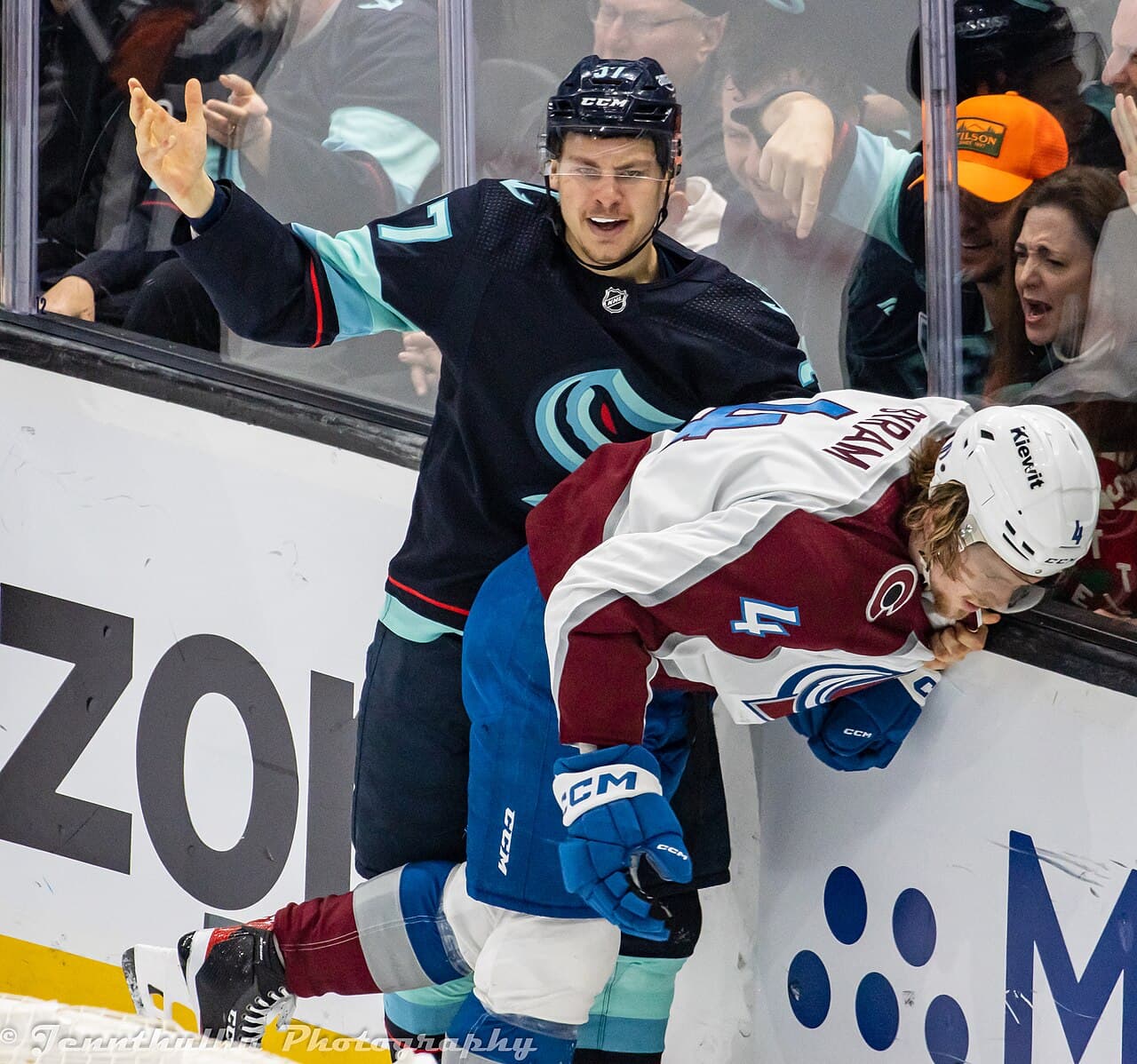
Bowen Byram scored a hat trick in his first game in a Chicago sweater, finishing it 29 seconds into overtime to give the Blackhawks a 4-3 preseason win over Minnesota at the United Center on Monday. He led the team with five shots on goal, added two hits, and finished plus-two. It is a preseason game and it should be treated as one, but the shape of the performance matches the projection, and that is what makes it worth writing about.
Byram arrived in Chicago in a June trade that sent the No. 4 pick in the 2026 draft to Buffalo, then signed a six-year contract reported at $75 million, a $12.5 million average annual value that begins this season. Chicago paid for a number one defenseman and the early returns suggest it is going to use him like one.
The opportunity is the story, not the hat trick
Three goals in a September exhibition tells you almost nothing about how many goals a defenseman will score in an 84-game season. What it tells you is how he is being deployed, and the deployment is the entire fantasy case.
Connor Bedard is expected to miss the start of the season after shoulder surgery in July, with reporting this month pointing toward a November return. He has been skating at camp without contact. That removes Chicago's best offensive player from the top power play unit for roughly the first quarter of the schedule.
Someone has to quarterback that unit, and there is no obvious internal competition for the job. Byram, a puck-moving left shot with power play experience and the largest contract on the blue line, is going to get it by default and keep it on merit.
Why 25 minutes a night matters more than talent
The single most predictive input for defenseman fantasy scoring is ice time, and specifically power play ice time. Points from the back end are a volume business. A defenseman who runs the first unit on a team with any offensive competence will outscore a more talented defenseman who runs the second unit, and the gap is not close.
Byram is projected to play north of 25 minutes a night for Chicago, which is top-of-the-league usage. Combine that with first-unit power play time and the reasonable projection range moves from the 40-to-45 point band most public forecasts have carried to something meaningfully higher. The 15-goal, 50-point outcome is live rather than aspirational.
The risk is the other side of a rebuilding roster. A defenseman who plays enormous minutes on a team that spends a lot of time in its own zone accumulates points slowly and plus-minus damage quickly. In category leagues that punish plus-minus, Byram is a significantly less attractive asset than he is in points-only formats.
What happens when Bedard comes back
This is the question fantasy managers should actually be modeling, because it determines whether Byram is a half-season play or a full-season one.
The optimistic read is that Bedard's return raises the ceiling of the power play without costing Byram the job. A quarterback and a finisher are different roles, and adding a high-end shooter to a unit makes the player distributing the puck more productive, not less.
The pessimistic read is that Chicago restructures the unit around Bedard in a way that shifts Byram to a secondary role, which is what happens on teams with multiple puck-movers. Chicago does not obviously have that problem, which is why the optimistic read is the more likely one.
Either way, the first six or seven weeks are the window where Byram's usage is least contested. Managers in weekly leagues should plan to lean on him early.
Draft-day recommendation
Byram is a mid-round defenseman in most public rankings, and he should not be. A defenseman with a $12.5 million cap hit, top-pair minutes, and uncontested first-unit power play time for the opening stretch of the season belongs several rounds earlier than his current price in points leagues.
The practical target is to draft him as your second defenseman while paying a third-defenseman price. That is the kind of positional arbitrage that decides fantasy hockey seasons, because the position is shallow and the gap between the top ten defensemen and the next twenty is enormous.
In dynasty formats, the six-year term is the whole argument. A 25-year-old on a long-term deal in a role that will only improve as the roster around him matures is a buy at almost any price.
The Verdexed model take
Our projection system builds skater scoring from ice time in each game state, on-ice shot rates, and individual shooting talent, in that order of importance. Byram's projection moved when the trade happened, not when he scored three goals in a preseason game.
The model reads his situation as a usage outlier: a defenseman whose deployment is in the top five percent of the league on a team whose offensive environment is in the bottom half. Those two facts partially cancel, but not evenly, because power play opportunity is worth more than even-strength team quality for defensemen specifically.
The output is a projection comfortably above the public consensus and a recommendation to treat him as a top-fifteen fantasy defenseman rather than a top-thirty one. The model is less enthusiastic about him in leagues that count plus-minus, where the Chicago environment is a genuine cost.
What is next
Chicago has a handful of preseason games left before the regular season opens September 29. Watch the power play personnel in those games rather than the scoresheet. If Byram is on the ice for the first unit with the team's best forwards, the projection holds regardless of whether he scores again.
The other thing to track is Bedard's contact status. A November return keeps the Byram-runs-everything window open for six weeks. An earlier return shortens it. Chicago has been deliberately vague, which is standard for a shoulder, and nothing about the current reporting suggests the timeline is moving up.