 NFL2026-09-10
Baker Mayfield Signed the Largest Contract in Buccaneers History and Tampa Bay's Offense Just Got a Ceiling Raise
By Verdexed NFL Desk
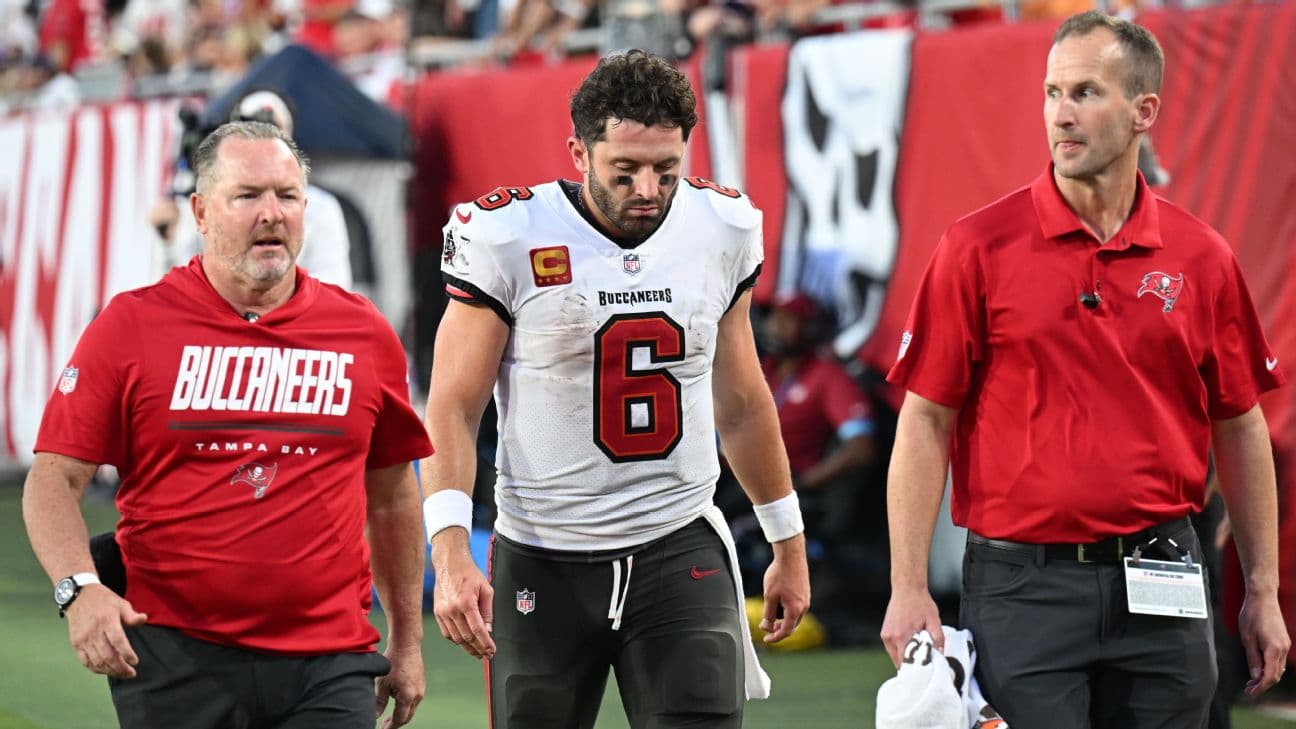
Baker Mayfield and the Tampa Bay Buccaneers agreed to a three-year, $165 million extension on Tuesday, ending a public stalemate that had run for months and producing the largest contract in franchise history. The deal carries an average annual value of $55 million, which places Mayfield in the same salary tier as several of the league's established starting quarterbacks. Reporting indicates roughly $110 million in new guarantees on top of the $40 million he was already scheduled to earn in 2026, and the agreement runs through his age-34 season.
The timing is the story as much as the money. Tampa Bay opens against Cincinnati on Sunday, and a contract dispute that had shadowed the entire offseason was resolved with days to spare.
Why the deal was contentious
Mayfield arrived in Tampa Bay on a modest contract and rebuilt his market from scratch. The negotiation that followed was the predictable consequence: a quarterback who outperformed his deal by a wide margin, and a front office reluctant to pay at a tier reserved for players with longer track records at that level.
The resolution reads as a bet on continuity. Tampa Bay has already turned over its offensive coaching staff and lost its longtime top receiver. Adding a quarterback change to that list would have been three simultaneous reconstructions of the same unit.
The offense around him has been rebuilt
Zac Robinson takes over as offensive coordinator after previously running Atlanta's offense. By the count of most beat coverage, Robinson is the eleventh play-caller Mayfield has worked with across nine NFL seasons, which is a remarkable number and the single most important variable in projecting this offense.
The personnel around Mayfield also shifted materially. Mike Evans departed in free agency, ending a long run as the franchise's primary outside threat. Rachaad White signed with Washington. Tampa Bay brought in Kenneth Gainwell from Pittsburgh to supplement Bucky Irving in the backfield. Emeka Egbuka, entering his second season, is being asked to absorb the volume Evans leaves behind, and Chris Godwin is slotted into the slot role that a Robinson offense has historically valued heavily.
That is a lot of turnover for a unit that also just made its quarterback one of the highest-paid players in the sport.
Fantasy fallout
The extension itself does not change anyone's projection directly. What it changes is the risk profile. A quarterback playing out a contract dispute is a quarterback whose team has an incentive to manage his exposure. That is gone now, and Tampa Bay has every reason to build its offense around him without hedging.
Emeka Egbuka is the player whose value moves most. He practiced fully on Wednesday after a toe injury and is expected to play against Cincinnati. A second-year receiver inheriting the target share of a departed six-time Pro Bowler, in an offense whose quarterback just got paid to keep throwing, is the most straightforward breakout setup on the Week 1 board. He should be in lineups.
Chris Godwin is the underpriced piece. Slot receivers in Robinson-style offenses see high-volume, short-area target loads, and Godwin's fantasy value has always been more about receptions than yards. He is a floor play in point-per-reception formats and a reasonable flex in standard scoring.
Bucky Irving remains the lead back, with Gainwell as the complementary piece. Gainwell ranked in the top 20 in yards per attempt among backs with at least 100 carries last season, which is a real efficiency marker, but efficiency without volume is not a fantasy asset. Irving is the one to start.
Mayfield himself is a QB1 in twelve-team leagues. He has thrown at least two touchdowns in each of his three season openers with Tampa Bay, and the opponent is a Cincinnati defense that has been substantially rebuilt and has not been tested by a competent offense in a game that counted.
The Verdexed model take
Contract resolutions are one of the few offseason events with a measurable effect on a team's win total market. The mechanism is not the money. It is the removal of variance: a team with an unresolved starting quarterback situation carries a fat left tail in its outcome distribution, and closing that dispute cuts the tail off.
Tampa Bay's season win total should be treated as slightly stale if it has not moved since the extension was reported. The same applies to the division market, where the Buccaneers' primary risk factor was never roster quality.
For the Week 1 game against Cincinnati, the angle is on the Tampa Bay team total rather than the side. A quarterback with a documented history of fast starts in openers, throwing to a receiving corps with a new lead target, against a defense that has turned over significant personnel, is a profile that supports the over on the Buccaneers' side of the total.
What to do in your league
Start Egbuka with confidence. Start Mayfield if you are streaming quarterbacks or if you drafted him as your starter. Play Irving as an RB2. Treat Godwin as a floor-first flex.
The trade angle is on Egbuka. His acquisition price will never be lower than it is before he plays a snap in an expanded role, and the combination of a paid quarterback, a new coordinator who throws, and a vacated alpha target share is the exact setup that produces a top-15 receiver season.
What is next
The first real information arrives Sunday. Watch Egbuka's route participation rather than his catch total, because a receiver running a full complement of routes in his first game as the primary option is a stronger forward signal than a single stat line. Watch Godwin's slot rate for the same reason. And watch how quickly Robinson leans on play-action, because that is the mechanism through which Mayfield has produced his best football.