 NFL2026-06-28
Baker Mayfield's Bucs Extension Talks Stall: What the Standoff Means for Tampa Bay
By Verdexed NFL Desk
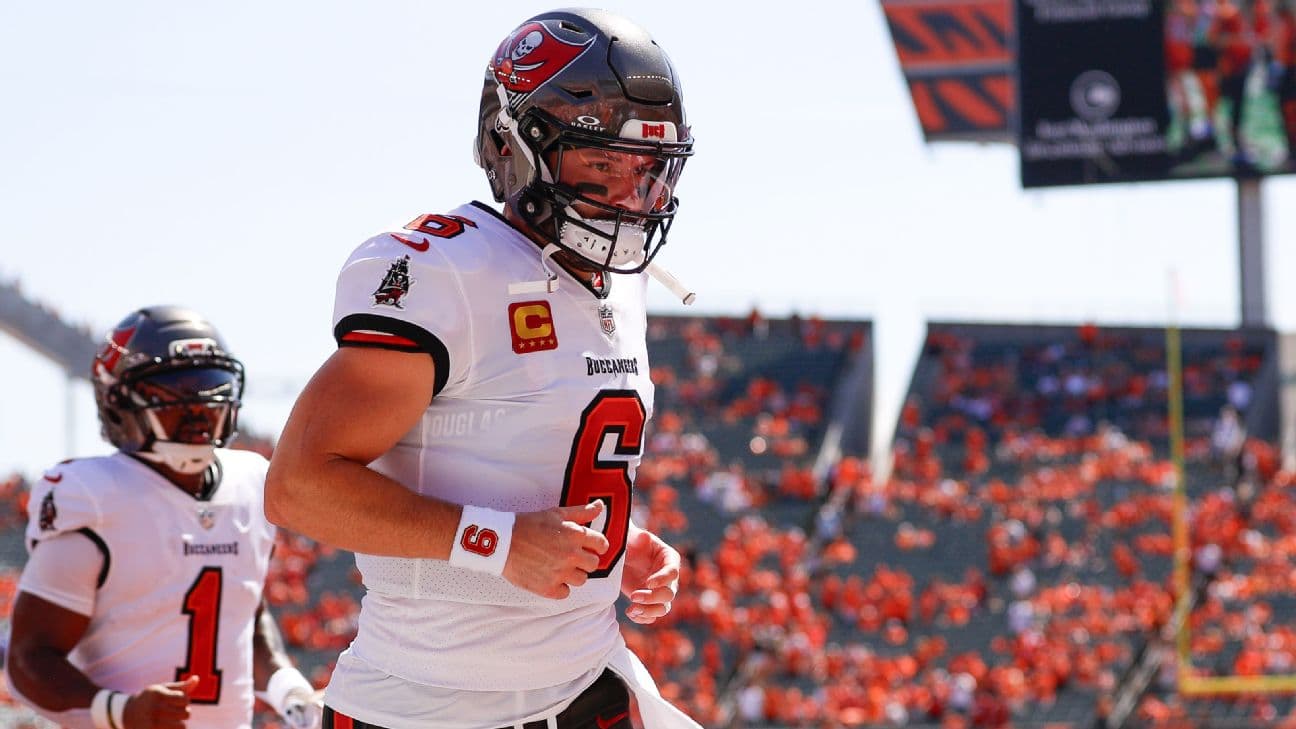
Baker Mayfield's contract extension, which once looked like an offseason formality, has turned into a standoff. The Buccaneers quarterback has said publicly that talks are not anywhere close to where his side had hoped, and the situation is now drifting toward training camp without a resolution. General manager Jason Licht has affirmed the team's desire to keep Mayfield long term, but the public gap between the sides is real, and it reframes how bettors and fantasy managers should think about Tampa Bay in 2026.
Mayfield is entering the final year of the three-year deal he signed with the Bucs, a contract that paid him roughly $33 million per season and currently slots him in the middle of the quarterback market. After two strong seasons in Tampa Bay, his camp is looking for a raise that reflects his production, and the early negotiations have not gotten there.
What is confirmed and what is reported
The confirmed pieces are the comments from both sides. Mayfield has characterized the talks as not close, and Licht has said the team wants a long-term deal done, calling Mayfield a constant priority. What is reported rather than confirmed is the financial baseline, with some accounts pointing to an asking price near the upper tier of the market. Treat that figure as reporting, not fact.
Earlier in the offseason, ESPN's Adam Schefter projected a deal would eventually get done, with a possible timeline around the start of the season. The momentum has clearly cooled since then, which is why the story is worth flagging now rather than assuming it resolves itself quietly.
The fantasy impact is small
Here is the key for fantasy managers: a contract overhang almost never changes a quarterback's on-field role or production. Mayfield is going to start, he is going to run the same offense, and his fantasy value is essentially unchanged by where the negotiation stands. If anything, a quarterback playing on an expiring deal has every incentive to put up numbers, which is a mild positive for his individual output.
So if you are drafting Mayfield, draft him on his merits as a quarterback, not on the noise around his contract. The standoff is a storyline, not a fantasy red flag.
The betting angle is where it matters
The contract situation is more relevant to the betting and team-narrative side. Locker-room and front-office noise can weigh on a team's win-total perception, and a quarterback publicly airing frustration is the kind of soft factor that shows up in how the market and the public read a roster. It does not move a line on its own, but it is worth folding into a broader read on Tampa Bay's outlook, especially if the standoff lingers into camp and starts generating distraction headlines.
The flip side is that an extension getting done would be a small positive signal, removing an offseason cloud. Bettors watching the Bucs win total should track the negotiation as one input among many rather than treating it as decisive.
The Verdexed model take
Verdexed's model does not move a quarterback's projection based on contract talks alone, because the historical link between offseason negotiations and in-season performance is weak. What the model does watch is whether the situation escalates into something that affects availability or preparation, such as a holdout, which there is no indication of here. Mayfield is expected to be on the field and engaged.
The model's read on Tampa Bay's win total leans on roster, schedule, and quarterback play, and Mayfield's steady recent production keeps that projection stable. The contract story is a narrative to monitor, not a number to fade.
The bigger quarterback-market context
Mayfield's standoff is happening against a backdrop of a quarterback market that keeps climbing, and that context explains why the talks stalled. Every offseason that passes resets the top of the position, and a quarterback coming off back-to-back productive seasons has a reasonable argument that his next deal should reflect the new going rate rather than the number he signed before he had proven himself in Tampa Bay. When a player's representation prices off the future market and the team prices off the current one, a gap is the natural result.
For the Buccaneers, the calculus is about timing and leverage. Letting Mayfield play out his deal carries the risk that he performs well and costs even more next offseason, or that the franchise-tag math becomes the only path to keeping him. Getting a deal done now locks in cost certainty but requires meeting a number the team has so far resisted. Neither side is wrong, which is exactly why these negotiations stall rather than collapse.
None of this changes the fantasy read, but it does inform the betting one. A team with an unresolved quarterback contract is not a team in crisis, but it is a team with one more variable in its season. Bettors weighing Tampa Bay's win total should treat the negotiation as a minor uncertainty rather than a thesis, and revisit it if camp arrives with no resolution and the headlines start to sharpen.
What it means
For fantasy, nothing changes: draft Mayfield where his play warrants and move on. For bettors, file the standoff as a minor input on Tampa Bay's outlook and watch whether it resolves before camp. The most likely outcome remains a deal at some point, but the cooling of talks is a reminder that even the safest-looking offseason storylines can turn into camp drama. The confirming moment to watch is the first week of camp: if there is still no deal and Mayfield keeps talking about it, the narrative grows. If a deal lands, it disappears.