 NBA2026-07-28
Jalen Duren and the Pistons Are at an Impasse: The Fantasy Risk Hiding in a Qualifying Offer
By Verdexed NBA Desk
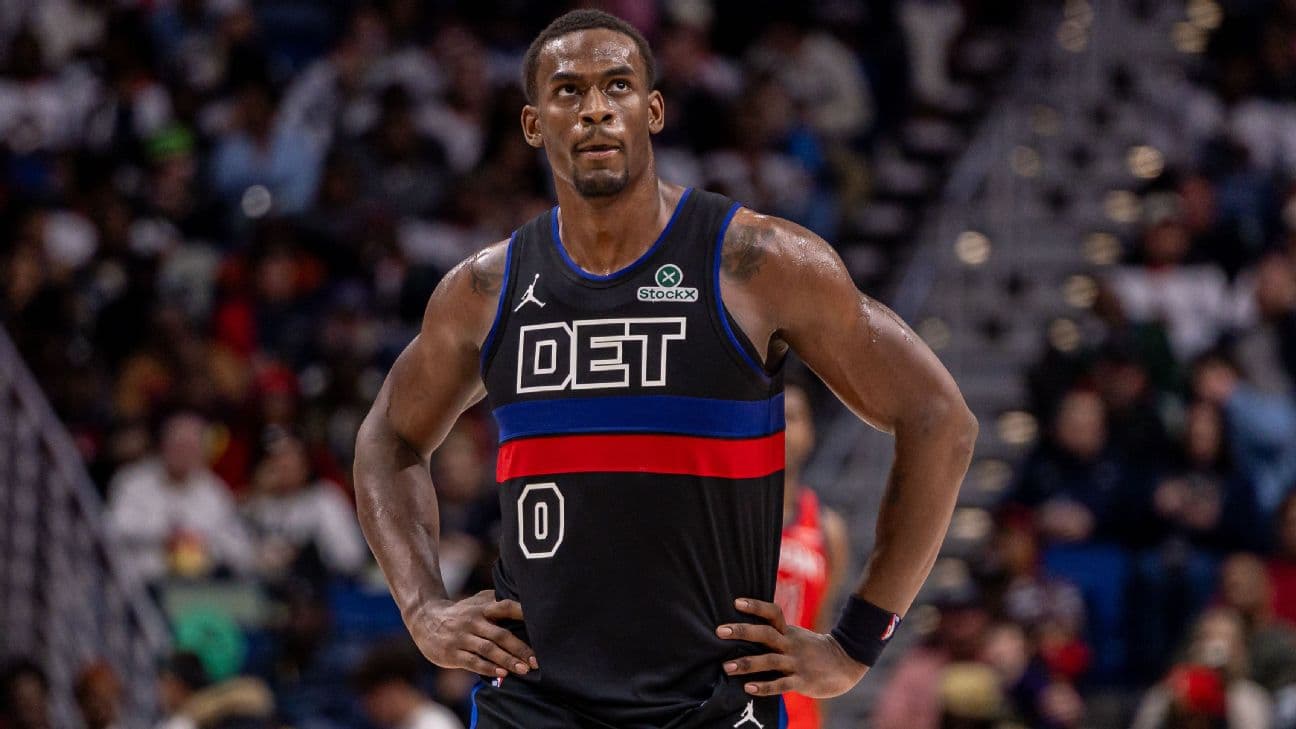
Jalen Duren remains unsigned as the calendar turns to August, and the reporting this week describes a negotiation at a standstill. Detroit and the 22-year-old center are far enough apart that the situation could stretch deep into August or beyond, and Duren has been considering accepting his qualifying offer, a one-year deal worth roughly $9.6 million that would carry an implied no-trade clause and deliver him to unrestricted free agency next summer.
That is the leverage play, and it is the only one available to him. Detroit tendered the qualifying offer, which preserved its right to match any offer sheet, and the practical reality of this offseason is that no team has the cap room to construct an offer sheet Detroit would hesitate to match. A restricted free agent without a bidder has exactly one form of leverage: the threat to bet on himself.
What Duren is worth
The production case is strong. Duren averaged 19.5 points and 10.5 rebounds with 2.1 assists across 70 regular season games last season while shooting 65.0 percent from the field, a full-season double-double at an age where most centers are still learning rotations. His playoff run was less productive, with 10.2 points and 8.5 rebounds on 51.4 percent shooting across 14 games at just over 30 minutes a night, though the shot volume and the defensive assignments both changed in that setting.
Executives polled around the league have projected deals ranging from roughly $180 million to $230 million over five years. The belief is that Duren is seeking something close to $40 million annually, which would put him at the upper end of that band. The gap between what he wants and what Detroit is willing to guarantee is the entire negotiation.
Why the qualifying offer is a real threat and a real risk
Accepting the qualifying offer would give Duren control over his next destination and would put him on the unrestricted market in 2027, when more teams project to have room. It would also mean playing a season for a fraction of what a long-term deal would pay him, with all the injury risk that carries.
Historically, very few restricted free agents actually take the qualifying offer. The ones who do tend to be players who believe the market misread them and who are young enough to absorb a lost year of earnings. Duren fits that profile better than most: he turns 23 during the season and would reach unrestricted free agency with a full prime ahead of him.
The fantasy implications
Duren has been a reliable fantasy center, and the near-term risk to that value is not about which contract he signs. It is about when he signs it. A player who misses training camp in a contract standoff typically starts the season behind on conditioning and rotation familiarity, and centers in particular pay for that in foul trouble and reduced minutes through the first month.
The larger question is what a qualifying-offer season would look like in practice. A player on a one-year deal with an implied no-trade clause is in an unusual position: the team cannot move him, and he has every incentive to chase counting stats. That is generally good for fantasy, because usage and rebounding volume both tend to rise when a big man is playing for his next contract. The offsetting risk is a team that decides to develop other players if it concludes the relationship is ending.
Duren's category profile is what makes him valuable and what makes him fragile. He delivers elite field goal percentage, high-volume rebounding and blocks, and he actively hurts you at the free throw line. That is a roster-construction asset rather than a plug-and-play one, and any minutes reduction hits the counting categories that justify his draft cost.
The Verdexed model take
Verdexed's model treats unresolved restricted free agency as a minutes-and-role risk rather than a talent risk, because the player's ability does not change and his opportunity might. For Duren, the model's expected minutes distribution has widened considerably over the past two weeks, which pushes his projected value down without changing his ceiling.
The model's base case remains that Duren signs with Detroit before the season, because that is how the overwhelming majority of these standoffs end and because the Pistons have publicly indicated they would match any offer sheet. The tail risk that matters is not that he leaves. It is that he signs in late September and opens the season out of rhythm.
What to do in your league
In redraft, this is a reason to let someone else take Duren at his consensus price. He is a fine player at a discount and a poor value at par, and the standoff creates enough uncertainty that the discount should exist by the time drafts happen in the fall. Set a target price a round below where he has been going and be willing to walk away.
In dynasty, the read is the opposite. A 22-year-old center coming off a 19-and-10 season whose value is temporarily suppressed by a contract dispute is exactly the kind of asset dynasty managers should be acquiring. The dispute resolves. The production profile is real. Buy the noise.
What's next
There are two signals worth tracking. First, whether Detroit and Duren exchange revised offers before the end of August, which would indicate the standoff is about price rather than principle. Second, the qualifying offer deadline itself, which is the hard stop on his leverage.
The comparison worth watching alongside it is Dereck Lively II, whose extension talks with Dallas are reportedly at an early stage with a deadline the day before the regular season opens. Two young centers negotiating in parallel means whichever signs first sets a reference point, and centers who reach restricted free agency next summer will be negotiating against whatever Duren ultimately accepts.